

Invisalign vs Braces for Adults: Your Actionable Guide

The choice between Invisalign and traditional braces as an adult boils down to a practical trade-off. Invisalign offers maximum discretion and lifestyle flexibility, but requires significant self-discipline. Traditional braces deliver unstoppable corrective power for complex dental issues, but require you to adapt your diet and hygiene routines. The right choice depends on what you value most: near-invisibility and removable convenience, or the continuous, powerful force of a fixed appliance.
Invisalign vs Braces for Adults The Quick Answer
Choosing orthodontic treatment as an adult isn't just about getting straighter teeth. It's about finding a solution that fits into the life you’ve already built. The "Invisalign vs. braces for adults" debate is less about which one is superior and more about which one is the right tool for your specific goals.
This section is your high-level guide, focusing on the practical differences that impact your day-to-day life. Use this to determine which path aligns better with your career, social commitments, and personal habits.
For a more exhaustive breakdown of all the pros, cons, costs, and lifestyle factors involved, this guide is a great resource: Adult Braces vs. Invisalign: A Clear Choice for Your Smile.
At a Glance Invisalign vs Traditional Braces
To give you a quick, actionable snapshot, let's lay out the key differences side-by-side. This table cuts through the noise and summarizes what you really need to know when comparing these two treatments.
Factor | Invisalign | Traditional Braces |
|---|---|---|
Aesthetics | Nearly invisible clear aligners offer maximum discretion for professional and social settings. | Visible metal or ceramic brackets and wires. Ceramic is less noticeable but still apparent. |
Daily Maintenance | Aligners must be removed for all meals and drinks (except water) and teeth brushed before reinsertion. | No removal necessary. Requires meticulous cleaning around brackets and wires to prevent plaque buildup. |
Dietary Impact | No food restrictions. You can eat whatever you want once the aligners are removed. | Requires avoiding hard, sticky, or chewy foods that can damage brackets or wires. |
Comfort Level | Smooth plastic aligners are generally more comfortable, with pressure felt during new tray changes. | Brackets and wires can cause initial soreness and potential irritation to cheeks and lips. |
Discipline Required | Very high. Success depends entirely on wearing aligners for 20-22 hours daily. | Low. The appliance is fixed, working continuously without needing patient compliance. |
Best For | Mild to moderate cases of crowding, spacing, and some bite issues. Ideal for disciplined adults. | Complex cases, including severe crowding, significant bite correction, and major tooth rotation. |
Office Visits | Fewer, less frequent check-ins, typically every 6-8 weeks, to receive new aligner sets. | More frequent visits, usually every 4-8 weeks, for manual adjustments and wire tightening. |
Ultimately, this table highlights the central question: Are you willing to trade the freedom of removable aligners for the "set it and forget it" nature of braces? Your answer will point you in the right direction.
Getting to the Root of Your Orthodontic Options
When you're weighing Invisalign against traditional braces as an adult, it’s easy to get stuck on aesthetics. But to make a smart choice, you must look past the surface and understand how each system actually works. They both achieve a straight smile, but their methods are worlds apart.
Understanding the mechanics helps you have a more meaningful conversation with your orthodontist. It's about identifying which approach truly fits your teeth, your lifestyle, and your goals.
The Engineering Behind Invisalign Clear Aligners
Invisalign utilizes a meticulously planned, digital-first approach. It starts with a detailed 3D scan of your mouth, creating a virtual model of your teeth. From there, your orthodontist maps out the entire treatment on a computer, charting the precise path each tooth will take.
This digital blueprint is then used to create a series of custom aligner trays. Each one is made from SmartTrack® material, a patented polymer engineered to apply gentle, consistent pressure. You'll wear a set of these aligners for one to two weeks before swapping to the next. Every tray is a small, calculated step forward, incrementally moving your teeth into their ideal positions.
Actionable Insight: The real power of Invisalign often lies in the details. You'll likely have small, tooth-colored bumps called attachments bonded to your teeth. These act like handles, giving the aligners the necessary leverage to execute complex movements, like rotating a stubborn tooth or pulling one down into place. Ask your orthodontist to point these out on your treatment plan.
How Traditional Braces Get the Job Done
Traditional braces, whether metal or ceramic, are a classic for a reason. They rely on a proven system of brackets and wires to meticulously guide your teeth, giving your orthodontist direct, hands-on control throughout the entire process.
It’s a system with a few key components:
Brackets: These are small squares bonded to each tooth, made from durable stainless steel or a less noticeable ceramic material.
Archwire: This thin wire threads through the brackets. It’s the engine of the operation, providing the force that moves your teeth.
Ligatures: These tiny elastics (the colored part) hold the archwire firmly onto each bracket.
You’ll see your orthodontist every 4-8 weeks to have the archwire adjusted. This consistent, controlled pressure triggers a natural process in your jaw where bone remodels around the shifting roots. It’s a highly effective method for tricky cases, which is why it remains an orthodontic cornerstone. And for those curious about other paths, exploring ways to fix crooked teeth without braces is a valuable starting point.
The Boom in Adult Orthodontics
Let's face it—straightening your teeth as an adult is more common than ever. Invisalign revolutionized the field by giving adults an effective and discreet option. Since its introduction, it has been used to treat over 10 million patients globally.
Today, roughly one in three orthodontic patients in the U.S. is an adult. This massive shift proves that modern orthodontic solutions have made a better smile accessible at any age. If you want to dive deeper, you can discover more insights about adult orthodontic trends on consumeraffairs.com.
Comparing Clinical Effectiveness and Timelines
When it comes to straightening teeth, the big question is always: which option will give me the best results? The truth is, both Invisalign and traditional braces are excellent tools, but they're built for different jobs.
Traditional braces have been the standard for decades because they are the undisputed champions of complex orthodontic work. Their fixed nature provides the constant, powerful force needed for precise control over even the most stubborn teeth.
Invisalign is a game-changer for adults with mild to moderate alignment issues. It excels at closing gaps, fixing minor crowding, and handling less complicated bite problems with a subtlety that braces cannot match.
When Braces Have the Clinical Edge
For adults facing significant orthodontic challenges, traditional braces are almost always the recommended route. Since the brackets and wires are bonded directly to your teeth, they can achieve movements that removable aligners simply can't.
Think of braces as the heavy-duty equipment in an orthodontist's toolkit. They are the go-to solution for situations like:
Severe Malocclusion: Correcting major overbites, underbites, or crossbites that involve significant jaw realignment.
Major Tooth Rotation: Turning teeth that are severely twisted or facing the wrong direction.
Vertical Tooth Movement: Pulling a tooth down (extrusion) or pushing it up (intrusion) into the jawbone.
Complex Extractions: Skillfully managing the large spaces left after a tooth is removed, which demands pinpoint control to close the gap properly.
These corrections require a level of consistent, targeted force that only a fixed appliance can deliver.
Where Invisalign Proves Most Effective
While braces handle the heavy lifting, Invisalign offers a remarkably effective and elegant solution for the most common issues adults face. Its strength lies in tackling less severe alignment problems with a discretion and convenience that fits a professional lifestyle.
Invisalign is often the perfect choice for:
Mild to Moderate Crowding: Unraveling teeth that are slightly overlapped or bunched up.
Gaps and Spacing: Neatly closing those small to medium-sized gaps between teeth.
Minor Bite Issues: Tweaking slight overbites or crossbites that don't need major jaw adjustments.
The image below shows how a series of clear aligners works. Each tray is a small, calculated step in a journey planned by your orthodontist to gently guide your teeth into their final position.
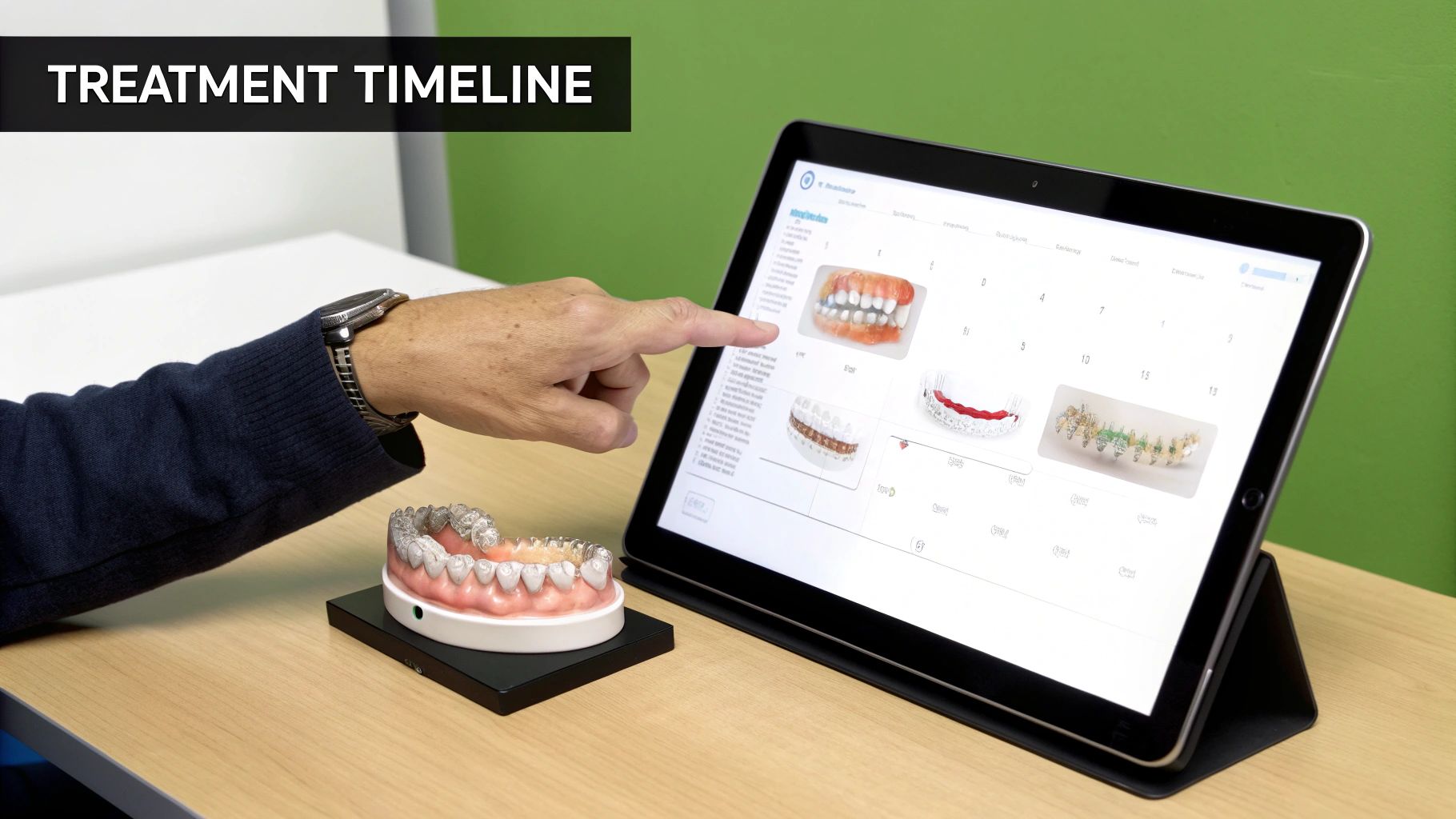
This entire sequence is mapped out digitally from the beginning, making the process highly predictable and efficient for the right candidate.
Actionable Insight: The biggest difference in effectiveness comes down to compliance. Braces are on 24/7, working regardless of your actions. Invisalign’s success hinges entirely on you wearing the aligners for the recommended 20-22 hours every single day. Be honest with yourself about your discipline before choosing this path.
Studies show Invisalign has a success rate between 80% and 90% for the mild to moderate cases it's designed for. Traditional braces, meanwhile, often top a 91% success rate, especially when dealing with tougher orthodontic cases. However, patient satisfaction paints a different picture: a huge 96% of Invisalign users report being highly satisfied with their experience. Discover more insights about these satisfaction rates on ashleyburnsdds.com.
Unpacking Treatment Timelines
Another critical factor is how long you'll be on this journey. While every smile is unique, there are general timelines to consider.
For many adults with mild to moderate alignment needs, Invisalign can be the faster option. The average treatment time is around 12 to 18 months, with some straightforward cases finishing in as little as six months. This efficiency comes from the digital plan that maps out the quickest path. If you're curious about what might affect your own treatment duration, you can find your Invisalign treatment timeline in our guide.
Traditional braces usually demand a longer commitment, ranging from 18 to 24 months on average, and potentially extending to three years for complex situations. This longer timeline is due to the nature of manual adjustments and the complexity of the dental issues being resolved.
Ultimately, only an orthodontist can give you a precise timeline after a thorough evaluation. Their assessment will balance a perfect clinical outcome with the most efficient treatment possible.
How Your Daily Life Changes With Braces vs. Invisalign
Choosing an orthodontic treatment as an adult isn't just about the final smile. It's about how you'll live with it for the next year or two. The right choice must integrate into your career, social life, and personal routines without causing major disruption.
This is where the day-to-day experience of Invisalign and traditional braces truly diverges. We’re moving past clinical details to talk about the practical reality. Understanding these nuances is key to picking a treatment you can stick with.
Keeping a Professional Look
For most adults, appearance is a huge factor. You’ve built a career, and confidence in meetings or on video calls is non-negotiable.
In this arena, Invisalign is the undisputed winner. The clear aligners are so discreet they are virtually invisible. Most people won’t know you’re wearing them unless you tell them.
Traditional braces, even modern ceramic versions, are more obvious. While ceramic brackets are tooth-colored, the wire is still visible. For some adults, particularly those in client-facing roles, this can be a source of self-consciousness.
The Bottom Line: If maintaining a polished, professional image is your top priority, Invisalign provides a massive advantage. It allows you to improve your smile without compromising your current professional presentation.
The Realities of Eating and Drinking
Your daily meals and social outings are where the fundamental difference between these two treatments—removable versus fixed—becomes most apparent.
With Invisalign, you remove your aligners for every meal, snack, or drink (other than water). This means total freedom—there are absolutely no food restrictions. The trade-off is the required discipline. You must brush your teeth after eating and before reinserting your aligners to prevent cavities and staining.
Traditional braces demand a much more careful approach to food. You must actively avoid certain items for your entire treatment to prevent damage.
The "Do Not Eat" List for Braces:
Hard Foods: Nuts, hard candies, chewing on ice.
Sticky Foods: Caramel, gum, taffy.
Chewy Foods: Tough bagels, crusty bread.
Crunchy Foods: You’ll need to cut apples and carrots into pieces instead of biting directly into them.
This isn’t a minor inconvenience; it requires a conscious shift in how you navigate everything from a business lunch to a casual get-together.
A Tale of Two Hygiene Routines
Maintaining oral health is critical with any orthodontic work, but the process is completely different for each option. The ease of cleaning often becomes a major tie-breaker for adults.
With Invisalign, oral hygiene is simple. Remove the aligners, then brush and floss as you normally would. You’ll also need to clean the aligners themselves—a quick scrub with a soft brush and water usually suffices.
Cleaning with braces is more complex and time-consuming. Food gets trapped easily, and plaque can build up around brackets, increasing your risk for cavities if you’re not meticulous. You'll need special tools like floss threaders, interdental brushes, or a water flosser to clean effectively. It is manageable, but it requires patience and commitment.
Day-to-Day Comfort
Finally, let’s talk about how they feel. Any treatment that moves teeth will involve some discomfort.
Invisalign wearers switch to new aligners every one to two weeks. You’ll feel a distinct pressure for the first day or so with a new tray. Beyond that, the smooth plastic is generally comfortable and won't irritate your mouth.
With traditional braces, you’ll have an adjustment every 4-8 weeks. This can leave your teeth sore for a few days. The brackets and wires can also rub against your cheeks and lips, causing irritation, though dental wax provides significant relief.
Ultimately, choosing the right treatment means taking an honest look at your lifestyle. One path offers flexibility but demands self-discipline. The other provides powerful treatment but requires you to adapt your daily habits.
Breaking Down the Costs and Insurance Coverage
Let's talk money. The financial side of straightening your teeth is as important as the clinical decision. When comparing Invisalign and traditional braces, the price difference often isn't as dramatic as you'd think. The final cost depends more on your unique dental needs than the brand name.
The total investment is determined by a few key factors: the complexity of your case, your geographic location, and your orthodontist's expertise. A simple six-month fix for minor crowding will cost significantly less than a two-year plan to correct a major bite issue.
What Determines the Final Cost
When your orthodontist provides a quote, it's typically an all-inclusive fee covering your entire treatment.
This single fee usually includes:
Initial Consultation and Records: 3D scans, X-rays, and photos needed to map out treatment.
The Appliance Itself: Your complete set of custom Invisalign aligners or the full setup of brackets and wires.
All Scheduled Appointments: All check-ups, adjustments, and progress reviews.
Your First Set of Retainers: Essential for maintaining your new smile.
Actionable Tip: Ask for a detailed breakdown of what the quote includes. Clarify costs for replacement retainers or potential refinement aligners to avoid surprises.
Navigating Dental Insurance for Adult Orthodontics
A common question is, "Will my insurance cover this?" The good news is that many dental plans with orthodontic benefits cover both Invisalign and traditional braces equally. If your plan helps pay for braces, it will likely contribute the same amount toward Invisalign.
The key is to check your benefits before you start. Most insurance plans offer a lifetime maximum for orthodontics—a fixed dollar amount they’ll pay out, separate from your regular dental coverage.
In the United States, braces and Invisalign typically range from $3,000 to $7,500. Many dental plans will contribute up to $3,000 for orthodontic work. On average, patients with this coverage see about $1,772 paid by their insurer. You can discover more insights about these adult orthodontic statistics on hellotend.com. Before diving in, it's also helpful to get a handle on understanding health insurance deductibles, as that’s the first part you'll pay out-of-pocket.
Smart Financial Strategies for Your New Smile
Even with insurance, you’ll have out-of-pocket costs. Thankfully, there are several ways to make treatment more manageable.
Payment Plans: Most orthodontist offices offer in-house, interest-free payment plans. You'll typically make a down payment and cover the rest with monthly installments.
HSA and FSA Accounts: Health Savings Accounts (HSA) or Flexible Spending Accounts (FSA) allow you to use pre-tax money for orthodontic care, effectively giving you a discount equal to your tax rate.
Third-Party Financing: Companies like CareCredit specialize in healthcare financing and often offer 0% interest promotional periods, which is a great option for spreading payments over a longer term.
Looking into these financial tools is a crucial step. For a deeper dive into managing dental costs, take a look at our guide on how to find affordable dental care. By combining insurance benefits with a smart payment strategy, you can make your dream smile a financial reality.
How to Make the Right Choice for Your Needs
Deciding between Invisalign and braces is a big commitment. You've weighed the clinical differences, lifestyle impacts, and costs. Now, it's time to apply that knowledge to your personal situation.
Forget a generic pro-con list. The best way to make this decision is to think through real-world scenarios. Use the following profiles to clarify which option is the right tool for you.
Actionable Scenarios to Guide Your Decision
Your career, social habits, and level of self-discipline are just as important as the shape of your teeth. See which of these profiles sounds the most like you.
You Should Strongly Consider Invisalign If:
Discretion is your top priority. You're a professional in a client-facing role, a public speaker, or you simply prefer to keep your orthodontic treatment private.
You're highly disciplined. Committing to wearing your aligners for 20-22 hours a day doesn't faze you. You're organized enough to handle the routine of removing, cleaning, and reinserting them at every meal.
Your case is mild to moderate. You're mainly looking to fix crowding, close a few gaps, or correct other minor alignment issues.
Traditional Braces Are Likely the Better Fit If:
You're dealing with complex orthodontic problems. Your orthodontist has identified a severe overbite, crossbite, or significantly rotated teeth that require the constant, powerful force of braces.
You prefer a "set-it-and-forget-it" approach. You’d rather adjust your diet and brushing habits than worry about taking aligners in and out all day.
You want the most powerful treatment available. You value the non-stop corrective force of a fixed appliance and don't want to worry about compliance.
The decision boils down to a single trade-off. Invisalign gives you more freedom but demands serious personal responsibility. Braces require you to adapt, but they work around the clock without relying on your daily compliance.
Empowering Your Orthodontist Consultation
The final step is your consultation. This is your chance to partner with an expert to make a confident choice. Walk in prepared with the right questions.
This infographic breaks down how your total cost can change once you factor in insurance and tax-advantaged accounts like an FSA or HSA.
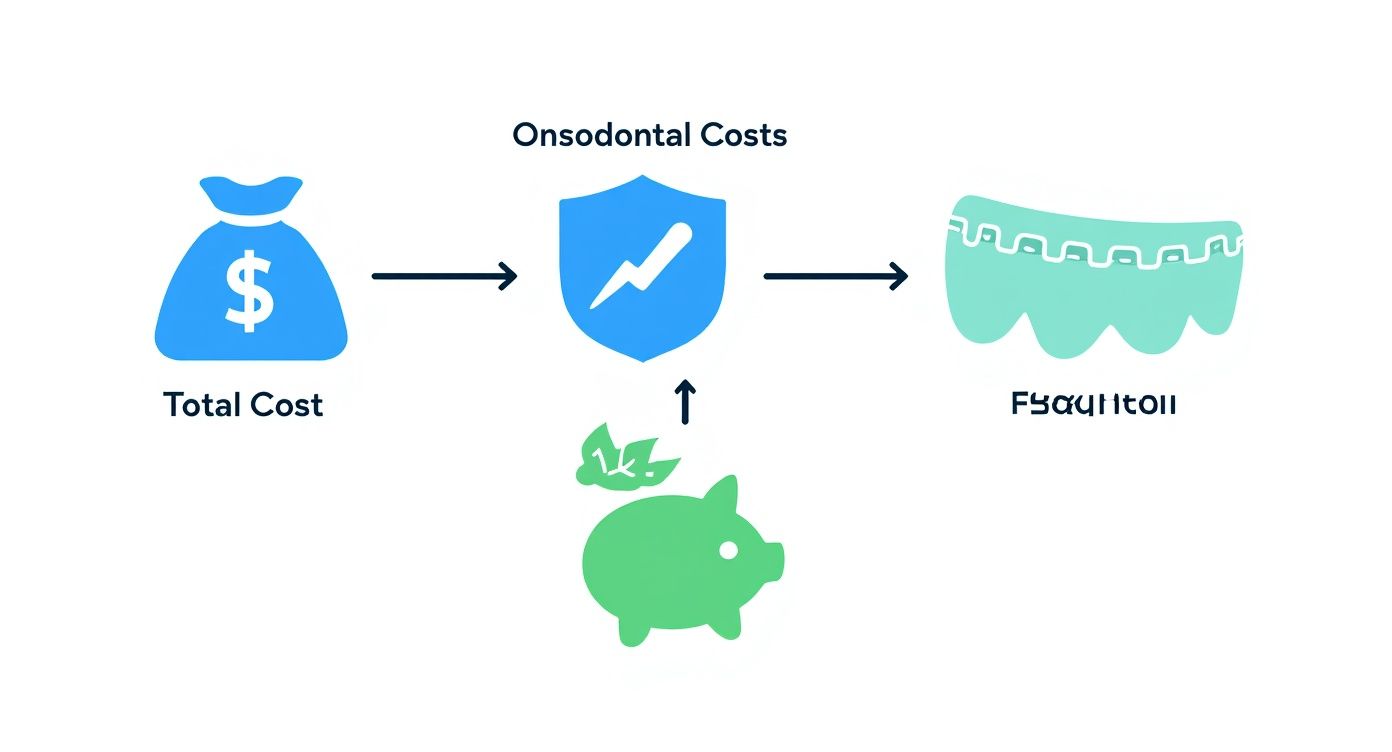
As you can see, using both your insurance benefits and FSA/HSA funds can make a huge dent in your out-of-pocket expenses.
Critical Questions to Ask Your Orthodontist:
Based on my specific case, am I a candidate for both, or is there a strong clinical reason to recommend one over the other?
What is the realistic treatment timeline for me with Invisalign versus with braces?
Can you show me before-and-after photos of your patients with issues similar to mine, for both treatments?
What does the all-inclusive price for each option cover? Does it include retainers, follow-up adjustments, or emergency visits?
What specific changes will I need to make to my daily oral hygiene routine with each option?
With these answers and a clear understanding of your priorities, you'll be equipped to make the best choice for your smile, schedule, and budget.
Your Top Questions Answered
When deciding between Invisalign and braces as an adult, many questions arise. Let's tackle the most common ones.
Which One Works Faster?
This depends entirely on the complexity of your case. For simpler issues like mild to moderate crowding or spacing, Invisalign can often be faster, typically taking 12 to 18 months.
However, for complex bite problems or severe crookedness, traditional braces usually have the edge. Their continuous force is more efficient for major movements, with treatment times of 18 to 24 months or longer.
What About the Pain Factor?
No orthodontic treatment is pain-free, but the experience differs. With Invisalign, you'll feel a tight pressure for a day or two after switching to a new aligner set. It's generally manageable and fades quickly.
With braces, you can expect soreness for several days after each adjustment. The brackets and wires can also irritate your cheeks and lips, especially at the beginning of treatment.
The right choice truly comes down to a blend of your specific orthodontic needs and your daily life. Invisalign is fantastic for its subtlety and flexibility, but when it comes to tackling really tough cases, traditional braces provide a level of control and power that's hard to beat. Because every smile is different, there's no substitute for a one-on-one consultation.
Ready to figure out which path is right for your smile? At Beautiful Dentistry, we specialize in creating personalized treatment plans that fit your goals. Schedule your visit with us today!


Comments