

The Actionable Benefits of Laser Dentistry: Your Guide to Faster, Precise, and Pain-Free Care
- Caterina Rutter
- Jan 10
- 12 min read

Imagine scheduling a dental appointment without the familiar dread of the high-pitched drill or the thought of a scalpel. This isn't a futuristic dream; it's the reality of modern laser dentistry, a technology engineered to directly improve your comfort and deliver superior clinical results.
So, how does it work? Think of a dental laser as a highly focused beam of light energy. Its precision allows your dentist to remove a tiny area of decay or reshape gum tissue without disturbing the healthy areas nearby. This means treatments are less invasive, preserving more of your natural tooth and gum tissue. You're effectively trading mechanical tools for the targeted power of light.
These benefits have a practical impact on your visit and recovery. For example, a soft-tissue procedure like a gingivectomy, which might take 30 minutes with a scalpel, can often be completed in just 10–15 minutes with a laser. Your action item? Ask your dentist if a laser option can reduce your time in the chair, potentially cutting it by 50–65%.
A Focus on Patient Well-Being
The core purpose of laser dentistry is to create a less stressful, more positive experience for you. If you struggle with dental anxiety, laser treatments can be a game-changer.
Here's what you can expect:
Less Discomfort: Many laser procedures require little to no anesthesia. If you have a fear of needles, ask if your procedure can be done with a laser to avoid injections.
Minimal Bleeding and Swelling: The laser's energy naturally cauterizes tissue, sealing blood vessels on contact. This leads to a cleaner treatment site and a smoother recovery.
Faster Return to Daily Life: With less trauma to surrounding tissue, you can often head back to work or school immediately. Plan your day without factoring in extensive downtime.
This focus on minimizing discomfort is especially valuable for anxious patients. By removing common triggers like drilling sounds and injections, laser dentistry helps create a calmer, more positive association with dental care.
For those with significant dental fear, combining laser treatments with other comfort-focused options can be incredibly effective. If you'd like to explore how different methods can help you relax during your appointment, you can learn more about how dental sedation works in our detailed guide. In the end, our goal is to provide exceptional care that prioritizes both your physical and emotional well-being from the moment you walk in.
How Different Dental Lasers Improve Your Treatment
Not all lasers are the same. Understanding the difference helps you see why your dentist might choose a specific laser for your treatment. Think of it like a craftsperson's workshop: you need different tools for different materials. A sledgehammer isn't used for fine carving, and a tiny chisel can't break up a large rock. Dentists apply this same precise approach with lasers.
The two main types are hard tissue and soft tissue lasers. Each uses a specific wavelength of light designed to interact with certain parts of your mouth, which is the key to achieving such effective and comfortable results.
Hard Tissue Lasers for Teeth and Bone
Hard tissue lasers are engineered to work on solid structures like your teeth and bone. Their light frequency is tuned to be absorbed by the water and mineral content in enamel and dentin, allowing the laser to cut or shape tooth material with remarkable precision.
Your dentist might use one for:
Preparing cavities for fillings: A laser can vaporize decay with incredible accuracy, often removing it layer by layer. This conserves more of your healthy tooth structure compared to a traditional drill.
Catching cavities early: Certain lasers can detect decay in its earliest stages, sometimes before it's visible on an X-ray. This allows for more conservative treatment.
Shaping teeth for crowns: The laser can meticulously prepare a tooth for a dental crown, creating an ideal surface for a strong, lasting bond.
Because these lasers work without the intense heat and vibration of a drill, you may not need anesthesia for the procedure. Ask your dentist if this is an option for your next filling.
Soft Tissue Lasers for Gums and More
Soft tissue lasers are designed to be absorbed by water and hemoglobin (the molecule in red blood cells). This makes them the perfect tool for procedures involving gums, cheeks, or other soft tissues.
A primary advantage is their ability to seal blood vessels and nerve endings as they work. This dual action means you experience dramatically less bleeding and discomfort after your procedure—a significant win.
Think of a soft tissue laser as a scalpel and a bandage in one. It makes a clean incision while simultaneously promoting clotting and reducing inflammation, leading to a much faster healing time.
This targeted technology is what makes the key patient benefits possible.
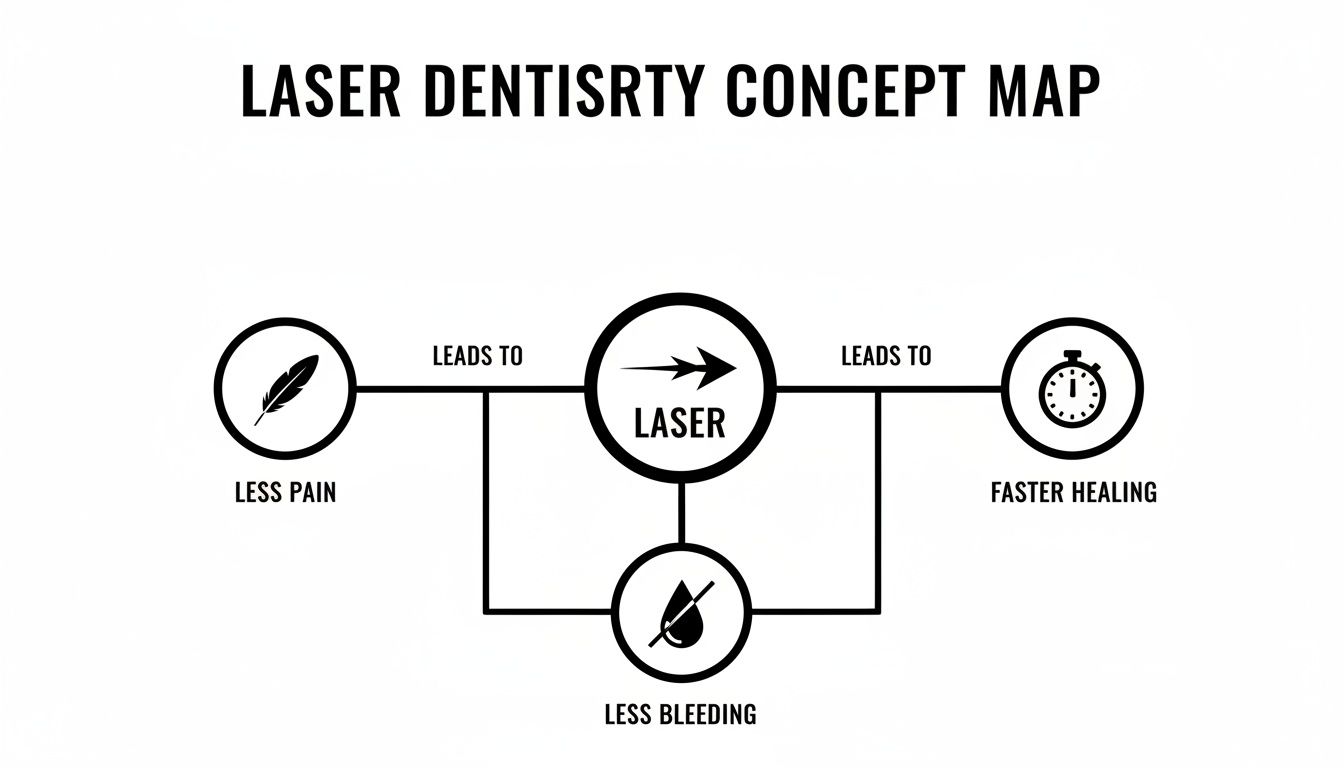
Common uses include treating gum disease by eliminating bacteria from periodontal pockets or reshaping the gumline for a more aesthetic smile. If you're curious about the science, you can dig into the underlying principles of diode laser systems to see how it works.
Some of the most advanced systems combine both hard and soft tissue capabilities. To see how this all-in-one technology provides truly next-level care, you can read about the Fotona LightWalker laser in Tempe. It all comes down to choosing the right tool to make your treatment as effective and minimally invasive as possible.
Five Patient-Focused Benefits of Laser Dentistry
While the technology is impressive, the real value lies in how it transforms your experience. The advantages of lasers aren't just about high-tech equipment; they lead to better, healthier, and more comfortable outcomes for you.
Here are five key reasons to ask your dentist about laser options for your next procedure.
1. Less Pain, Less Anxiety
For many, the high-pitched whine and vibration of a traditional dental drill are major sources of anxiety. Lasers operate quietly and without that unnerving vibration, creating a calmer atmosphere.
Better yet, the focused light energy of a laser often eliminates the need for anesthesia, especially for smaller fillings or soft tissue work. For many common procedures, this means no more dreaded needles. If you have a fear of injections, this is a benefit worth discussing with your dental team.
2. Quicker Healing and Recovery
Procedures performed with a scalpel or drill can be hard on surrounding tissues, often leading to swelling, bleeding, and a longer recovery. Lasers offer a gentler alternative.
As a laser treats an area, its energy creates a photothermal effect that instantly seals (cauterizes) blood vessels. The direct benefits for you are:
Virtually no bleeding: The treatment area remains clean during and after the procedure.
Minimal swelling: The laser's precision and sealing action significantly reduce inflammation.
This means you can often resume your daily activities immediately, without planning for the downtime associated with conventional dental work.
3. Pinpoint Precision
In dentistry, every millimeter matters. This is where laser technology excels. A drill removes decay with friction, which can inadvertently remove healthy tooth structure or create micro-fractures. A scalpel is precise but can still cause collateral damage to nearby gum tissue.
Lasers, however, are incredibly selective. They can be tuned to target and vaporize only diseased tissue, leaving healthy structures untouched. It’s like using a fine-point pen instead of a thick marker.
This precision not only preserves your natural tooth and gum tissue but also leads to stronger, longer-lasting restorations.
4. A Lower Risk of Infection
Any incision in the mouth carries a risk of bacterial infection. Laser dentistry provides a powerful, built-in defense. The high-energy light beam has a sterilizing effect, killing bacteria on contact.
When a laser is used to treat gum disease or prepare a tooth for a filling, it disinfects the area simultaneously. This dramatically lowers your risk of a post-operative infection and creates a cleaner environment for healing. This is particularly beneficial for patients with compromised immune systems.
5. Incredible Versatility in Treatment
One of the most practical benefits is the sheer number of procedures that can be enhanced with a laser. By adjusting the wavelength and power, a dentist can use the same core technology for a wide range of treatments, from routine fillings to complex gum surgery.
The table below shows how laser technology transforms common dental treatments into better patient experiences.
Actionable Benefits of Laser Dental Procedures
Here’s how a laser-based approach directly improves common procedures and what it means for you.
Procedure | Traditional Approach Concern | Laser Dentistry Solution |
|---|---|---|
Gum Disease Therapy | Scalpels, cutting, and stitches | Kills bacteria and removes infected tissue without sutures. |
Cavity Preparation | Drilling, vibration, and noise | Quietly and precisely removes decay, often without shots. |
Cosmetic Gum Contouring | Painful surgery and long healing | Gently reshapes the gumline with minimal bleeding or swelling. |
Lesion Removal | Biopsy with scalpel and stitches | Removes soft tissue lesions painlessly for analysis. |
This adaptability allows your dentist to perform treatments more efficiently and with greater comfort. This technology is a key component in a clinic's commitment to your care. To see how this fits into a bigger picture, you can explore other strategies that improve patient satisfaction scores.
How Lasers Are Changing Everyday Dental Procedures
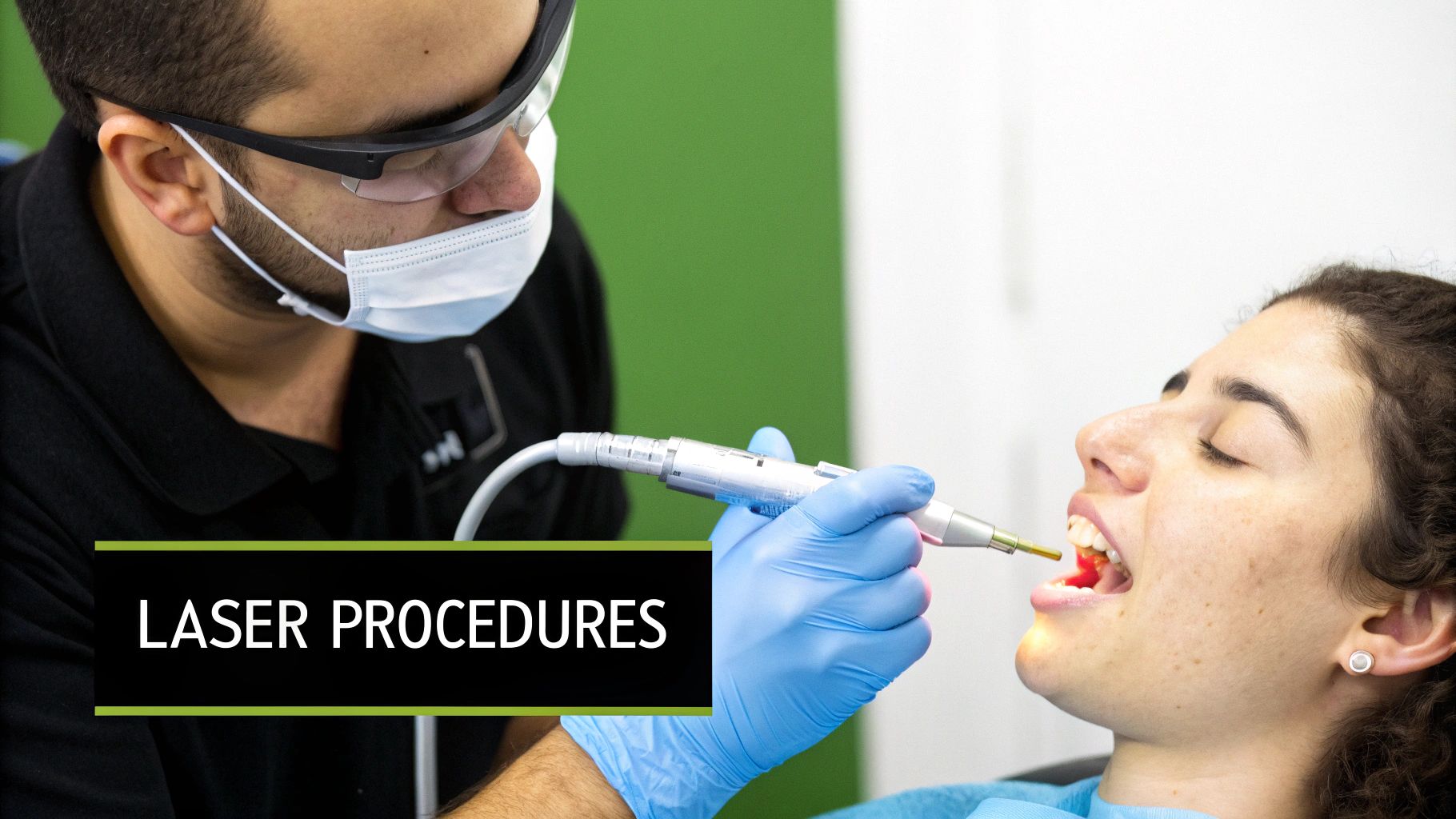
The real value of laser dentistry becomes clear when you see how it revolutionizes procedures we've done for decades. By swapping traditional tools for a focused beam of light, we can deliver better results with a level of comfort and accuracy previously unattainable.
Let’s examine four common treatments where lasers have made a significant difference, fundamentally shifting the approach to patient care.
Advanced Gum Disease Therapy
Historically, treating significant gum disease (periodontitis) involved an invasive procedure called scaling and root planing, often requiring a scalpel to surgically clean deep pockets between the gums and teeth. This approach frequently involved cutting, stitches, and a difficult recovery.
Laser dentistry offers a powerful, non-surgical alternative. A soft tissue laser can be guided deep into periodontal pockets to vaporize infected tissue and eliminate the bacteria causing the disease.
The laser’s precision means it only targets the diseased lining of the gum pocket, leaving healthy tissue intact. It also sterilizes the area, creating an ideal environment for your gums to heal and reattach to the tooth—often without a single suture.
This transforms an intimidating surgical appointment into a minimally invasive therapy. You can expect far less bleeding and swelling, and post-operative discomfort is dramatically reduced.
Precision Cavity Preparation
For many, the high-pitched whine and vibration of a dental drill are primary sources of anxiety. A hard tissue laser eliminates both. When preparing a tooth for a filling, the laser meticulously removes the decayed portion without the pressure, noise, or jarring sensations of a drill.
The laser targets water molecules within the decayed tooth structure, gently vaporizing it layer by layer. The process is so comfortable that many patients do not require anesthesia—a significant benefit if you fear needles. This precision also preserves more of your healthy tooth. You can learn more about using laser dentistry to fix cavities and see how it improves the experience.
Cosmetic Gum Contouring
If you feel your smile is overly "gummy," it may be due to excess gum tissue. The traditional solution, a gingivectomy, involved a scalpel, bleeding, stitches, and a lengthy healing period.
Today, a soft tissue laser makes cosmetic gum contouring a simple and predictable procedure. Your dentist can use the laser to sculpt the gumline, vaporizing excess tissue with pinpoint accuracy to reveal more of your natural teeth.
As the laser shapes the gums, it also seals blood vessels, which means:
There's minimal to no bleeding, allowing for a clear view to create a symmetrical gumline.
Swelling and discomfort are greatly reduced, simplifying recovery.
The results are immediate, letting you see your new, balanced smile the same day.
Pain-Free Frenectomies
A frenectomy releases a frenum—the small band of tissue connecting your lips, cheeks, or tongue to your jaw. If this tissue is too tight ("tongue-tie" or "lip-tie"), it can interfere with breastfeeding, cause speech issues, or lead to gum recession.
The traditional method using a scalpel could be frightening, especially for a child. With a laser, the procedure is transformed. The laser beam releases the tissue in moments with virtually no pain or bleeding, as it instantly cauterizes the area. It’s so quick and gentle that it often requires little to no anesthetic, and healing is remarkably fast.
Is Laser Dentistry the Right Choice for You?
While the benefits are clear, the key question is whether laser dentistry is the right tool for your specific needs. Every patient is unique, and the best treatment plan is always one customized for you.
To determine if it's the right fit, it helps to understand who benefits most from laser treatments and when traditional methods might still be the better option. This will empower you to make an informed decision about your care.
Who Is an Ideal Candidate for Laser Treatments?
This decision begins with a conversation about your comfort, health history, and goals. Most people who choose laser dentistry are seeking a gentler, more efficient, and better overall experience.
You might be a perfect candidate if:
You struggle with dental anxiety. If the sound and vibration of a drill cause you stress, the quiet, vibration-free operation of a laser can be a revelation.
You have children who are afraid of the dentist. A noisy drill and the prospect of an injection can create lasting fear. Lasers are gentler and often don't require a shot, helping to shape a positive view of dental health.
You need precise, minimally invasive gum work. For procedures like gum contouring or treating gum disease, lasers provide a fantastic non-surgical path with less bleeding and a faster recovery.
For many, the decision comes down to comfort. By removing common anxiety triggers like needles and drilling sounds, laser dentistry enables patients who may have postponed necessary care to finally move forward.
When Traditional Methods May Be Preferred
Despite its capabilities, a dental laser isn't a universal solution. The goal is always to use the most effective tool for the job, and sometimes that means relying on trusted, traditional instruments.
Your dentist will likely stick with conventional tools for tasks like:
Prepping a tooth for a crown. While lasers can assist, a traditional drill is often the best tool for precisely shaping the tooth to ensure a perfect, long-lasting fit.
Removing old metal fillings. Lasers cannot remove amalgam (silver) fillings; a drill is necessary for this task.
Dealing with very deep cavities. When decay is extensive or located between teeth, a traditional approach often provides better access and a more predictable outcome.
A great dentist will always explain your options and why they recommend a specific approach, whether it involves a laser, traditional tools, or a combination of both.
Understanding the Cost and Insurance Aspect
It's natural to consider the cost. While laser procedures can sometimes have a different price point, it's important to look at the total value.
The benefits of laser dentistry often translate into long-term savings and convenience. Consider that laser treatments frequently mean fewer appointments, less need for anesthesia, and much quicker recovery times. That equates to less time missed from work and a lower risk of post-operative complications.
Regarding insurance, coverage is almost always based on the procedure, not the tool. If your plan covers gum disease therapy, it should cover it whether a laser or a scalpel is used. The best action is to talk with your dental office. We can provide a transparent breakdown of costs and help you navigate your insurance benefits before treatment begins.
Got Questions About Laser Dentistry? We've Got Answers.
It's normal to have questions about a technology that differs so much from traditional dental tools. Let’s address some of the most common inquiries we hear from patients.
Here, we'll cover the practical details—what it feels like, safety, cost, and how to ensure your dentist is properly qualified.
Is Laser Dentistry Really Painless?
This is a top question. A major advantage of laser dentistry is enhanced comfort. For many treatments, like small fillings or gum reshaping, patients often report feeling next to nothing and don't require numbing injections.
However, "painless" is subjective. What you feel depends on your sensitivity and the specific procedure. Most people describe a mild warming or tapping sensation—a significant improvement over the pressure and vibration of a drill. The bottom line: lasers make dental care significantly more comfortable.
Are Dental Lasers Actually Safe?
Yes, absolutely. In the hands of a properly trained dentist, dental lasers are exceptionally safe. This technology has been used in dentistry for decades and has been thoroughly tested and refined.
We adhere to strict safety protocols:
FDA Cleared: Every laser we use is cleared by the U.S. Food and Drug Administration (FDA) for its intended use, confirming its safety and effectiveness.
Specialized Training: Dentists and their teams complete in-depth training to become certified in using laser technology.
Protective Eyewear: You, your dentist, and the entire team will wear special glasses to protect your eyes from the laser's light.
Think of a dental laser as a highly precise, regulated medical instrument, not a sci-fi gadget. The technology is designed to target only the intended area while keeping all surrounding healthy tissue safe.
Will My Insurance Pay for Laser Procedures?
This is a key financial question, and the answer is usually yes. Most insurance plans base coverage on the treatment, not the tool. For example, if your plan covers gum disease therapy, it typically doesn't matter if your dentist uses a laser or a scalpel—the coverage should be the same.
Reimbursement is tied to the procedure code, not the instrument. While the office fee for a laser treatment might differ, your insurance benefit often remains the same. Our team at Beautiful Dentistry is always ready to provide a clear cost estimate and help you understand your plan's coverage.
How Can I Be Sure My Dentist Is Using the Right Laser?
An excellent question. It's crucial that your dentist has both the right tools and the right training. Different lasers are designed for different tasks—some for hard tissues like teeth (hard-tissue lasers) and others for gums (soft-tissue lasers). A skilled laser dentist will not only have the appropriate laser but also the advanced training to achieve the best results with it.
Don't hesitate to ask your dentist about their experience with laser technology. Inquire which laser they plan to use and why it's the best choice for your treatment. A good dentist will be happy to explain the details and how the technology will contribute to the best possible care.
Ready to see for yourself how comfortable and precise modern dental care can be? At Beautiful Dentistry, we bring together advanced laser technology and a true commitment to gentle, patient-first treatment.
Schedule your consultation today and discover a better path to a healthy, brilliant smile. Visit us online at https://zdentist.com to get started.


Comments