

How to Fix Crooked Teeth Without Braces: A Practical Guide

If you're exploring how to fix crooked teeth without braces, you've come to the right place. The days of metal brackets being your only choice are long gone. Modern dentistry provides a range of effective solutions, from discrete clear aligners that methodically shift your teeth, to cosmetic fixes like veneers and bonding that deliver an immediate smile transformation.
The best path forward for you depends on three key factors: the specific alignment issue you want to correct, your ideal timeline, and your budget. This guide will give you the actionable insights needed to make an informed decision.
Why a Straighter Smile Is More Than Just Aesthetics
While boosting your confidence is a major motivator, the functional benefits of straight teeth are even more compelling. Well-aligned teeth are fundamentally easier to clean, which directly lowers your risk of plaque buildup, cavities, and gum disease.
A properly aligned bite also ensures that chewing forces are distributed evenly. This mechanical advantage helps prevent premature tooth wear, chips, and even jaw pain associated with TMJ disorders. Think of it this way: investing in a straighter smile is a direct investment in your long-term oral health.
You're Not Alone in Wanting a Straighter Smile
It might seem like everyone around you has a flawless smile, but that's rarely the case. Naturally straight teeth are uncommon. In fact, research indicates that only about 35% of adults have well-aligned teeth without ever undergoing orthodontic treatment.
This means the majority of us have some level of crookedness, a condition dentists call "malocclusion." One comprehensive review found the worldwide prevalence of malocclusion to be 56%. You can find more insights about these dental alignment trends from Aligner Co.
The key takeaway is that if your teeth aren't perfectly aligned, you're in good company. And the good news is that achieving a straighter smile is more accessible than ever.
The infographic below offers a quick comparison of the typical timelines for different teeth-straightening methods.
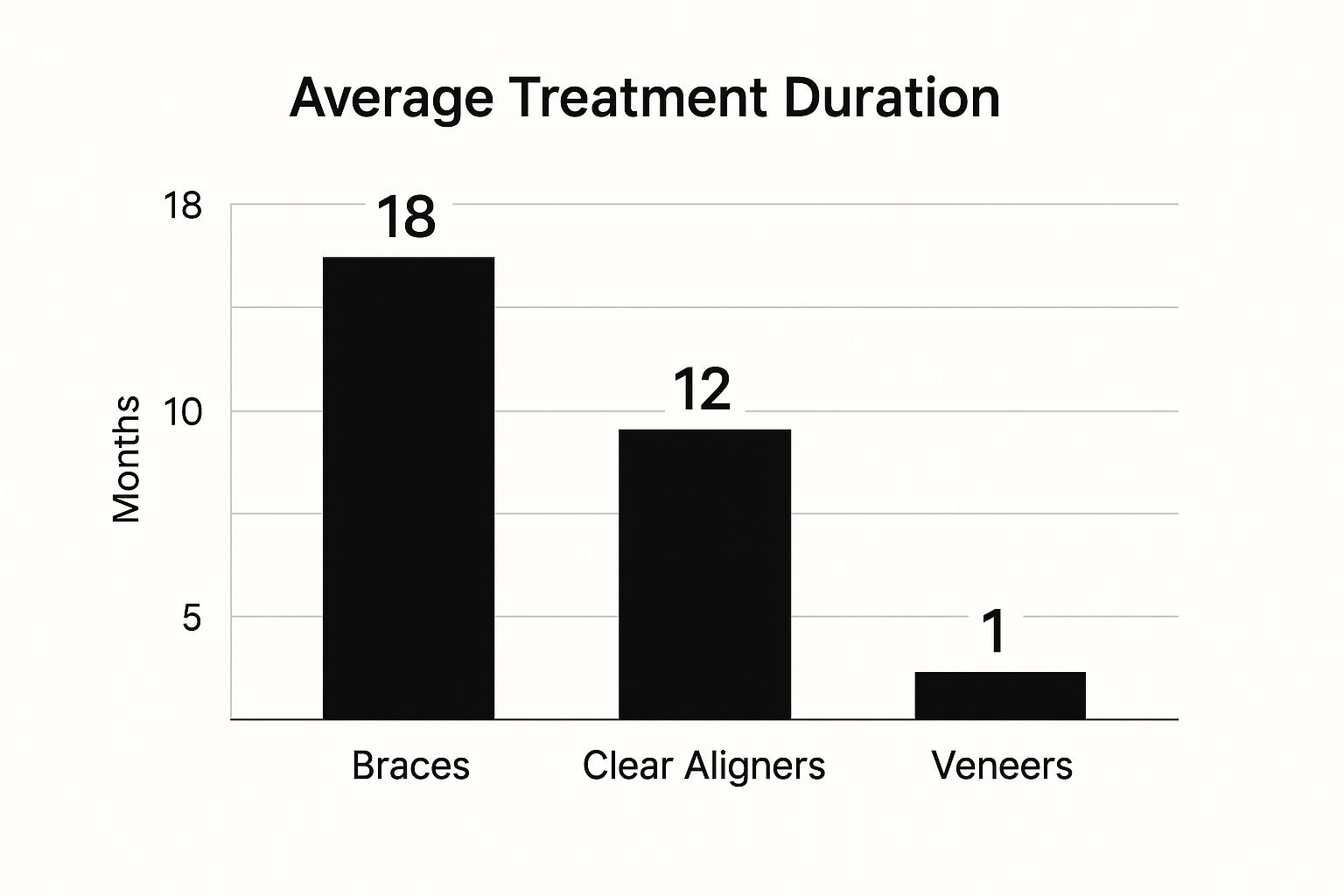
As you can see, timelines vary significantly. Cosmetic options can provide almost instant results, while orthodontic methods require a longer commitment to achieve lasting, structural changes.
Using Clear Aligners to Straighten Teeth
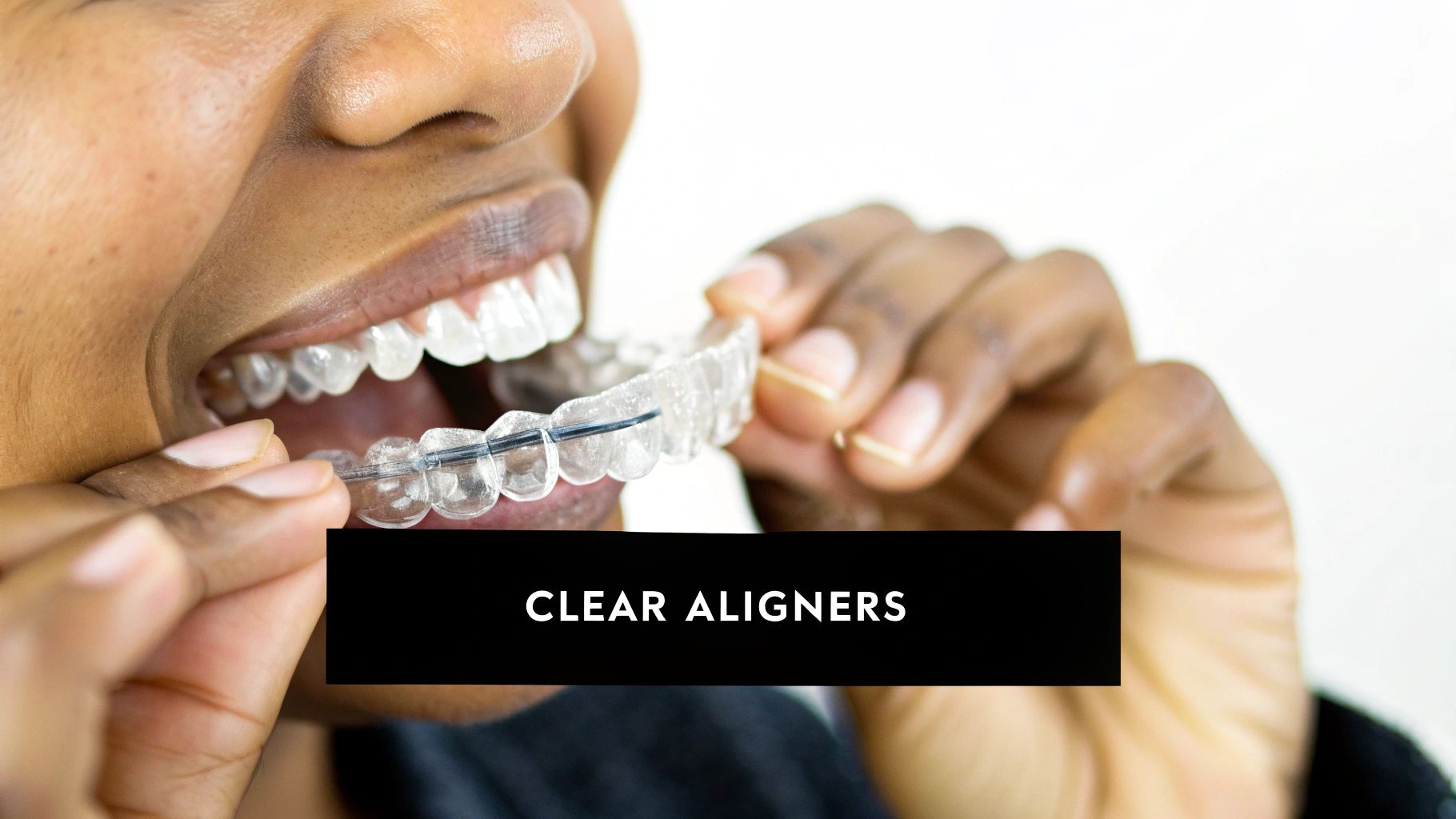
When searching for ways to fix crooked teeth without braces, clear aligners are often the first option people discover. These custom-fitted, transparent trays are a leading choice for adults and teens who want to straighten their teeth discreetly. They are nearly invisible and, most importantly, removable.
The process begins with a consultation where your dentist takes a high-tech 3D scan of your mouth. This digital model is used to map out your entire treatment plan, allowing you to see a virtual preview of your final smile. Based on this blueprint, a series of custom aligners are fabricated, with each new tray designed to make precise, incremental adjustments.
The Clear Aligner Lifestyle: What to Expect
Committing to clear aligners requires integrating them into your daily routine. The most critical rule is wearing them for 20 to 22 hours per day. This consistent pressure is what moves your teeth. You’ll switch to the next tray in your series every one to two weeks, as directed by your dentist.
The secret to success with aligners is simple: consistency. Each new tray is a small but crucial part of the puzzle. If you consistently miss hours, you'll slow everything down and likely extend your treatment time.
Living with aligners means planning ahead. You must remove them every time you eat or drink anything other than plain water. This is non-negotiable, as it prevents staining and stops sugar and food particles from being trapped against your teeth, which can lead to cavities.
Actionable Tips for Aligner Success
Staying on track is what gets you to the finish line. From my experience, here are a few practical tips that make the process a whole lot easier:
Build a "Go Kit": Always have a small case on you with a toothbrush, travel-sized toothpaste, floss, and your aligner case. It's a lifesaver for cleaning up after a coffee meeting or a spontaneous lunch out.
Plan Your Social Time: Heading to a party or a long dinner? No problem. Just plan your "aligner-out" time. A couple of hours is fine, but make a mental note to pop them back in as soon as you can.
Stick to Water: Sipping water throughout the day is great for you and your aligners. It helps rinse away any lingering debris and keeps your mouth from feeling dry.
Clean Your Trays Daily: Get into the habit of gently brushing your aligners with a soft-bristled toothbrush. Use a clear, unscented soap or a designated aligner cleaner—not toothpaste, which is abrasive and can create tiny scratches on the plastic.
It also helps to know what to expect timeline-wise. While a typical case might take around 12 months, you can get a better idea of how long Invisalign might take for your specific situation. And if you're weighing your options, understanding the differences between Invisalign vs. traditional braces is a great place to start. In the end, your results truly come down to how well you stick to the plan your dentist creates for you.
Cosmetic Fixes: A New Smile with Veneers and Bonding
Sometimes, the objective isn't to physically move teeth but to create the appearance of a perfectly straight smile. This is where cosmetic dentistry offers powerful alternatives, delivering dramatic transformations in just a couple of visits instead of months or years.
The two most popular methods for this are porcelain veneers and dental bonding. While both can conceal imperfections to give you a straighter smile, they are very different treatments. Your choice will depend on the scale of the correction needed, your budget, and how long you want the results to last.
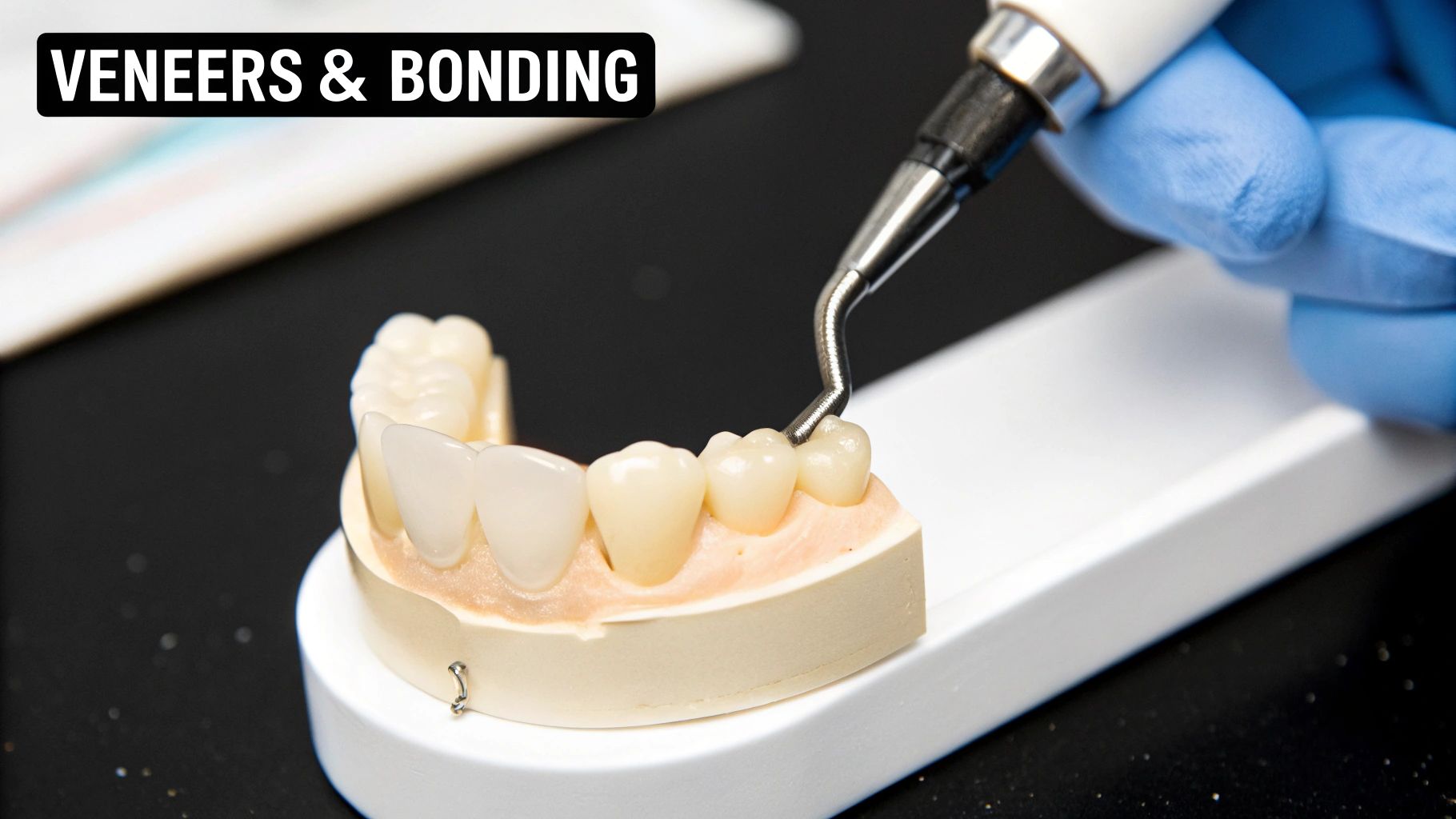
Porcelain Veneers for a Total Smile Makeover
Think of porcelain veneers as thin, custom-crafted ceramic shells that are permanently bonded to the front surface of your teeth. They are meticulously designed to create a flawless, durable, and natural-looking facade.
Veneers are the ideal solution when you want a comprehensive smile redesign or need to correct more significant cosmetic issues. This is your go-to option if you are dealing with:
Moderately crooked teeth: Veneers can make rotated or slightly overlapping teeth appear perfectly aligned.
Unwanted gaps: They can be shaped to close spaces between teeth for a uniform look.
Irregular shape or color: Veneers provide a bright, symmetrical smile that is highly resistant to stains from coffee, tea, or red wine.
The process is typically completed in just two to three appointments. It starts with a consultation and preparation, where a minimal amount of enamel is removed to ensure a seamless fit. After impressions are taken, you'll wear temporary veneers while your permanent, handcrafted ones are made.
Dental Bonding for Quick, Targeted Fixes
Dental bonding is a more direct, minimally invasive procedure. Your dentist applies a tooth-colored composite resin directly onto your tooth, sculpts it by hand to achieve the desired shape, hardens it with a special light, and polishes it to blend in perfectly.
Bonding is the ideal solution for minor, targeted fixes and is usually completed in a single visit.
Imagine this common scenario: You have one slightly turned incisor that’s always bothered you in photos. Instead of a full year in aligners, a skilled dentist can use bonding to artfully build up that tooth's surface, making it look straight in under an hour. It’s an immediate and very cost-effective fix.
Bonding is also an excellent choice for repairing small chips, closing minor gaps, or reshaping a single tooth that doesn't quite match the others. It is a conservative approach, as it typically requires no removal of your natural tooth structure.
Veneers vs. Bonding: A Head-to-Head Comparison
Choosing between veneers and bonding comes down to your specific goals, budget, and timeline. While both can give you a straighter-looking smile, they excel in different areas. This table breaks down the key differences to help you see which might be the better fit.
Feature | Porcelain Veneers | Dental Bonding |
|---|---|---|
Best For | Complete smile makeovers, moderate crookedness, multiple teeth, or severe staining | Minor imperfections, small chips or gaps, or reshaping a single tooth |
Durability | Highly durable and long-lasting, typically 10-15 years or more with proper care | Less durable, often lasting 3-10 years; more prone to chipping |
Stain Resistance | Excellent. Porcelain is non-porous and highly resistant to stains. | Good, but the composite resin can stain over time, much like natural teeth. |
Cost | Significant investment, priced per tooth. | More affordable and budget-friendly, also priced per tooth. |
Procedure Time | 2-3 visits over a few weeks. | Typically completed in a single visit, often in just 30-60 minutes per tooth. |
Invasiveness | Requires removal of a thin layer of enamel, making it an irreversible procedure. | Minimally invasive; usually requires no enamel removal, so it's often reversible. |
Ultimately, veneers offer a premium, long-lasting solution with incredible stain resistance, while bonding provides a fast and affordable way to address smaller imperfections. To get a better feel for what's possible, you can explore some of the best cosmetic dentistry treatments available and, most importantly, have a conversation with your dentist to see what they recommend for your smile.
Can Retainers Actually Straighten Your Teeth?
Retainers are the essential final step after orthodontic treatment, designed to hold your newly straightened teeth in place. But can a retainer be used to initiate tooth movement, even for very minor corrections?
The answer is a conditional "yes," but only in specific situations and with a particular type of retainer.
Most retainers are passive; their sole purpose is to maintain the current position of your teeth. However, there are also active retainers, which are designed with springs or wires that apply gentle, targeted pressure to make minor adjustments. This is often a solution for patients who had braces years ago and have noticed a slight relapse, such as a single lower incisor starting to rotate.
When Can Active Retainers Work?
Let's be clear: an active retainer is not a substitute for braces or clear aligners. It is a precision tool intended for a very small, targeted touch-up, not for correcting significant crowding or complex bite issues.
A typical use case would be a patient whose front teeth have shifted just enough to create a tiny gap or a slight overlap. In this scenario, an orthodontist might prescribe a removable Hawley retainer with an adjustable spring. When worn consistently, this device can gently guide the rogue tooth back into alignment over a few months.
Crucial Takeaway: Any kind of tooth movement, no matter how small, has to be managed by a dental professional. Trying to use a retainer to straighten your teeth on your own can backfire, potentially damaging your tooth roots or messing up your bite.
Understanding the Limitations and Risks
The primary difference between an active retainer and a clear aligner series is the scope of the treatment. Aligners are part of a comprehensive, pre-planned sequence designed to move multiple teeth in a coordinated fashion. An active retainer, in contrast, is a single-purpose tool used to correct the position of just one or two teeth by a millimeter or so.
Pushing on a tooth without considering its neighbors can create a domino effect of new problems. For instance, closing a small gap between your front teeth might create a new pressure point that shoves another tooth out of alignment. This is precisely why professional oversight is non-negotiable.
Here’s what a dentist looks at before even considering an active retainer for you:
The Scale of the Problem: Is this a truly minor relapse, or is it a symptom of a larger, more complex shift happening in your mouth?
Your Oral Health: Your teeth, roots, and gums have to be healthy and strong enough to handle the applied pressure without any issues.
Your Overall Bite: The proposed movement can't throw off the way your top and bottom teeth come together when you chew or close your mouth.
For the right person, this can be a fantastic and budget-friendly fix. The only way to know if it's a safe and effective option for you is to have a conversation with your dentist.
Choosing the Right Path for Your Smile
With several effective ways to straighten teeth without braces, the key is to determine which method aligns best with your goals, budget, and lifestyle. This is where you transition from researching options to creating a concrete plan.
Your first step is to assess the severity of your misalignment. Are you looking to fix one slightly rotated tooth, or do you have more significant crowding and bite issues? For minor cosmetic adjustments, dental bonding can be a perfect one-visit solution. For more substantial structural changes, clear aligners are the more appropriate tool.
It's no surprise that so many adults are seeking treatment, even for small imperfections. The number of adults in orthodontic care in the U.S. jumped by 16% between 2012 and 2016, to more than 1.6 million people. We've seen firsthand how much a person's confidence is tied to their smile. If you're curious, you can discover more about the confidence-boosting effects of a straighter smile on mosdenthospital.com.
Questions to Bring to Your Dental Consultation
Your conversation with your dentist is the most critical step in this process. Arriving prepared with specific questions will ensure you leave with a clear, actionable plan. Your goal is to understand not just the procedure, but also the long-term commitment.
Here are a few questions I always recommend patients ask:
Timeline and Milestones: "Looking at my teeth, what’s a realistic timeline for the whole treatment? What are the major checkpoints we’ll hit along the way?"
Long-Term Maintenance: "What does upkeep look like for this option over a lifetime? What are the expected costs for things like retainers or future touch-ups?"
Bite and Function: "How will this treatment impact my bite and the way my jaw works? Are there any potential risks I should know about?"
All-In Costs: "Could you give me a complete cost breakdown? I want to know about follow-ups, any potential refinements, and all the necessary aftercare."
Your personal goals are the priority here. For example, if you have a wedding in three months, a quick cosmetic fix like dental bonding makes a lot more sense than starting a year-long aligner treatment. Be upfront with your dentist about what’s important to you.
Making the Final Decision
Ultimately, the best choice comes from a partnership between your personal needs and your dentist's professional guidance. Your dentist can see the full picture—the health of your teeth, your gums, and your jaw—and might recommend a solution you hadn't even thought of.
For particularly tricky cases, they might bring in another expert. It's really common in dentistry, and it's helpful to understand why we refer to dental specialists to ensure you get the absolute best outcome.
By carefully considering things like treatment duration, overall cost, and the specific issue you want to fix, you can pick the solution that fits your life and finally get the smile you've always wanted.
Your Questions, Answered
It's completely normal to have questions when you're thinking about changing your smile. Diving into the world of non-brace options can feel a little overwhelming, so I've gathered some of the most common questions my patients ask. My goal is to give you clear, honest answers so you can feel confident about what comes next.
Am I Too Old to Fix My Crooked Teeth?
Absolutely not. There's no age limit on wanting a smile you love. We see adults of all ages—from their thirties to their seventies and beyond—who are finally ready to get the smile they've always wanted. Many either didn't have braces as a kid or have seen their teeth shift over the years.
As long as your gums and jawbone are in good health, your teeth can be moved safely with aligners or enhanced with cosmetic treatments like veneers. The first step is always a simple dental exam to make sure you're a good candidate.
Are At-Home Clear Aligners Safe to Use?
This is a big one. At-home aligner kits have exploded in popularity because they're convenient and often cheaper. For very minor crowding or small gaps, they can sometimes work out.
But there's a huge "if" here. You have to be sure a licensed dentist or orthodontist is genuinely creating and supervising your plan from start to finish. These systems skip the in-person check-ins that are so important for catching problems early. If you have any sort of bite issue or more than just minor crookedness, professionally supervised treatment is, without a doubt, the safer and more reliable choice.
The real advantage of seeing a dentist in person is their ability to spot trouble. A remote service might miss subtle changes in your bite or gum health, but a dentist can catch these things right away and make adjustments. This keeps your treatment on track and protects your overall oral health.
What's the Real Cost of These Options?
The investment for straightening your teeth without braces really depends on which route you take and how much work needs to be done. It helps to have a ballpark idea of the costs.
Here’s a general breakdown of what patients typically see:
At-Home Aligners: These are usually the most affordable option, often running between $1,800 and $2,500 for the full treatment.
In-Office Aligners (like Invisalign): For a more hands-on, comprehensive approach, expect a range of $3,000 to $8,000, depending on how long your treatment is.
Dental Bonding: This is a great cosmetic fix that is priced per tooth, usually costing $300 to $600 per tooth.
Porcelain Veneers: As a top-tier, durable cosmetic solution, veneers are a bigger investment, typically between $900 and $2,500 per tooth.
Don't forget to call your dental insurance provider! Some plans will actually cover a portion of orthodontic treatments, including clear aligners.
Do I Really Have to Wear a Retainer Afterwards?
I can't stress this enough: Yes, you absolutely do. Wearing your retainer is the single most important thing you can do to protect the time and money you've invested in your new smile.
Your teeth have a memory and will naturally try to drift back to their old positions—we call this "orthodontic relapse." The retainer is what stops this from happening. It doesn't matter if you get a removable one for nighttime or a permanent one bonded behind your teeth; following your dentist’s instructions is the key to making sure your straight smile lasts a lifetime.
Ready to figure out which non-brace solution is right for you? At Beautiful Dentistry, we love helping people create personalized plans that fit their goals, lifestyle, and budget. Schedule a consultation with us today and take the first step toward that confident smile you've been waiting for. Visit us at https://zdentist.com to get started.


Comments