

How to Tell If You Have a Cavity Without Guessing

That twinge in your tooth—is it a passing sensitivity, or a sign of something more? To tell if you have a cavity, you need to become an active observer of your own oral health. Look for specific clues like a new sensitivity to sweets on a single tooth, a dull ache that won’t quit, or visible dark spots you can see in the mirror. These are actionable signals that let you take control before a small issue becomes a painful problem.
Your Guide to Spotting a Cavity Early On
Most people wait for sharp, impossible-to-ignore pain before suspecting a cavity. But tooth decay rarely starts with a shout; it begins with subtle clues. Learning to recognize these early signs is the most effective action you can take to catch decay before it requires extensive treatment.
Dental cavities are one of the most common chronic diseases in the world, affecting billions. This isn't just a statistic; it's a powerful reason to be proactive. A 2022 study on automated detection systems highlights the global scale of the problem, reinforcing why early, personal detection is so critical.
The First Visible Signs of Decay
Before a hole forms, your tooth enamel sends out distress signals. The initial stage of decay, demineralization, is when acids from bacteria start stripping away minerals from your tooth's protective layer. You can often spot this yourself.
Here is your action plan for a quick self-check:
Look for Chalky White Spots: Grab a mirror and find good lighting. Scan each tooth for dull, matte-white patches, especially near the gumline or in the grooves of your back teeth. A healthy tooth should be glossy.
Identify Light Brown or Tan Stains: If decay progresses, the weakened enamel will start to stain. Note any faint brown spots that don't brush away.
Catching these visual cues gives you the power to reverse the damage. At this early stage, you can often stop a cavity from forming with improved oral hygiene and a dental consultation.
Actionable Insight: Don't wait for pain. Pain is a late-stage symptom. If you wait until your tooth hurts, you have likely missed the chance for simple, preventive fixes. Treat visual changes as your primary call to action.
Differentiating Sensitivity from a Cavity Twinge
It's easy to confuse general tooth sensitivity with the specific pain of a cavity. General sensitivity often feels like a brief, sharp shock across several teeth when they're exposed to hot or cold.
A cavity's sensitivity is more targeted. Here’s how to tell the difference: pay attention to whether the pain is repeatable and localized. Is it a sharp zap on one specific tooth every time you eat something sweet? Does a dull ache linger in that same spot after drinking something cold?
This targeted, repeatable twinge is a strong indicator that a single tooth needs professional attention. Use the table below as a checklist to interpret what you're feeling.
Cavity Warning Signs At-a-Glance
Symptom | What to Look For or Feel | What It Likely Means |
|---|---|---|
Visual Spots | Chalky white, light brown, or even black spots on a tooth's surface. | Early to advanced stages of enamel demineralization and decay. |
Pain or Aches | A spontaneous, dull, or persistent ache in one specific tooth. | The decay may be getting closer to the tooth's nerve. |
Sensitivity | A sharp, localized pain when eating sweets or drinking hot/cold liquids. | Enamel has worn away, exposing the sensitive dentin layer underneath. |
Holes or Pits | A noticeable hole, pit, or rough spot you can feel with your tongue. | The cavity has physically broken through the tooth's enamel surface. |
Pain on Biting | Sharp pain when you put pressure on a specific tooth while chewing. | The decay could be affecting the root or creating a crack in the tooth. |
If you check off any of these boxes, your next actionable step is to schedule a dental visit.
Decoding Pain and Sensitivity Signals

Tooth pain is your body's alarm system. To use it effectively, you need to learn how to translate its signals into actionable information. A persistent, dull throb from a single tooth isn't just a random annoyance; it’s a specific message that decay may be advancing. This isn't the fleeting "ouch" from ice cream; it's a nagging, spontaneous pain that disrupts your day and can keep you up at night.
The Tell-Tale Signs of Cavity Pain
Pain from a cavity has a distinct signature. If you can describe these patterns to your dentist, you can help them diagnose the problem faster.
Watch for these specific pain signals and be ready to report them:
Sharp, Sudden Jabs: Do you feel a jolt of pain when you bite down on food? Make a note of which tooth it is. This often means decay has weakened the tooth's structure, making it unable to handle normal chewing pressure.
Lingering Sweet Sensitivity: Time the sensation. If the sensitivity from a sweet treat lasts for more than a few seconds, it’s a strong indicator of a cavity.
A Spontaneous Ache: Pain that appears without any trigger (hot, cold, or sweet) is a serious red flag. Don't ignore it; document when it happens and for how long.
A frequent complaint is sharp pain when chewing, which points to decay breaking through the enamel and into the softer dentin layer. With dental caries affecting an estimated 2.4 billion people with untreated decay, learning to identify these specific pains is a critical skill.
Understanding Hot and Cold Sensitivity
That jolt of pain from a hot or cold drink happens for a specific reason. Enamel shields the sensitive inner parts of your tooth. A cavity creates a breach in that shield, exposing the dentin, which contains microscopic tubes leading to the nerve.
Actionable Insight: Think of your enamel as insulation around a live wire (the nerve). A cavity is a hole in that insulation. When you feel a jolt of pain from hot or cold on one tooth, it's a direct signal that the insulation is compromised.
This is why understanding what causes tooth sensitivity to cold is a practical tool for spotting cavities. If your sensitivity is new, localized to one tooth, and getting worse, your most logical next step is to assume it's a cavity and book an appointment. While you wait, learn how to find relief for severe tooth pain.
Visual and Physical Clues of Tooth Decay
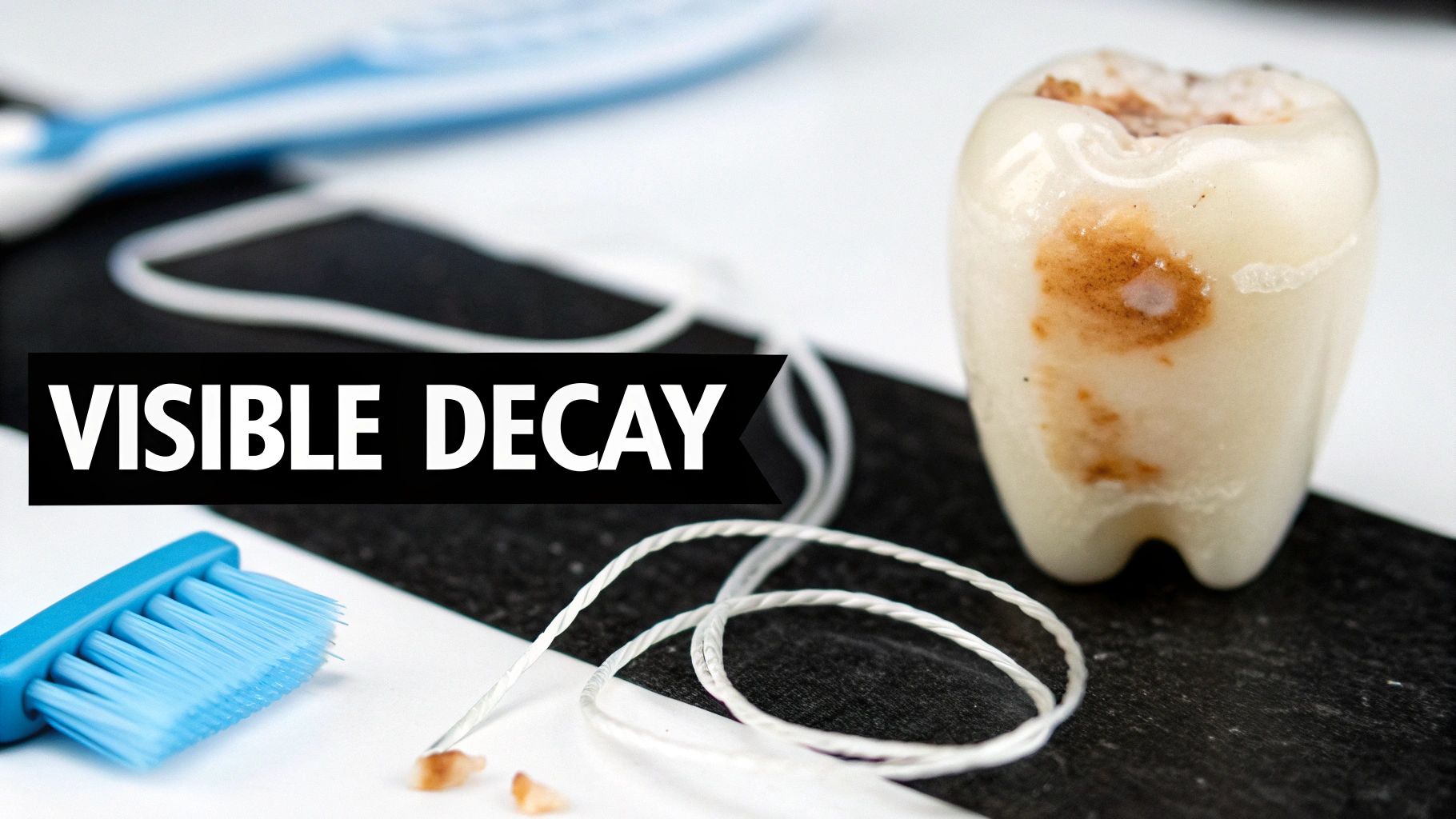
While pain is a clear warning, your eyes and tongue can often detect a cavity long before it hurts. Knowing how to tell if you have a cavity through a physical check-up can turn a complex dental problem into a simple fix.
Grab a mirror and find good lighting. The earliest visible sign of decay isn't a dark hole, but a subtle color change. Actively look for chalky, dull white patches. These indicate that the enamel is losing minerals. If you don't take action, these spots will progress to light brown, dark brown, or black stains.
Identifying Holes, Pits, and Other Physical Signs
Beyond color, your tooth's texture provides direct evidence of decay. A cavity is a physical hole created as enamel breaks down. You can often detect this yourself.
Actionable Test: Run your tongue over all your teeth. Does one spot feel rough when it used to be smooth? Can you feel the edge of a tiny pit, especially in the grooves of your molars? These tactile clues are a reliable way to identify active decay.
A visible hole means decay has breached the enamel, creating a trap for bacteria and food. This is a massive global health problem, with untreated cavities affecting an estimated 2.5 billion people according to the WHO's oral health data portal.
Here's another practical test: Pay attention when you floss. If your floss consistently shreds or snags in the exact same spot every day, it's likely catching on the sharp edge of a new cavity between your teeth.
Key Takeaway: Any change to a tooth's surface that you can see or feel is a signal to act. Healthy enamel is smooth and uniform. Treat any new roughness, stain, or pit as a reason to schedule a dental exam.
What to Look for During a Self-Exam
To perform an effective self-exam, be systematic. A focused check helps you spot issues you might otherwise miss. Use this checklist:
Discoloration: Inspect each tooth for chalky, brown, or black spots that don't brush off. Focus on the areas near your gumline and in the chewing grooves of your back teeth.
Physical Pits: Use the tip of your tongue as a detector to feel for small holes or rough patches. Molars are the primary target for this test.
The Floss Test: As you floss, note any specific spot where the floss frays or catches repeatedly. This is a classic sign of an interproximal (in-between) cavity.
New Food Traps: Is food suddenly getting stuck where it never used to? A new pocket that traps food particles can indicate that a cavity has formed.
When to See a Dentist and What to Expect
You’ve performed a self-check and noticed something isn't right. That's a crucial first step. Now, you need to know when to escalate from monitoring the situation to calling your dentist. Acting decisively is what saves your teeth.
Book an appointment immediately if you experience any of these symptoms:
Persistent pain that disrupts your sleep or daily focus.
Visible holes or dark pits you can see or feel.
Swelling in your gums or face near a painful tooth.
A persistent foul taste in your mouth, even after brushing.
These are not minor issues; they are clear signs that decay requires professional intervention before it escalates into a more serious problem like an abscess.
Demystifying Your Dental Visit
A dental visit for a suspected cavity is a straightforward information-gathering mission. Knowing the process can reduce anxiety and help you prepare.
Your dentist will first perform a visual exam, using a small instrument called a dental explorer to gently check for soft or sticky spots on the enamel—a tell-tale sign of active decay. However, a visual check only tells part of the story.
Dental X-rays are essential for a complete diagnosis. They allow your dentist to see decay hiding between teeth or under existing fillings—areas invisible to the naked eye. Knowing how often you should get dental X-rays is part of a proactive health strategy.
Actionable Insight: Come to your appointment prepared. Be ready to tell your dentist exactly which tooth is bothering you, what the pain feels like (sharp, dull, throbbing), and what triggers it (hot, cold, sweet, pressure). This information helps them pinpoint the problem faster.
Understanding Your Treatment Options
Once a cavity is confirmed, your dentist will explain how to fix it. The treatment plan is determined by the depth of the decay. For most cavities caught early, the solution is simple.
Here are the most common treatments, from simplest to most complex:
Dental Filling: The standard treatment for most cavities. The dentist removes the decayed portion and fills the space with a durable material, like a tooth-colored composite resin, restoring the tooth's function.
Crown: If a large cavity has weakened the tooth structure, a filling won't be strong enough. A crown, or cap, is placed over the entire tooth to provide the strength and protection it needs.
Root Canal: If decay reaches the tooth's inner nerve (the pulp), it can cause a painful infection. A root canal cleans out the infected pulp and seals the tooth, eliminating the pain and saving the tooth from extraction.
Your dentist will explain their findings and treatment recommendation. The goal is to ensure you understand the "what" and the "why" so you can make a confident decision. Remember, the faster you act, the more likely you are to need only the simplest, least expensive solution.
Building a Cavity-Proof Oral Health Routine
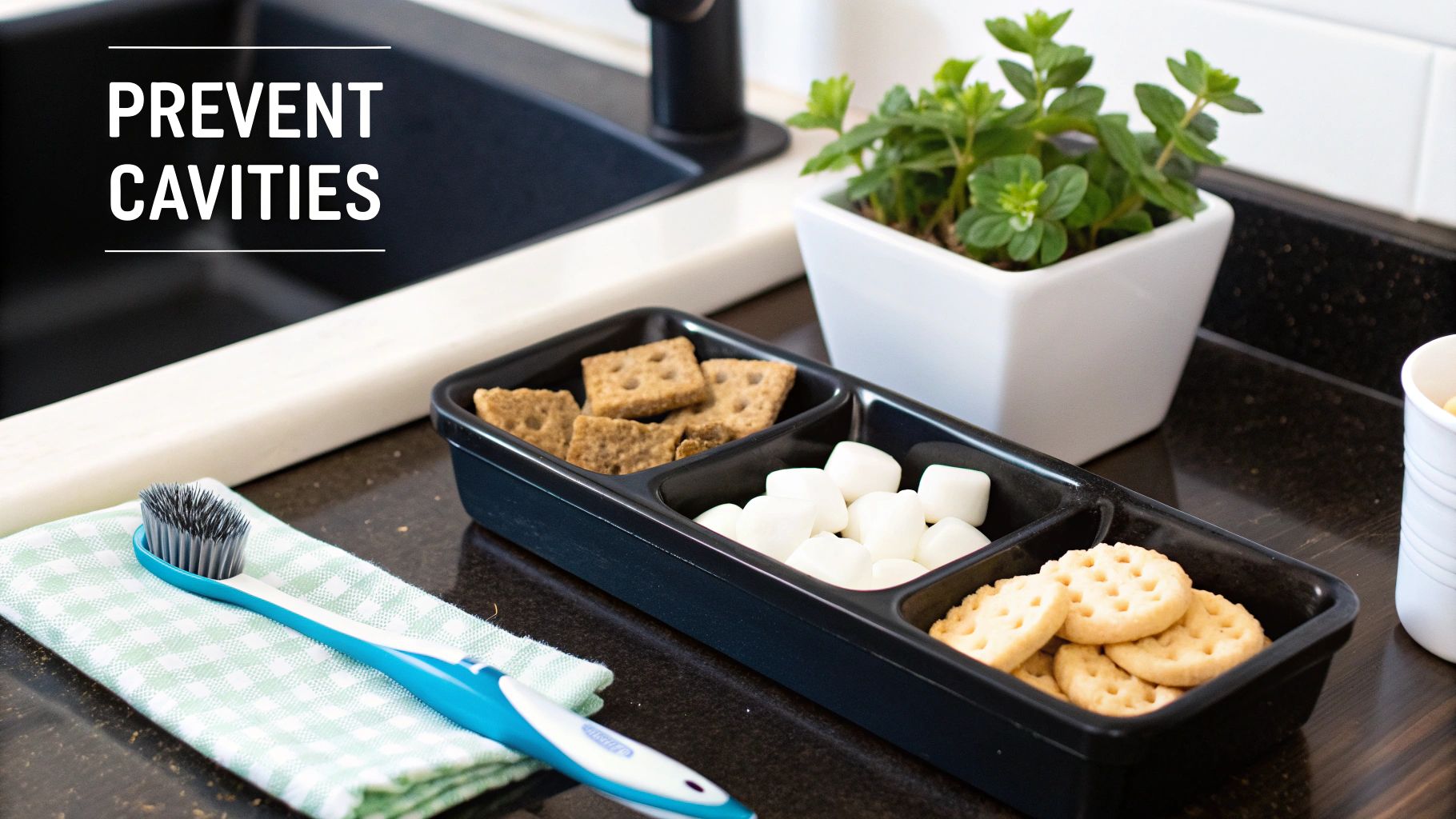
Fixing a cavity is a reactive measure. The ultimate goal is to build a proactive defense so you don't have to deal with them again. This requires a solid daily routine designed to fight the bacteria responsible for tooth decay. The key is to shift from just going through the motions to making every cleaning session a strategic attack on plaque.
Elevating Your Daily Cleaning Game
Your toothbrush and floss are your most important tools. Small, consistent adjustments to your technique can dramatically reduce your risk of cavities.
Here are actionable steps you can implement tonight:
Master the 45-Degree Angle: When brushing, tilt your toothbrush at a 45-degree angle toward your gumline. This allows the bristles to sweep out plaque from just beneath the gums, where it accumulates.
Use the Two-Minute Rule: Set a timer for a full two minutes. Divide your mouth into four quadrants (upper right, upper left, lower right, lower left) and spend 30 seconds on each. This ensures every tooth gets equal attention.
Floss with the C-Shape Technique: Don't just snap the floss between your teeth. Your toothbrush misses about 35% of your tooth surfaces. Wrap the floss in a C-shape against the side of each tooth and gently slide it up and down, going slightly below the gumline.
To boost your defense, integrate a specialized cavity prevention toothpaste into your routine. These formulas are designed to strengthen enamel and make it more resistant to acid.
The Crucial Role of Diet in Cavity Prevention
What you eat directly fuels—or starves—the bacteria that cause cavities. Sugary and starchy foods create an acid attack on your enamel. You can actively fight this by making smarter food choices.
Instead of grabbing chips or crackers for a snack, choose cheese, nuts, or yogurt. These foods are low in sugar and can help neutralize acids. Swap sugary sodas and juices for water to reduce acid exposure and help rinse away food particles. You can learn more about how to prevent tooth decay naturally through diet.
Actionable Insight: It's not just about what you eat, but how you eat it. Snacking on sugary foods throughout the day is more harmful than eating them with a meal, because it keeps your mouth in a constant acidic state. If you have a sweet treat, consume it in one sitting and rinse with water afterward.
Professional Support for Long-Term Protection
Your daily habits are your first line of defense, but professional dental care provides protection you can't achieve at home. Your dentist can spot weakening enamel and intervene before a full-blown cavity forms.
Ask your dentist about these two powerful preventive treatments:
Fluoride Treatments: A professional-grade fluoride varnish applied in the office makes your enamel significantly more resistant to acid.
Dental Sealants: A game-changer for your back teeth. A sealant is a thin, protective coating painted onto the chewing surfaces of your molars, creating a barrier that "seals out" plaque and food from the deep grooves where most cavities start.
By combining an effective home routine, smart dietary choices, and regular professional care, you build a multi-layered defense system to keep your teeth healthy.
Got Questions About Cavities? We've Got Answers
Suspecting a cavity can bring up a lot of questions. Getting clear, straightforward answers can help reduce worry and empower you to take the right steps. Here are some of the most common questions we address every day.
Can a Cavity Go Away on Its Own?
No, an established cavity cannot heal itself. Once bacteria have created a physical hole in your tooth enamel, the damage is permanent and requires professional repair. Your body cannot regrow tooth structure the way it heals a cut.
However, you can reverse the earliest stage of decay, known as demineralization. If you see a faint, chalky white spot on a tooth, that's your window of opportunity. With excellent brushing and flossing, dietary changes, and professional fluoride treatments, you can help the enamel remineralize and stop the cavity from forming.
What's the Difference Between Tooth Sensitivity and a Cavity?
This is a common point of confusion. The key difference is scope and persistence.
General Sensitivity: Often feels like a quick "zing" across several teeth when exposed to hot, cold, or sweet stimuli. It's usually caused by widespread enamel wear or gum recession.
Cavity-Related Sensitivity: This is typically localized to one specific tooth. The pain may linger long after the trigger is gone, or you might feel a sharp twinge only when you bite down on that single spot.
Actionable Tip: If your sensitivity is new, getting worse, or isolated to a single tooth, treat it as a suspected cavity and have it examined.
Key Takeaway: Never ignore sensitivity that is getting worse or is focused on one spot. It is your tooth's most direct way of signaling that something specific is wrong and requires attention.
How Long Can I Wait to Get a Cavity Filled?
You shouldn't wait. A cavity is a progressive disease; it will only get worse. A small spot on your enamel will eventually burrow deeper into the tooth, moving toward the nerve.
Delaying treatment allows the decay to spread, turning a simple filling into a potential root canal and crown. This means more complex procedures, more time at the dentist, and higher costs. Acting immediately is the most practical and cost-effective strategy.
Does Getting a Cavity Filled Hurt?
The procedure should not be painful. Your dentist's top priority is your comfort. Before starting, they will use a local anesthetic to completely numb the tooth and surrounding area.
You may feel some pressure or vibration from the dental instruments, but you should not feel any pain. If you experience dental anxiety, talk to your dentist. Many practices, including ours, offer sedation options to ensure you are relaxed. The goal is always to fix the problem without causing you stress.
At Beautiful Dentistry, we believe knowledge empowers you to take control of your oral health. If you're noticing any of these signs or have more questions, our team is here to provide clear answers and gentle, effective care. Schedule your comprehensive exam today.


Comments