

How Often Should You Get Dental Xrays: Your Essential Guide

When it comes to the question of how often you should get dental xrays, the most actionable answer is this: it depends on your specific oral health. There is no universal schedule. The right frequency is a personalized plan you and your dentist decide on together, based on your current oral health, your age, and your individual risk factors.
Why Your Xray Schedule Is a Personal Plan
Think of your dental X-ray schedule like a personalized fitness plan—what works for a marathon runner is different from what a beginner needs. Your oral health requires the same custom approach, not a rigid, one-size-fits-all rule.
The goal is to move past outdated timelines and help you understand the why behind our recommendations. This allows you to co-create a care plan that makes sense, catching potential problems early without unnecessary radiation exposure. It's about being smart and proactive with your health.
A Guideline, Not a Rule
Professional groups like the American Dental Association (ADA) provide a starting framework, but it's your dentist's job to apply it to your unique situation. The ADA's guidelines are based on individual risk.
For example, if you're an adult with a low risk of cavities and healthy gums, bitewing X-rays might only be needed every 24 to 36 months. However, if you're dealing with active decay or gum disease, that frequency might increase to every 6 to 18 months to stay ahead of the problem.
To give you a clearer picture, here’s a quick breakdown of how these recommendations often play out for different patients.
Quick Guide to Dental X-Ray Frequency
Patient Profile | Recommended Bitewing X-Ray Frequency | Actionable Insight |
|---|---|---|
New Adult Patient | Every 6-18 months (initially) | This establishes your oral health baseline, allowing your dentist to spot future changes quickly. |
Adult with Low Cavity Risk | Every 24-36 months | If you have excellent hygiene and no history of issues, you can safely extend the time between X-rays. |
Adult with High Cavity Risk | Every 6-18 months | If you get frequent cavities or have dry mouth, more frequent X-rays are a key tool for early intervention. |
Child or Teenager | Every 6-12 months | Their developing mouths require closer monitoring to guide growth and prevent future orthodontic issues. |
Remember, this table is a general guide. Your dentist will always consider your complete health history before making a final recommendation.
This personalized approach ensures we use diagnostic tools effectively—getting the maximum benefit while keeping exposure to an absolute minimum. It’s all about being proactive, not just reactive.
What This Means for Your Next Visit
Understanding that your X-ray schedule is flexible is the first step to becoming a partner in your dental care. The key action for you is to have an open conversation with your dentist about your health history and any concerns.
This dialogue is a vital part of your routine dental cleaning and exams, where we assess all of your personal risk factors. By working together, we can land on a schedule that keeps your smile healthy and gives you peace of mind.
Seeing Beyond the Surface: Why X-rays Are Essential
Ever wonder what your dentist sees that you can’t? Think of your teeth as just the tip of the iceberg. What’s visible is only part of the story; the most critical structures—like roots, your jawbone, and unerupted teeth—are all hidden from view.
Dental X-rays are the only way for your dentist to see that complete picture. Without them, we are limited to what we can see with our eyes, meaning serious problems could go unnoticed until they become painful, complicated, and more expensive to fix.
What Are Dentists Looking For?
X-rays are a foundational diagnostic tool that provides crucial information for creating an effective treatment plan. Here are specific problems your dentist is looking for that are impossible to spot during a standard visual exam:
Bone Loss: Gum disease can silently destroy the bone supporting your teeth. X-rays are the only way to measure this loss and intervene before teeth become loose.
Impacted Teeth: Wisdom teeth can get stuck in the jaw, causing pain, damaging adjacent teeth, and leading to infection. X-rays identify this early.
Cysts and Abscesses: An infection at a tooth's root can create a hidden abscess or cyst. X-rays reveal these issues so they can be treated, often saving the tooth.
Decay Under Existing Fillings: A crown or filling might look fine, but new decay can form underneath. An X-ray lets us see through the restoration to catch the problem before the tooth is compromised.
This is why the question of how often you should get dental xrays is so important. Regular imaging creates a timeline of your oral health, letting your dentist spot subtle changes and catch problems when they are small and easy to manage.
Ultimately, dental X-rays are a cornerstone of preventive dentistry. They empower your dental team to see the unseen, helping you avoid painful emergencies and keep your smile healthy for the long haul.
Key Factors That Determine Your X-ray Schedule
So, how often do you really need dental X-rays? The right schedule is entirely unique to you. Your dentist weighs several critical factors to decide when imaging will provide the most benefit while keeping radiation exposure to an absolute minimum. Understanding these factors helps you become a more informed partner in your care.
Your Age and Stage of Life
Your age plays a massive role in X-ray frequency. A child’s mouth is constantly changing—baby teeth fall out, adult teeth come in, and the jaw grows. This dynamic environment needs closer monitoring, which often means X-rays every 6-12 months to catch developmental issues early.
For a healthy adult with no major dental problems, the risk of sudden changes is lower. In these cases, a set of bitewing X-rays every 24-36 months may be perfectly sufficient to monitor for slow-developing issues.
Your Overall Oral Health History
Your dental history is a powerful predictor of your future needs. Your past experiences with cavities, fillings, or gum disease are direct indicators of your future risk.
Actionable Insight: If you have a history of frequent cavities, you are statistically more likely to develop new ones. This justifies more frequent X-rays to spot them before they become big problems. Discuss your history with your dentist to determine if you fall into a higher-risk category.
This is why a new dentist will almost always recommend a full set of X-rays on your first visit. It’s not just about seeing what’s there now; it's about creating a detailed baseline to track subtle changes over time and tailor a truly personal care plan.
This decision tree gives you a great visual of how dentists think through the process.
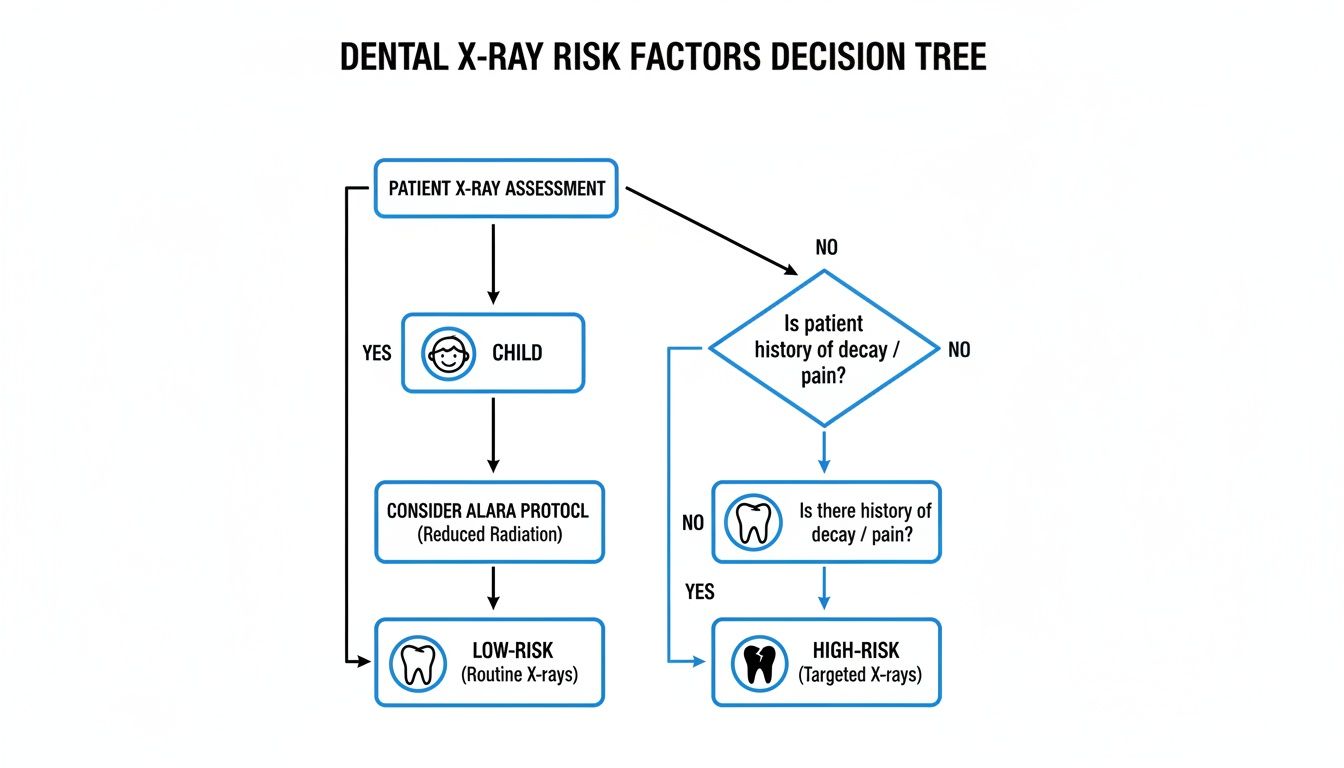
As you can see, your personal risk level—whether it's considered low, high, or based on your developmental stage—is the main factor driving the recommended X-ray frequency.
Current Symptoms and Risk Factors
What’s happening in your mouth right now can override any routine schedule. If you come in with a toothache, sensitivity, or swelling, your dentist will recommend an X-ray on the spot, regardless of when you had your last one. These symptoms are red flags for hidden issues like deep decay, a cracked root, or an abscess.
Beyond urgent symptoms, certain ongoing conditions also place you in a higher-risk category, warranting more frequent imaging. Be sure to tell your dentist if you experience:
Gum Disease (Periodontitis): X-rays are essential to measure bone loss around the teeth, a critical part of managing the disease.
Dry Mouth (Xerostomia): Lack of saliva dramatically increases your risk for aggressive cavities, making regular monitoring essential.
Extensive Dental Work: A mouth with many crowns, bridges, or large fillings needs more frequent checks to spot decay starting underneath existing restorations.
By carefully considering all these factors, your dentist can confidently answer the question of how often you should get dental xrays. It's a thoughtful, evidence-based process designed to keep your unique smile healthy for a lifetime.
Why Children and Teens Need Xrays More Often
While an adult’s mouth is relatively stable, a child's mouth is a zone of constant change. Teeth are erupting, jaws are growing, and the entire landscape is shifting. This rapid development is why kids and teens usually need dental X-rays more often than adults.
Think of your dentist as a construction manager; they need regular blueprints (X-rays) to ensure everything is developing correctly. Without this inside view, it’s impossible to know if permanent teeth have enough space or to catch orthodontic problems before they become complex.
Monitoring Growth and Preventing Future Problems
For younger patients, the goal of more frequent X-rays is proactive intervention. This allows your dentist to guide your child's oral development and prevent major issues later on. It’s about catching a small problem today to avoid a big, expensive one tomorrow.
Here are the specific things a dentist looks for with X-rays:
Eruption of Permanent Teeth: To confirm adult teeth are correctly positioned under the gums.
Checking for Adequate Space: To determine if the jaw has enough room for incoming teeth, which is key to preventing crowding.
Early Orthodontic Insights: To reveal potential bite issues or impacted teeth long before they’re visible, often allowing for simpler orthodontic fixes later.
Tracking Wisdom Teeth: To monitor how wisdom teeth are developing in teenagers and decide if they will cause future problems.
This proactive approach is backed by professional guidelines. The American Academy of Pediatric Dentistry (AAPD), for instance, often recommends X-rays every 6 to 12 months for many young patients to monitor development and catch problems early. This practice is detailed in studies about the "Image Gently" initiative, which focuses on child-sized radiation doses, as noted in this detailed study.
Protecting Vulnerable Teeth from Decay
Besides tracking growth, there's another critical reason for more frequent X-rays in children: the enamel on baby teeth is much thinner than on permanent teeth, making them more vulnerable to cavities.
A small cavity that might take a year to become a problem for an adult can develop much faster in a child's mouth. Because of this, regular X-rays are an essential tool for early detection.
This is especially true for cavities between the teeth, where they are completely hidden. A bitewing X-ray can spot this decay when it's small, allowing for a simple filling instead of a more involved procedure like a crown or extraction.
Working with a team that specializes in dentistry for children in Tempe ensures that your child’s care is perfectly matched to their developmental needs, safeguarding their long-term oral health through proactive monitoring.
Are Dental X-rays Actually Safe? Let's Talk About It.

It’s completely normal to have questions about radiation. But when it comes to modern dental X-rays, the technology we use today is incredibly safe, and the amount of radiation exposure is extremely low.
To put it in perspective, the dose from a routine set of dental X-rays is often less than what you’d absorb during a short airplane flight. It's also a tiny fraction of the natural background radiation we're all exposed to every day just by living on Earth.
How Technology Has Changed the Game
The biggest reason for this leap in safety is the shift from old-school film to modern digital imaging. This isn't just a minor upgrade; it's a game-changer.
Digital X-rays have reduced radiation exposure by a staggering 80-90% compared to traditional film. This means we get a crystal-clear picture of your teeth and jaw with minimal exposure, making the decision about how often you should get dental xrays safer than ever.
When you weigh the enormous diagnostic benefit of finding hidden decay, bone loss, or impacted teeth early, the minuscule risk from a modern X-ray is a trade-off that overwhelmingly protects your long-term health.
A full mouth series of images exposes you to a dose roughly equivalent to just a few days of normal background radiation. A standard set of four bitewings is even less. This makes dental X-rays one of the lowest-risk diagnostic tools in all of medicine.
The Standard Safety Playbook in Our Office
Beyond the technology, every dental office follows strict safety protocols based on the ALARA principle—As Low As Reasonably Achievable. This is our guiding principle for patient safety. You can learn more about our specific equipment and approach to the dental X-ray in Tempe and see how we put your safety first.
Every time we take an X-ray, we use these protective measures:
Lead Aprons: You will wear a heavy, leaded apron over your chest and abdomen to shield your vital organs from scattered radiation.
Thyroid Collars: We use a smaller leaded shield that fits around your neck to protect your sensitive thyroid gland.
These simple, effective tools, combined with our targeted digital technology, ensure your safety is our number one priority.
Partnering With Your Dentist for Personalized Care
When it comes to your health, you are the co-pilot. The real answer to how often should you get dental xrays comes from a conversation with your dentist. The goal is to build a care plan tailored specifically for you, not for an "average" patient.
By understanding the key factors—your age, dental history, and personal risk for cavities—you can have a much more productive discussion about whether an X-ray is necessary at your next check-up. This dialogue is the cornerstone of patient-centered dentistry.
Empowering Your Next Dental Visit
Your role is to share your story. Inform your dentist about any new aches, pains, changes in your overall health, or other concerns. Their job is to combine that information with their clinical exam to recommend an X-ray schedule that provides the most benefit with the least exposure.
Your Action Plan: At your next visit, ask your dentist, "Based on my personal risk factors, what X-ray schedule do you recommend for me, and why?" This single question opens the door for a collaborative decision.
To make this partnership work, communication has to be easy. Many modern practices use tools like a chatbot for healthcare to answer common questions and ensure you and your dental team are always on the same page.
By working together, you and your dentist can ensure every tool, including X-rays, is used wisely. This shared responsibility is what keeps your smile healthy and strong for years to come.
Common Questions We Hear About Dental X-Rays
We’ve covered how your X-ray schedule is unique, but it's natural to have more questions. Here are the answers to a few common ones.
I Don't Have Any Pain, So Why Do I Need X-Rays?
The simple answer is prevention. Most serious dental issues—like cavities forming between teeth, early bone loss from gum disease, or cysts—don't cause any pain in their early stages.
Think of dental X-rays as an early warning system. They let us see what the naked eye can't, allowing us to fix small problems before they become painful and expensive. Waiting for a toothache is reactive; proactive X-rays keep you ahead of potential issues.
Are Dental X-Rays Safe if I'm Pregnant?
Yes, they are considered safe. Major health groups, including the American Dental Association and the American College of Obstetricians and Gynecologists, agree that the low, focused dose of radiation is safe during pregnancy.
We always use a lead apron and thyroid collar for extra protection. While routine screening X-rays can often be postponed, any imaging needed for a dental problem or emergency is safe and important for your health.
What’s the Difference Between All the X-Ray Types?
Your dentist uses different X-rays to get a unique perspective on your oral health.
Bitewing X-rays: These are the most common type, giving a clear view of the crowns of your back teeth to spot decay hiding between them.
Periapical X-rays: This shows a whole tooth, from crown to root tip, and is crucial for diagnosing root issues or problems in the surrounding bone.
Panoramic X-rays: This captures your entire mouth in a single shot—all teeth, both jaws, and your TMJ. It's useful for planning orthodontics, checking on wisdom teeth, or assessing your jaw for implants.
At Beautiful Dentistry, our goal is for you to feel confident and informed about every part of your care. If you have any more questions or want to map out a dental plan that truly fits your life, we're here to help. Schedule your visit today to get started.
You can learn more and book an appointment with us at https://zdentist.com.


Comments