

Dentures Pros Cons A Tempe Patient's Guide
- Caterina Rutter
- Jan 14
- 11 min read

When you're deciding on dentures, it's critical to look at both sides of the coin. The most actionable benefits are often the lower upfront cost and the quick, non-invasive process. This means you can restore your smile much faster and more affordably than with surgical options.
However, the actionable insight on the downside is preparing for a potential adjustment period. You'll need to learn how to eat and talk comfortably with them, and commit to a daily maintenance routine.
Weighing The Pros And Cons Of Dentures
To make a confident decision, you need a full picture of what living with dentures is really like. This guide provides a straightforward, balanced look at the pros and cons, helping you choose a solution that fits your life in Tempe and South Phoenix. Today’s dentures are advanced, but understanding their practical realities is key to long-term satisfaction.
This isn't just about filling gaps—it's about finding a practical solution that fits your budget, lifestyle, and health goals. For many, dentures are a fantastic choice, restoring their smile and chewing ability almost immediately. For others, the long-term upkeep may lead them to consider different paths.
Your goal should be to match your expectations with the day-to-day reality of wearing dentures. A well-fitting set can be a game-changer, but getting there starts with understanding both the advantages and the potential challenges from the very beginning.
Quick Look At Denture Pros vs Cons
This table offers a clear breakdown of the main arguments for and against traditional dentures. Use it as a quick reference to identify what's most important for your decision-making process before we dive into the details.
Aspect | Pros (The Upside) | Cons (The Downside) |
|---|---|---|
Cost | Significantly more affordable upfront than implants or fixed bridges. | Ongoing costs for relines, repairs, and eventual replacement. |
Process | Non-surgical and can be completed in a few weeks. | Requires an adjustment period for comfort, speech, and eating. |
Stability | Modern materials offer a good fit for most patients. | Can become loose over time and may require adhesives. |
Bone Health | Helps maintain facial structure by supporting cheeks and lips. | Does not stimulate the jawbone, leading to gradual bone loss. |
Now, let's break down what each of these points means for you in practical, everyday terms.
The Practical Advantages of Choosing Dentures
When discussing tooth replacement options, the conversation often turns to the practical, real-world benefits of dentures. It's about finding a solution that fits your immediate needs, your budget, and your life.
For many of our patients in Tempe and South Phoenix, the most significant pro is affordability. Dentures are one of the most cost-effective ways to replace a full set of teeth, making a confident, healthy smile accessible without the major financial outlay of surgical alternatives.
Immediate Results Without Invasive Surgery
A compelling reason to choose dentures is the non-invasive process. If you are anxious about dental surgery or have health conditions that make it risky, dentures offer a direct path to a complete smile without any surgical procedures.
The timeline is another powerful advantage. While getting dental implants can take months to complete, we can have you fitted with conventional dentures and smiling again in just a few weeks. That’s a game-changing difference.
This speed allows you to quickly regain your confidence for work, social events, or simply feeling like yourself again. The ability to walk out with a new smile in a short period is a powerful motivator.
Enhanced Functionality and Aesthetics
Let's talk about day-to-day improvements. Modern dentures are designed to transform your quality of life by restoring your ability to chew a wider variety of foods and significantly improving your speech clarity.
Today’s dentures are custom-crafted from realistic materials that mimic the appearance of natural teeth and gum tissue. We focus on creating an authentic-looking smile, which can be a huge boost to your self-esteem.
A key benefit of dentures is their ability to support your facial structure. By filling the space left by missing teeth, they support your lips and cheeks. This prevents the sunken appearance that can occur with tooth loss, helping you maintain a more youthful profile.
A Cost-Effective and Proven Solution
When you consider the balance of cost and function, dentures present a sensible choice. Over 36 million adults in the U.S. live without teeth, and dentures are a reliable, time-tested solution for many. You can find more market insights on SkyQuestt.com.
Traditional dentures can cost 70-80% less than implants and can restore chewing function in up to 85-90% of cases. This makes them an excellent option if you are on a fixed budget or if significant bone loss means you are not an immediate candidate for implants.
This combination of affordability, a quick timeline, and immediate results makes dentures a powerful and practical choice. They offer a clear path to regaining not just your smile, but also your ability to eat, speak, and connect with others confidently.
Getting Real About the Downsides of Dentures
While dentures offer a fast and affordable path to a new smile, it's crucial to understand the challenges to ensure you're making the right choice. Being prepared for the realities of living with them is key to a successful outcome.
The first few weeks with new dentures will feel strange, and that's normal. Most people experience some initial soreness or irritation as their gums adapt to the new appliance.
The Make-or-Break Adjustment Period
Think of your first month with dentures as a training period. Your mouth, from your tongue and cheek muscles to your brain, needs time to learn how to hold the denture in place, speak clearly, and chew effectively.
Talking and Chewing: You'll likely notice a slight change in your speech at first. The best way to overcome this is to practice. Read a book aloud or chat with family. For eating, start with soft foods cut into small pieces to build confidence before moving on to tougher items.
Sore Spots are Common: As your dentures settle, you may develop tender spots on your gums. This usually just means a minor adjustment is needed. A quick visit to our Tempe office can typically resolve this in minutes.
The most important action you can take is to be patient. These initial hurdles are temporary. Give yourself time to adapt—it's a significant change, and your persistence will pay off.
The Hidden Impact: Jawbone Loss
One of the most significant long-term drawbacks is the effect on your jawbone. Natural tooth roots stimulate the jaw, keeping it strong. When teeth are removed, that stimulation is lost.
Over time, the jawbone begins to shrink in a process called bone resorption. This is the primary reason why dentures that once fit perfectly start to feel loose—the shape of your jaw is changing underneath them.
This makes regular check-ins and adjustments essential. Eventually, significant bone loss can alter your facial profile, leading to a sunken look around the mouth.
Day-to-Day Upkeep and The Wobble Factor
Life with dentures introduces a new daily routine. You must remove and clean them thoroughly every day to prevent plaque, stains, and fungal infections like oral thrush.
Beyond daily cleaning, professional maintenance is required. As your jawbone shrinks, you'll need a reline every few years to refit the denture to your gums. A full replacement is typically necessary every 5 to 10 years.
Stability can also be an issue. Many people use dental adhesives to prevent slipping, especially when eating or speaking. While effective, these products can be a daily hassle and an added expense. These practical realities are central to the "dentures pros cons" debate and are vital for your long-term satisfaction.
Comparing Denture Types And Modern Innovations
When exploring dentures, it’s clear that the best solution is highly personal. The right choice depends on how many teeth are missing, your budget, and your priorities for daily comfort and stability. Fortunately, modern dentistry offers several excellent options.
The first step is to determine your specific needs. Are you replacing all the teeth in an arch or just filling a few gaps? This question separates full dentures from partials.
Full vs Partial Dentures: A Situational Choice
A full denture, or complete denture, is designed to replace an entire arch of teeth when all teeth in the upper or lower jaw are missing. These rest directly on your gums and are held in place by natural suction.
A partial denture is used when you still have some healthy, stable teeth. It fills the empty spaces and uses small clasps to anchor onto your remaining natural teeth. This restores your bite and prevents your existing teeth from shifting.
This flowchart can help you visualize some of the factors patients weigh when making their decision.
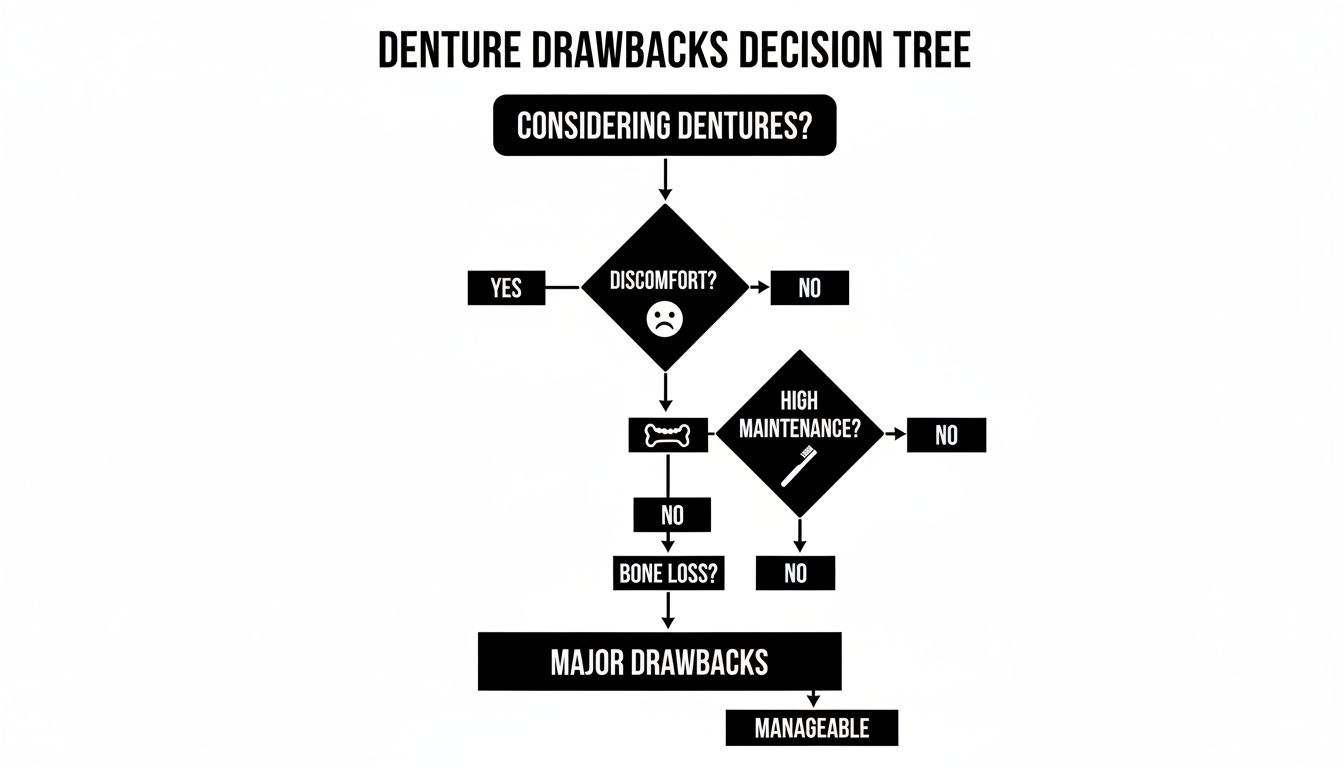
As you can see, factors like potential discomfort and daily maintenance vary depending on the type of denture you choose.
The Rise Of Implant-Supported Dentures
For patients seeking the most secure fit, implant-supported dentures (or overdentures) are a fantastic option. They bridge the gap between traditional dentures and permanent implants. The process involves placing a few dental implants in your jawbone, which act as anchors that the denture snaps onto.
The key benefit is stability. Implant-supported dentures eliminate the slipping and clicking associated with traditional ones, allowing you to eat, speak, and laugh with confidence. The implants also stimulate the jawbone, helping prevent the bone loss that occurs when teeth are missing.
New technology is improving all types of dentures. The market for complete dentures is expected to grow beyond USD 2 billion by 2032, largely due to digital design and manufacturing. Using CAD/CAM and 3D printing, we can create dentures with up to 95% accuracy in just a few days, resulting in a better fit from the start.
This technology directly addresses the main debate around dentures: fit versus stability. By anchoring a denture to implants, you get the affordability of a denture with the security of implants. If this sounds like the right solution for you, consider reading our guide to dental O-ring implants for a secure denture fit.
Choosing Your Denture Solution
This side-by-side comparison can help you think through which option best fits your lifestyle and needs.
Denture Type | Best For | Key Benefit | Consideration |
|---|---|---|---|
Full Dentures | Patients missing all teeth in an entire arch (upper or lower). | A cost-effective and non-invasive way to restore a full smile. | Relies on suction, which can lead to slipping and requires an adjustment period. |
Partial Dentures | Patients with some healthy, natural teeth remaining. | Prevents remaining teeth from shifting while filling in gaps. | The clasps that hold it in place may be visible when you smile or speak. |
Implant-Supported | Anyone seeking superior stability and confidence. | Eliminates slipping and helps preserve jawbone health. | Requires a surgical procedure and is a higher initial investment. |
The goal is to find a solution that not only restores your smile but also functions comfortably for you every day. Each option is a valuable tool; the best one depends on your dental health and personal priorities.
Thinking Beyond Traditional Dentures
While traditional dentures are a fast and affordable option, they aren't your only choice. Many of my patients in Tempe and South Phoenix want to explore alternatives that offer long-term stability and jawbone health. The main alternatives are dental implants and All-on-4 bridges, which provide a more permanent solution but come with different considerations.
Evaluating these alternatives is a crucial part of the dentures pros cons conversation. Your decision will ultimately balance your immediate needs, future goals, and budget. Each choice has its own set of benefits and trade-offs.
Dental Implants: A Permanent Foundation for Your Smile
Dental implants are the gold standard for tooth replacement because they function like natural tooth roots. A small titanium post is surgically placed into the jawbone, where it fuses with the bone through a process called osseointegration. This creates a strong, permanent anchor for a new tooth.
The primary advantages of implants are their stability and natural feel. You can eat, speak, and smile with total confidence. However, this permanence comes with a higher upfront cost and a longer treatment timeline, often taking several months to complete.
All-on-4 Bridges: The Best of Both Worlds
The All-on-4 treatment is an innovative hybrid solution that provides a full arch of new teeth supported by just four strategically placed dental implants. It offers the stability of implants without the cost and time required to replace each tooth individually, making it a quicker and more cost-effective way to achieve a permanent smile.
The most critical difference between dentures and implants is their impact on your jawbone. Implants stimulate the bone, helping to maintain your facial structure. Dentures, however, rest on the gums, allowing the underlying jawbone to slowly shrink over time.
This comparison highlights the key trade-offs. A major pro for dentures is speed; a smile can often be restored the same day. Implants require a 4 to 6-month healing period. For a working professional in Tempe, that immediate result can be a decisive factor.
While denture adhesives can boost retention by 80-90%, about 40% of users find the daily cleanup to be a hassle. For more data, you can review market analyses from firms like Research Nester.
Choosing the right option means weighing stability, cost, and daily maintenance. To get a complete overview of your choices, our guide to the best options for missing teeth provides detailed information to help you prepare for your consultation.
Making An Informed Decision In Tempe
Choosing the right path for your smile is a personal journey. The best solution depends on your health, lifestyle, and what you want to achieve.
You've reviewed the options, from the affordability of traditional dentures to the stability of implant-supported ones. Now, the goal is to find the solution that feels right for you—one that provides the confidence and comfort you deserve.

The most effective next step is a one-on-one conversation. During a consultation, we can listen to your concerns and develop a personalized plan that makes sense for you.
At Beautiful Dentistry, we believe an informed patient is an empowered patient. Our commitment is to provide clear, honest guidance so you can choose your new smile with complete confidence.
We are here for our neighbors in Tempe, South Phoenix, and Chandler. Learn more about your options for dentures in Tempe and schedule a consultation to start your journey.
Give us a call to book your $59 new patient exam with X-rays. Together, we’ll find the ideal solution for your smile.
Your Denture Questions, Answered
Once you understand the pros and cons, practical questions about daily life with dentures often arise. Feeling prepared for the reality of wearing them is crucial.
Here are answers to some of the most common questions our patients in Tempe and South Phoenix ask.
How Long Until My Dentures Feel Normal?
While everyone's experience varies, most people adjust within 30 to 60 days. Initially, expect minor soreness and increased saliva as your mouth gets used to the appliance.
Speaking and chewing will feel awkward at first. With practice, your facial muscles will adapt, and the denture will start to feel like a natural part of your mouth.
Can I Still Eat All My Favorite Foods?
Yes, but you'll need to work up to it. Start with soft foods cut into small bites and chew on both sides of your mouth simultaneously to keep the denture stable.
As you build confidence over a few weeks, you can gradually reintroduce tougher foods. Be mindful of anything excessively hard or sticky that could damage your dentures or dislodge them.
A common concern is, "Will my dentures look fake?" Modern dentures are crafted from high-quality, layered materials that mimic the translucency of natural teeth and gums, ensuring your new smile looks completely authentic.
What’s the Daily Cleaning Routine Like?
Consistent cleaning is essential for your oral health and the longevity of your dentures. Follow this simple routine:
Rinse After Meals: Remove and rinse your dentures to wash away food particles.
Brush Daily: Use a soft-bristled denture brush and a non-abrasive denture cleaner. Regular toothpaste is too harsh and can cause scratches.
Soak Overnight: Soaking your dentures in a special solution cleans, disinfects, and helps them maintain their shape.
Clean Your Gums: Gently brush your gums, tongue, and the roof of your mouth before reinserting your dentures to remove plaque and promote circulation.
At Beautiful Dentistry, we’re here to guide you through every step, from the initial conversation to ensuring a perfect final fit. If you're ready to explore the possibilities for your smile, we're ready to help.


Comments