

Can You Repair Cavities? Your Actionable Guide to Dental Treatment
- Caterina Rutter
- Dec 9, 2025
- 12 min read
Yes, you can repair cavities, but your treatment options depend entirely on how far the decay has progressed. Think of it like a small chip in a car windshield. Your first action should be to catch it early for a simple fix. Let it go, and you're looking at a full replacement. Tooth decay works the same way.
The Definitive Answer on Repairing Cavities
When you ask if a cavity can be repaired, you're likely picturing the hole itself. But to take effective action, you must understand that tooth decay is a process, not a single event. It starts on a microscopic level and worsens over time. This progression is what dictates your best course of action.
Action Step 1: Reverse Early Damage at Home
The earliest sign of trouble is demineralization. This is when acids from plaque bacteria start weakening your tooth enamel. The key takeaway here is that a physical hole has not yet formed. At this stage, you have the power to reverse the damage. Your action plan should include:
Improving your brushing and flossing technique.
Using a fluoride toothpaste and mouthwash.
Making immediate changes to a high-sugar diet.
With these steps, your enamel can remineralize and heal itself. However, once that weakened enamel gives way and a physical hole breaks through the surface, the game changes.
Here is your most critical takeaway: Once a true cavity forms, your body cannot regrow the lost tooth structure. From this point on, your only effective action is to see a dentist. Professional care is the only way to stop the decay and repair the tooth.
This flowchart shows why early action is so crucial.
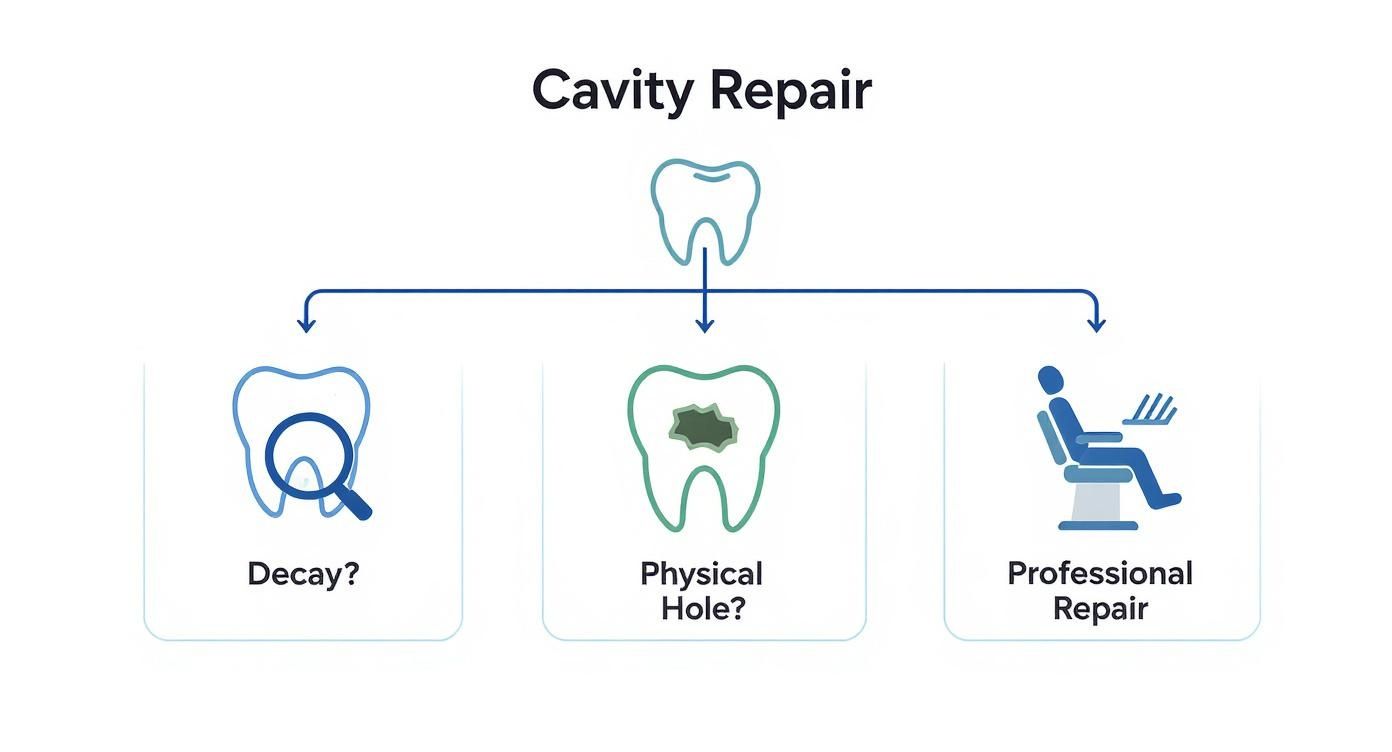
The presence of a physical hole is the point of no return for home remedies. Ignoring it gives bacteria a direct path deeper into your tooth, leading to more complex and expensive treatments. Your best strategy is to act early for a simple, lasting fix.
To help you understand what to expect, here's a quick guide to the different stages of decay and the professional actions required for each.
Cavity Stages and Required Actions
This table breaks down the progression of tooth decay and the necessary repair, so you can anticipate the treatment you might need.
Cavity Stage | What It Means For You | Your Next Action |
|---|---|---|
Stage 1: Enamel Demineralization | White spots appear; enamel is weakened but intact. | Use fluoride, improve hygiene, and cut back on sugar. |
Stage 2: Enamel Decay | The decay has broken through the enamel, forming a hole. | Schedule a dental filling appointment. |
Stage 3: Dentin Decay | The decay reaches the softer layer beneath enamel (dentin). | See a dentist immediately for a filling, inlay, or onlay. |
Stage 4: Pulp Involvement | Decay has reached the tooth's inner pulp (nerve). | This is a dental emergency. You will likely need a root canal. |
Stage 5: Abscess Formation | The infection spreads past the tooth root, causing swelling. | Seek immediate dental care for a root canal or extraction. |
Stage 6: Tooth Loss | The tooth is too damaged to save. | Discuss tooth replacement options (like an implant) with your dentist. |
Understanding these stages empowers you to act quickly. A problem that starts with a simple home-care solution can escalate if you delay, making regular check-ups your most powerful defensive tool.
How Dentists Find and Diagnose Tooth Decay

Before we can repair a cavity, we have to find it. Catching tooth decay early is the entire goal, and this requires a combination of a hands-on examination and modern technology. Think of it as detective work for your teeth.
The process often starts with a dental explorer. This small, pointed tool allows us to feel the surfaces of your teeth for subtle changes—any soft, sticky, or rough spots that signal weakened enamel. It’s a classic, effective way to spot decay on chewing surfaces where food gets trapped.
Looking Beneath the Surface with Technology
Of course, many cavities hide where the eye can't see, like between teeth or just below the gumline. This is where you can rely on our technology to find problems before they escalate.
Digital X-rays are essential for a complete diagnosis. They reveal decay inside and between your teeth long before it would be visible. The actionable benefit for you is that modern digital X-rays use up to 80% less radiation than old film-based methods and provide instant images, making your check-up faster and safer.
Your takeaway: A regular dental check-up isn't just a cleaning; it's a proactive search for early trouble. By using tools from a simple explorer to detailed X-rays, your dentist can identify weak spots, allowing you to get them fixed before they become major problems.
By combining a visual exam, a tactile check, and X-ray images, we build a complete picture of your oral health. This comprehensive approach is critical for deciding the most effective and least invasive action to take.
Staging the Decay for Effective Treatment
Once we confirm decay, the next step is to determine its severity. We "stage" cavities to create the right treatment plan. A tiny weak spot on the enamel requires a completely different approach than decay that has reached the tooth's core.
Here's what each stage means for you and your treatment:
Stage 1 Demineralization: This is a pre-cavity. You might see a small, chalky white spot. Your Action: Implement a rigorous home-care routine with fluoride. We can often reverse this without a filling.
Stage 2 Enamel Decay: A small hole has formed. Your Action: This is the point of no return for home care. A dental filling is the necessary next step.
Stage 3 Dentin Decay: The decay has reached the softer layer beneath the enamel and will now progress much faster. You'll likely feel sensitivity. Your Action: Schedule an appointment immediately to prevent it from reaching the nerve.
Stage 4 Pulp Involvement: The decay has hit the nerve center of the tooth, causing a toothache. Your Action: This requires a root canal to save the tooth from being lost.
Understanding these stages helps you see why your dentist recommends a specific treatment, empowering you to ask informed questions and feel confident in your care plan.
Your Guide to Common Cavity Repair Treatments
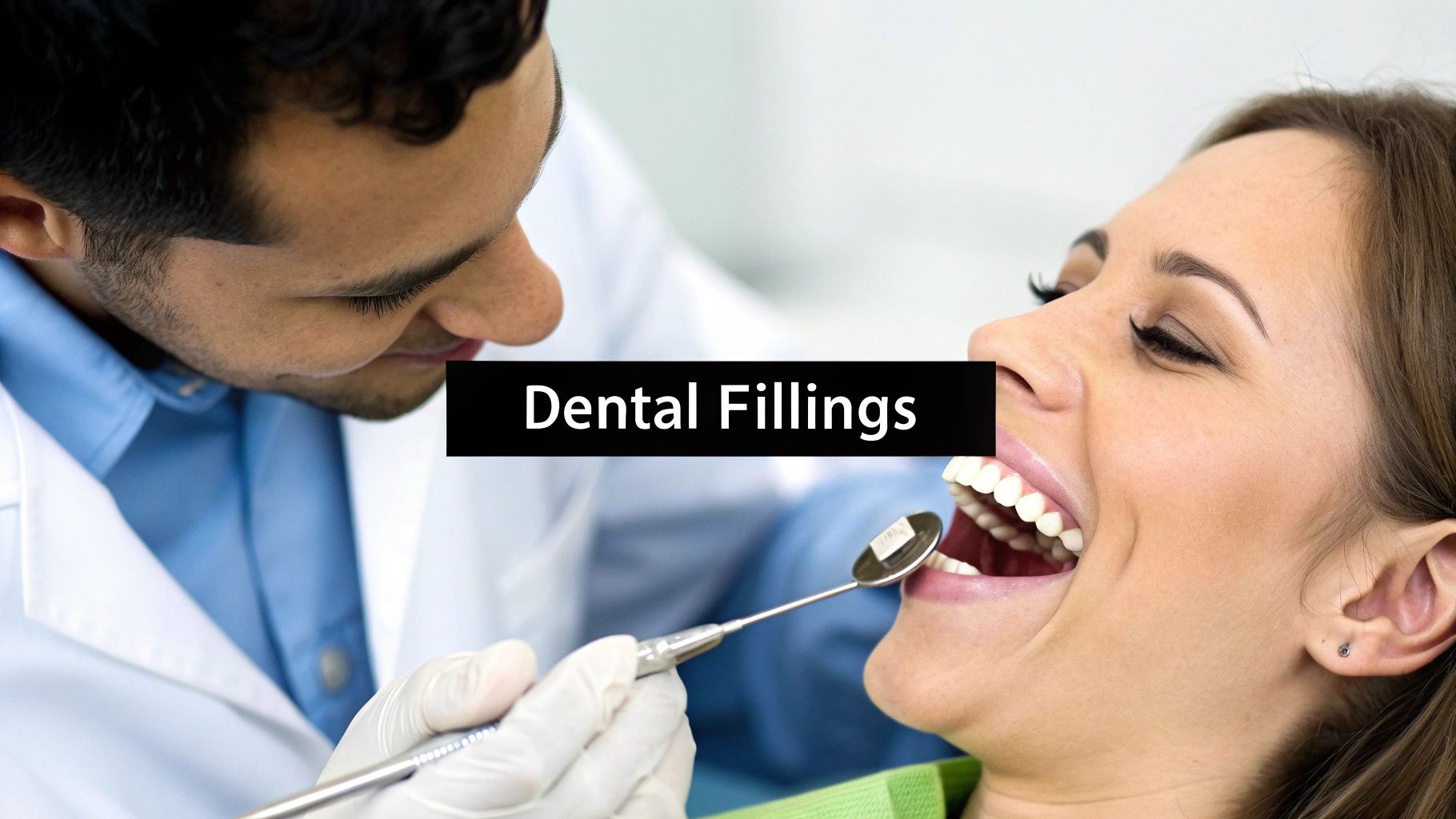
When decay creates a hole in your tooth, a dental filling is the most common and effective solution. The goal is to clear out the decay and rebuild the tooth to restore its strength and shape, stopping the damage from spreading.
The entire process is designed for your comfort. We start by numbing the area with a local anesthetic. Then, we gently remove the decayed tooth structure, clean the space, and place the filling material. We then shape and polish it for a perfect fit. The entire appointment usually takes less than an hour, making it a simple and effective way to restore your tooth's health.
Actionable Insight: Choosing the Right Filling
You have choices when it comes to filling materials. We will always discuss the best option for your specific situation, based on the cavity's location, its size, and your cosmetic preferences. Here are the pros and cons to help you decide:
Composite Resins (Tooth-Colored): Choose these for visibility. We can match the shade to your natural teeth, making them nearly invisible. They also bond directly to the tooth, often allowing us to preserve more healthy tooth structure. They are the ideal choice for front teeth or any that show when you smile.
Amalgam Fillings (Silver): Choose these for durability. Made from a mix of metals, they are incredibly strong and long-lasting. While more noticeable, their strength makes them a reliable choice for molars in the back of your mouth that handle heavy chewing forces.
When patients ask, "can you repair cavities," the answer is a firm yes—and fillings are incredibly successful. Worldwide studies show that annual failure rates are low, typically 1.7% to 12.9%, depending on the material and technique. A well-placed composite filling can have a failure rate as low as 1.7% per year.
The actionable takeaway: When your dentist recommends a material, it’s a strategic choice. We balance the need for strength on a back molar with the desire for a seamless look on a front tooth. Ask questions so you can make an informed decision with us.
What to Expect During Your Appointment
Knowing the procedure steps can reduce anxiety. A filling is a routine process that follows a predictable path.
Here is your step-by-step guide:
Numbing the Area: We use a local anesthetic to ensure the tooth and surrounding tissue are completely numb. Your comfort is our top priority.
Removing the Decay: Using precise instruments, we carefully clean out all the decayed material.
Placing the Filling: We place the chosen material—composite or amalgam—into the prepared space.
Shaping and Polishing: We sculpt the filling to mimic the natural anatomy of your tooth and polish it so your bite feels normal and comfortable.
Sometimes, a cavity is too big for a standard filling but not severe enough for a full crown. For these cases, there are other solutions. You can get more actionable information in our guide explaining what inlays and onlays are and how they provide a durable, custom-fit repair.
Advanced Repairs for Deep or Extensive Cavities
When a cavity becomes too large for a standard filling, you still have excellent options to save your tooth. We simply need to use more robust repairs designed to handle significant damage. Our goal remains the same: restore the tooth’s function and preserve as much of your natural tooth as possible.
A filling is like a patch. It's perfect for a minor issue. But when a large part of the tooth is gone, you need a stronger solution to handle daily chewing forces and prevent the tooth from cracking.
Inlays and Onlays: The Custom-Fit Solution
When a cavity is too large for a filling but doesn't yet need a full crown, inlays and onlays are your best option. These are custom-made pieces, typically crafted from durable porcelain, that fit into your tooth like a puzzle piece.
Here’s how to know which you might need: an inlay fits within the cusps (the raised points on a molar's chewing surface), while an onlay is larger and covers one or more of those cusps. They are an excellent choice for large cavities on back teeth because they provide superior strength and longevity compared to a large filling.
Dental Crowns: Ultimate Protection for Your Tooth
If a tooth is severely weakened by a large cavity, a crack, or has had a root canal, a dental crown is the most effective solution. A crown is a protective cap that covers the entire visible part of the tooth down to the gumline.
This full-coverage approach restores the tooth's original shape and strength. It also seals it off from bacteria, providing a powerful, long-lasting fix. When you're dealing with major structural damage, a crown is the go-to restoration.
Actionable Tip: Don't let fear of a root canal stop you from saving your tooth. The procedure is designed to relieve the severe pain of an infected nerve. With modern anesthetics, the process is typically comfortable and no more intense than getting a filling.
Root Canals: Saving a Tooth from the Inside
If decay reaches the center of the tooth—the pulp, which contains the nerve—you're likely facing a serious infection and significant pain. At this point, a root canal is the only procedure that can save the tooth from being extracted.
During a root canal, we remove the infected pulp, then clean, disinfect, and seal the inside of the tooth. It's an incredibly effective, tooth-saving treatment with high success rates, with tooth-level survival ranging from 83% to 92% over an average of 7.5 years.
When Extraction is the Only Option
In the most severe cases, decay may have destroyed too much of the tooth for any restoration to be successful. When that happens, tooth extraction is the last resort. Removing the tooth is a necessary action to prevent the infection from spreading into your jawbone. After extraction, we can discuss replacement options like dental implants or bridges to restore your smile.
Many of these advanced treatments can be made more comfortable with new technology. Our guide on laser dentistry to fix cavities explains how these tools are making dental work more precise and comfortable.
What to Expect: The Cost and Timeline for Cavity Treatments
Let's address the two most common questions: "How much will this cost?" and "How long will it take?" Understanding the investment of time and money is key to feeling in control of your dental care.
The straightforward answer is: it depends on how advanced the decay is. A small, simple fix will always be faster and more affordable than a complex one.
For example, a standard dental filling is usually a single visit that takes less than an hour. In contrast, a dental crown typically requires two appointments: the first to prepare the tooth and take an impression, and the second a couple of weeks later to bond the custom-made crown into place.
Factors That Determine Your Final Cost
The cost of fixing a cavity is influenced by a few key factors. Here’s what you need to know to anticipate your expenses:
The Treatment Required: A composite filling has a different cost than a porcelain crown or a root canal. Each requires different materials, time, and expertise.
Your Dental Insurance: Most dental plans cover a significant portion of restorative work. Action Step: Call your insurance provider or ask our office to run a pre-authorization to understand your specific out-of-pocket costs before treatment.
Geographic Location: The cost of living in different areas can affect dental fees.
Materials Used: A high-end porcelain crown might have a higher initial cost but offers superior aesthetics and durability, making it a better long-term investment.
The most effective action you can take to control dental costs is to catch problems early. A small filling today is a minor investment that prevents a much more expensive—and time-consuming—root canal and crown down the road.
This is why regular check-ups are so important. They allow you to find decay when it’s small, simple, and inexpensive to fix, protecting both your smile and your wallet.
Prevention: The Best Approach to Cavity Repair
While we have excellent tools to fix cavities, the best "repair" is preventing one from ever forming. It is the simplest and most cost-effective strategy. A little prevention saves you time, money, and discomfort.

This requires building a solid oral hygiene routine that becomes second nature.
Your Action Plan for Cavity Prevention
Think of your daily routine as building a fortress around your teeth. Each step reinforces your defenses against decay-causing bacteria.
Proper Brushing: Use a soft-bristled brush and fluoride toothpaste. Angle the brush at 45 degrees toward your gumline and use gentle, circular motions for two full minutes, twice a day.
Effective Flossing: Floss daily. It's the only way to clean the 40% of your tooth surfaces your brush cannot reach. Curve the floss into a "C" shape around each tooth and slide it gently beneath the gumline.
The Power of Fluoride: This mineral is your enamel's best defense. Use fluoride toothpaste and consider a fluoride mouthwash to strengthen teeth and reverse the earliest signs of decay.
Your most important preventative action: Schedule regular dental check-ups. We can spot issues when they are tiny and simple to fix—long before you would ever notice a problem yourself.
The Impact of Diet and Professional Care
What you eat is a major factor. Since sugar is the primary fuel for cavity-causing bacteria, exploring practical ways to reduce sugar intake is a game-changer. Cutting back on sugary drinks and snacks starves these harmful bacteria.
Ultimately, nothing replaces professional care. For more tips, check out our guide on how to prevent tooth decay naturally. Combining diligent at-home care with regular professional cleanings and exams is your ultimate strategy for a cavity-free smile.
Got Questions About Cavity Repair? We've Got Answers.
It's completely normal to have questions when facing a dental procedure. Here are clear, actionable answers to the most common concerns.
Can I Fix a Cavity at Home by Myself?
No. Once decay has created a physical hole, you cannot make that tooth structure grow back. Home remedies cannot fill a cavity.
You can reverse the very earliest stage of decay—demineralization—with diligent home care and fluoride. But once a cavity forms, you need a dentist to clean out the decay and repair the tooth. Attempting to fix it yourself will only allow the decay to worsen, leading to more serious problems like infection or tooth loss.
Your key action: Don't self-diagnose. Only a dentist can determine the true extent of the problem. What looks like a small spot could be hiding deeper decay, and a professional exam is the only way to ensure you get the right treatment.
Is Getting a Cavity Filled Painful?
Your comfort is our top priority. Before we begin, we use a local anesthetic to completely numb the tooth and surrounding tissue.
You might feel some pressure or vibration from the instruments, but you should not feel any pain. Action Step: If you feel anxious about dental visits, tell us beforehand. We have sedation options available to help you relax and ensure a calm, pain-free experience.
How Long Will My Filling or Crown Last?
The longevity of your dental work depends on the material used, the tooth's location, and your home-care routine.
Here’s a practical timeline you can expect:
Composite (White) Fillings: Typically last 5 to 10 years.
Amalgam (Silver) Fillings: Can last for 15 years or more due to their durability.
Crowns: A long-term solution that often lasts well over 15 years with proper care.
To maximize the lifespan of your dental work, maintain good oral hygiene and schedule regular check-ups. This allows us to monitor your restorations and address any potential issues early.
At Beautiful Dentistry, we want you to feel confident and informed about your dental health. If you have more questions or you’re ready to get that tooth looked at, our team is here to give you honest answers and the gentle care you deserve. Head over to https://zdentist.com to book your appointment today.