

What Can Invisalign Fix? A Practical Guide to Your Straighter Smile
- Caterina Rutter
- Dec 24, 2025
- 10 min read

You know about Invisalign, but what dental issues can it actually fix? The short answer: a wide range of common problems. Invisalign is a powerful orthodontic system designed to correct many mild to moderate alignment issues, from crowded teeth and gaps to complex bite problems. It's a proven method for achieving a healthier, straighter smile without the look and feel of traditional metal braces. This guide provides the actionable insights you need to determine if it's the right solution for you.
What Common Dental Problems Can Invisalign Correct?
Think of your Invisalign aligners as a pre-programmed roadmap for your teeth. Each custom-molded tray applies gentle, consistent pressure to specific teeth, guiding them into their ideal positions. The process is mapped out from the start using advanced 3D imaging, allowing you to see a simulation of your final result before you even begin. This digital blueprint ensures every aligner contributes to a predictable and successful outcome.
From Crowding to Gaps
The most frequent alignment issues are related to spacing—either too much or not enough. Invisalign is exceptionally effective at resolving these concerns.
Action for Crowded Teeth: If you have teeth that overlap or twist because there isn't enough room in your jaw, Invisalign works by methodically creating space and guiding each tooth into its proper position. This is a practical alternative to more invasive procedures.
Action for Gaps in Teeth (Diastema): If you have noticeable gaps from genetics or a missing tooth, Invisalign aligners are engineered to gently close these spaces, creating a more uniform and complete smile.
Misaligned teeth (malocclusion) are very common, with some studies suggesting it affects around 56% of people globally. For cases involving 5–7 mm of crowding or spacing, Invisalign is often the most practical and efficient solution.
Correcting Common Bite Issues
A healthy, functional bite is as crucial as straight teeth. An improper bite can lead to chewing difficulties, jaw pain, and premature tooth wear. Invisalign isn't just cosmetic; it's a tool for improving your mouth's long-term health and function.
Invisalign gives us a modern way to approach orthodontics. It leverages sophisticated technology to solve many of the same problems as traditional braces, but with far more comfort and discretion for our patients. It's a game-changer for both cosmetic and functional improvements.
This table breaks down the common issues Invisalign can fix, giving you a clear picture of its capabilities. If you're weighing your options, you can learn more about all the orthodontics in Tempe we offer to find the perfect fit for your smile goals.
Common Dental Issues Invisalign Can Fix
Orthodontic Issue | What It Is | How Invisalign Fixes It |
|---|---|---|
Crowded Teeth | Lack of space causing teeth to overlap or twist. | The aligners gradually expand the arch and move teeth to create the necessary space for proper alignment. |
Gapped Teeth | Unwanted spaces between two or more teeth. | Invisalign trays gently and consistently push the teeth together to close the gaps for a seamless smile. |
Overbite | The upper front teeth significantly overlap the lower front teeth. | Aligners can be combined with attachments or elastics to shift the jaw and teeth into the correct position. |
Underbite | The lower front teeth protrude past the upper front teeth. | For mild to moderate cases, Invisalign can move the lower teeth back and the upper teeth forward to correct the bite. |
Crossbite | Some upper teeth sit inside the lower teeth when the mouth is closed. | The aligners apply targeted pressure to move the misaligned teeth into their correct outward or inward positions. |
As you can see, Invisalign’s capabilities go far beyond simple straightening, making it a versatile and effective choice for many patients.
How Invisalign Tackles More Complex Cases
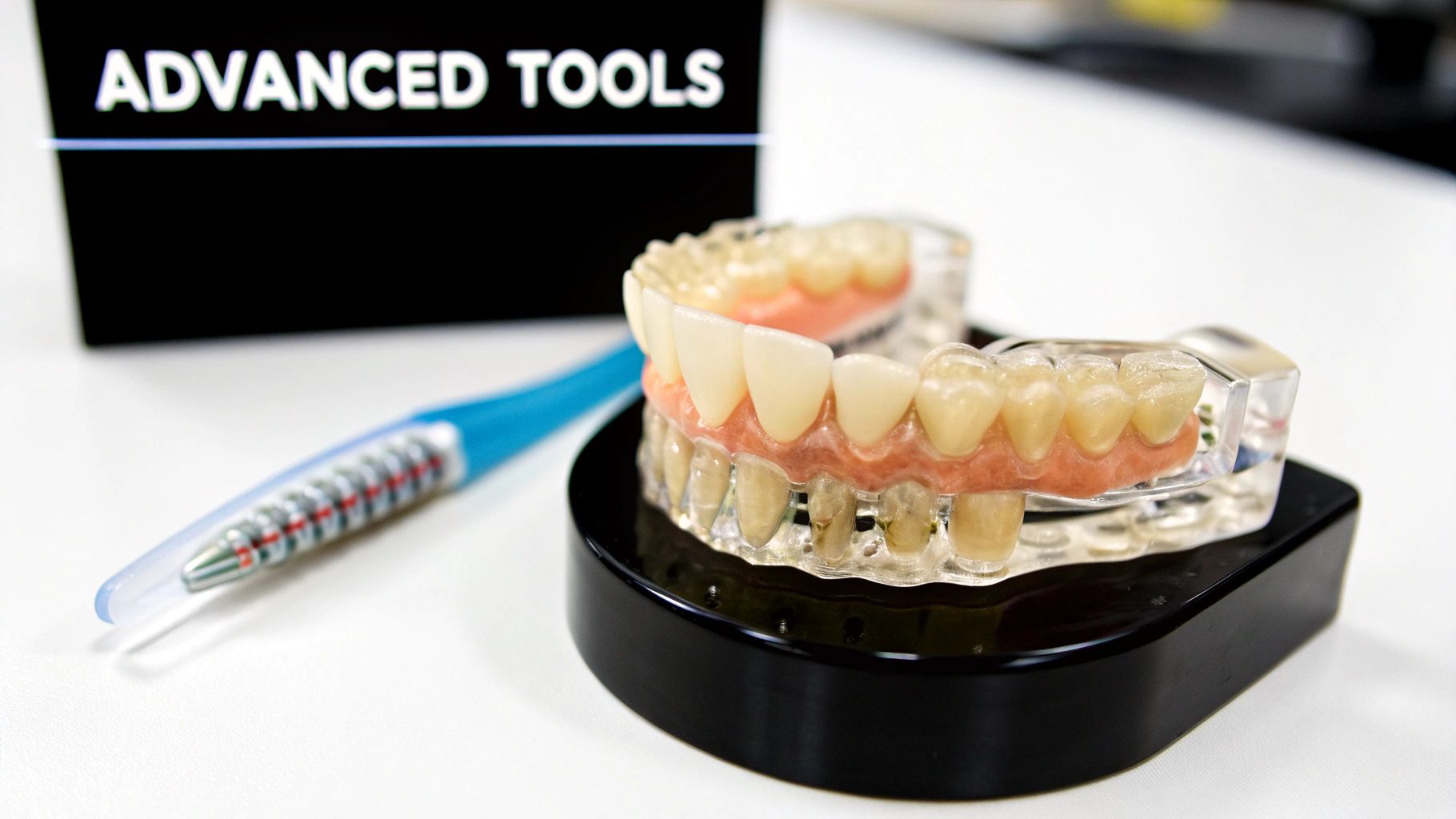
While Invisalign is known for fixing minor issues, its ability to handle more significant orthodontic problems is what makes it a truly powerful tool. This is achieved using specialized accessories that give the aligners extra leverage and precision, turning a standard treatment into a highly customized solution.
Attachments: The Keys to Complex Movements
Attachments are tiny, tooth-colored dots of dental composite bonded to specific teeth. They act as handles, giving the aligners the necessary grip to perform more complex movements. You'll barely notice them, but they are critical for achieving advanced results.
This extra grip enables the aligner to execute maneuvers like:
Rotation: Turning a twisted tooth into proper alignment.
Extrusion: Gently pulling a tooth down to match the height of neighboring teeth.
Intrusion: Carefully pushing a tooth up into the jawbone to create an even smile line.
Elastics: Guiding Your Bite into Place
For bite problems like an overbite or underbite, correcting the jaw's alignment is as important as straightening the teeth. We use elastics—small, specialized rubber bands—that connect the upper and lower aligners.
These elastics apply a gentle, continuous force that guides your jaws into the correct position. This means your treatment is working on two fronts simultaneously: straightening your teeth and correcting your bite for a stable, healthy, and beautiful final result.
These assistive tools are what really expand what Invisalign can do. They let us apply very specific, targeted forces to individual teeth and even the jaw, which is how we get such predictable and impressive results in more complex situations.
IPR: Creating Space for a Perfect Fit
In crowded smiles, the core issue is often a lack of space. Instead of extracting teeth, we can use a technique called Interproximal Reduction (IPR).
During IPR, your dentist carefully removes a minuscule amount of enamel from the sides of certain teeth—fractions of a millimeter. This painless procedure feels like a quick polishing and creates just enough room for your teeth to move into their ideal positions. To understand how small adjustments can make a big impact, you can learn more about enamel shaping and recontouring in Tempe.
Are You a Good Candidate for Invisalign?
Determining if Invisalign is the right choice for you involves a practical evaluation of three key factors: the complexity of your dental issues, your ability to commit to the treatment plan, and your age. Understanding these elements will help you set realistic expectations and ensure the treatment aligns with your lifestyle and goals.
Evaluate the Severity of Your Case
First, your dentist will assess your specific alignment problems. Invisalign is highly effective for a wide range of mild to moderate cases, including most instances of crowding, spacing, overbites, and underbites.
However, certain severe conditions may require a different approach. Significant jaw discrepancies, severely rotated teeth, or large vertical gaps between your upper and lower teeth might be better suited for traditional braces or a hybrid treatment. An expert consultation is the only way to know for sure.
The Critical Role of Patient Commitment
Invisalign's main advantage—its removability—is also your biggest responsibility. To ensure your treatment progresses on schedule, you must wear your aligners for 20-22 hours every day. They should only be removed for eating, drinking anything other than water, and oral hygiene.
Your personal commitment is the engine that drives your Invisalign treatment. Consistent wear is non-negotiable for achieving the beautiful, predictable results outlined in your treatment plan.
If you cannot commit to this level of wear, your treatment will take longer, and the final results may be compromised. An ideal candidate is someone ready to make wearing their aligners a daily priority.
Age Is Just a Number
The idea that orthodontic treatment is only for teenagers is outdated. More adults are choosing Invisalign than ever before. As long as your teeth and gums are healthy, you are never too old to start.
Conversely, Invisalign is also an excellent option for teens. Align Technology reported 225.8 thousand teen cases in a single quarter, a 13.3% increase year-over-year. This growth is driven by features in Invisalign Teen designed for younger patients. You can dive deeper into this trend by reading the latest industry reports.
Your Invisalign Treatment Journey From Start to Finish
Knowing what Invisalign can fix is the first step. Understanding the process will empower you to move forward with confidence. Here is a practical, step-by-step breakdown of the journey to your new smile.
Step 1: Your Initial Consultation and Digital Scan
Your journey begins with a comprehensive consultation at our Tempe office. We use an advanced iTero 3D intraoral scanner to create a precise digital model of your mouth—no messy impressions required.
This digital scan is the foundation of your treatment. It allows us to analyze your smile from every angle and, most importantly, show you a simulation of your final results before you commit. This gives you a clear, tangible goal to look forward to from day one.
Step 2: Designing Your Custom Smile
Using your 3D model, your dentist designs a personalized treatment plan. This digital roadmap plots the exact movement of each tooth from its current position to its final destination. Every stage is calculated for gradual, comfortable, and efficient progress.
Based on this plan, your series of custom, BPA-free plastic aligners is fabricated. Each aligner is slightly different, engineered to apply the right amount of pressure. You will switch to a new set every one to two weeks as directed.
This flowchart breaks down the key factors we consider to see if you're a good fit for the journey.
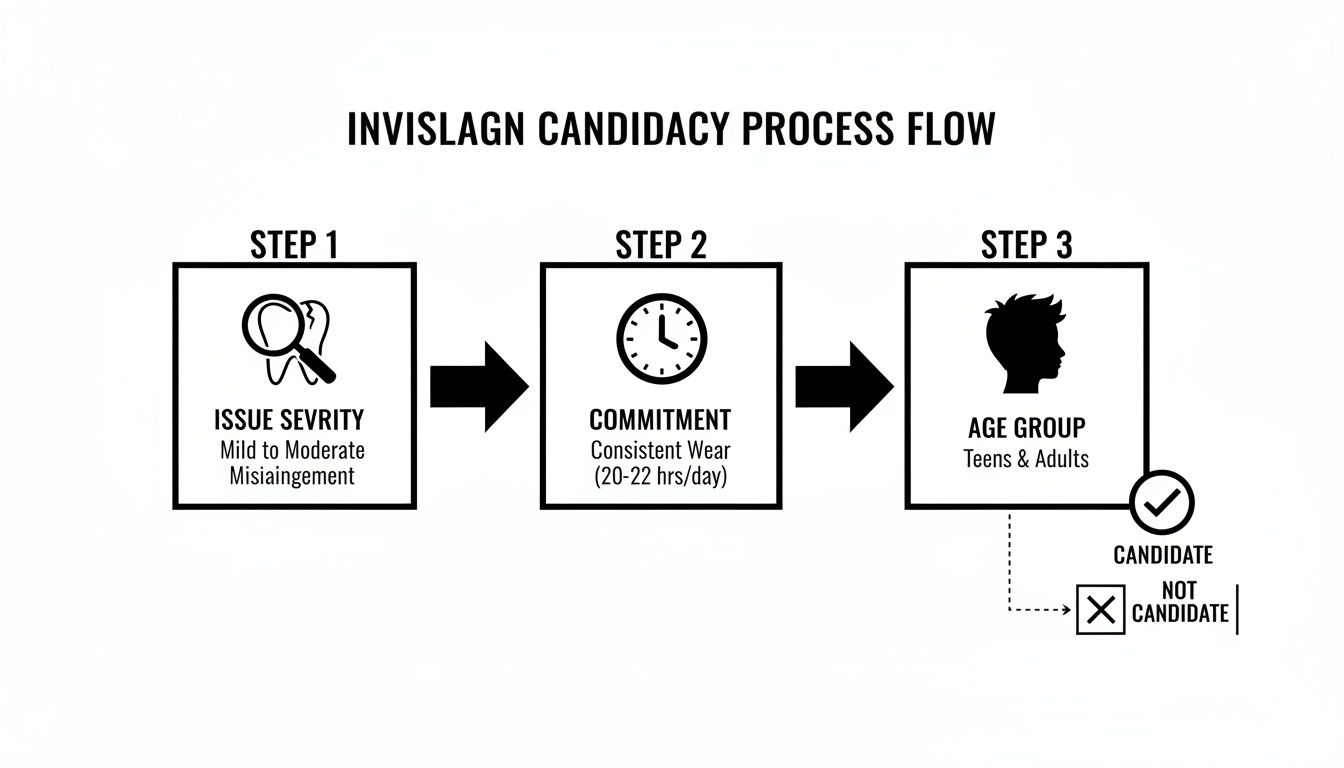
As you can see, successful treatment is a mix of your specific dental needs, your commitment to wearing the aligners, and your overall health.
Step 3: Living With Your Aligners
This is the active phase where your commitment is crucial. To achieve results, you must wear your aligners for 20–22 hours per day, only removing them to eat, drink, brush, and floss.
Actionable Tip: To keep your aligners clean, simply brush them gently with a soft toothbrush and rinse with lukewarm water. No complex cleaning routine is needed.
You will visit our office for a quick check-in every six to eight weeks. During these appointments, we will monitor your progress, answer questions, and provide your next sets of aligners.
Your Invisalign journey is a true partnership. We bring the clinical expertise and the technology, but your daily commitment is what powers the entire process and gets you to that amazing result on schedule.
Step 4: The Final and Most Important Phase—Retention
Once you complete your final set of aligners, your teeth will be straight. However, the treatment isn't over. The most critical phase is retention.
Teeth have a natural tendency to shift back to their original positions (orthodontic relapse). To protect your investment and maintain your new smile, you will need to wear a retainer. We provide custom Vivera® retainers, which look and feel similar to your aligners.
Your action plan for retention: Initially, you will wear your retainer full-time. Soon, you will likely transition to wearing it only at night—a simple, lifelong habit to ensure your smile stays perfect.
Invisalign vs. Traditional Braces: An Honest Comparison
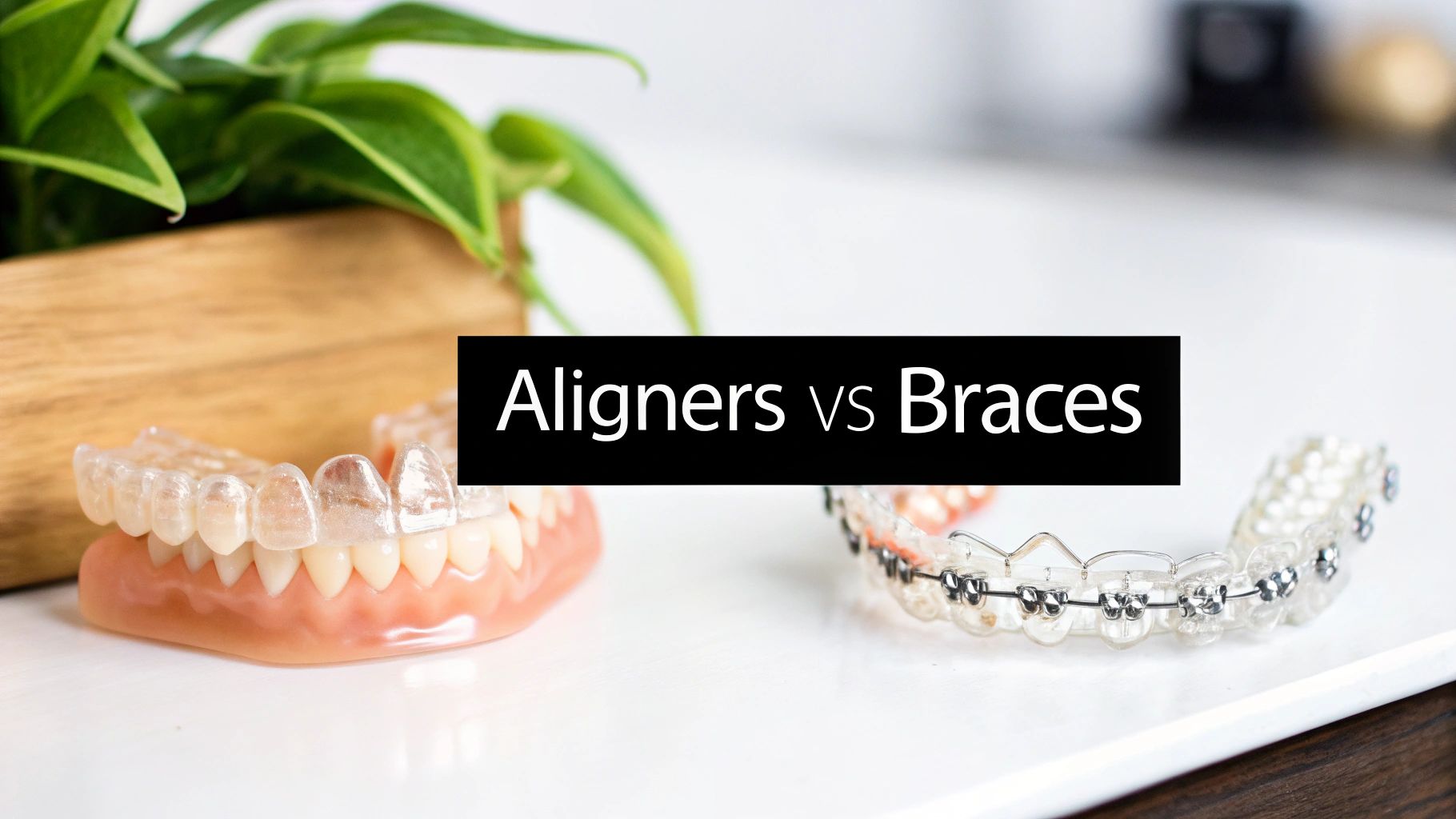
Both Invisalign and traditional braces are excellent tools for achieving a straighter smile. The decision isn't about which is "better," but which is the best fit for your specific needs, lifestyle, and priorities. This practical comparison will help you determine which treatment path aligns with your personal goals.
The ultimate goal is always the same: achieving a healthy, stable bite and a smile you can't wait to show off. Both Invisalign and braces are proven to be highly effective; they just work differently and fit into your daily life in unique ways.
Use this table to directly compare the key features that matter most to patients.
Feature Comparison: Invisalign vs. Traditional Braces
Factor | Invisalign | Traditional Braces |
|---|---|---|
Aesthetics | Virtually invisible clear plastic aligners. | Visible metal or ceramic brackets and wires. |
Comfort | Smooth plastic trays with no sharp edges. | Brackets and wires can cause some irritation to cheeks and lips. |
Maintenance | Removable for easy brushing and flossing. | Requires special tools like floss threaders to clean around brackets. |
Diet | No food restrictions since aligners are removed for meals. | Avoid hard, sticky, or chewy foods to prevent damage to brackets. |
Treatment Time | Typically 6 to 18 months for most cases. | Can range from 18 to 36 months, depending on case complexity. |
As you can see, each option has its own clear set of pros and cons.
Living With Your Choice
The most significant difference lies in daily life. With Invisalign, the freedom to remove your aligners means you can eat what you want and maintain your normal oral hygiene routine. The trade-off is the required discipline: you must wear them 20-22 hours a day for the treatment to be effective.
Traditional braces offer a "set it and forget it" approach. They work 24/7, which is a major advantage if you worry about misplacing or forgetting to wear your aligners. The trade-off is the need for more meticulous cleaning and some dietary restrictions.
Ultimately, both are effective orthodontic solutions. For some patients focused purely on cosmetic enhancements rather than significant bite correction, exploring options like dental veneers in Tempe can also be a valuable part of the discussion.
Your Invisalign Questions, Answered
It's natural to have questions before starting treatment. Getting clear, practical answers will help you feel confident and prepared. Here are the most common questions we hear from patients in our office.
How Long Does Invisalign Treatment Usually Take?
There is no single answer, as every smile is unique. However, most Invisalign treatments are completed in 6 to 18 months. Minor adjustments may take only a few months, while more complex cases will take longer.
Actionable Insight: Your adherence to the plan is the biggest factor influencing your timeline. Wearing your aligners for the prescribed 20-22 hours a day is the most effective way to ensure you finish on schedule.
Is Invisalign Treatment Painful?
Most patients describe the sensation as "pressure," not pain. When you switch to a new set of aligners, you will feel a snug fit for the first day or two. This is a positive sign that the aligners are actively moving your teeth. This mild, temporary pressure is significantly more comfortable than the irritation that can be caused by the metal brackets and wires of traditional braces.
"Pressure" is the word we hear most often. It's a noticeable but totally manageable feeling with each new tray, and it's the clearest sign that you're one step closer to your final result.
Can Invisalign Fix Teeth That Shifted After Braces?
Yes, this is a very common and effective use for Invisalign. Teeth can naturally drift years after previous orthodontic work, a condition known as orthodontic relapse. Invisalign is an excellent solution for correcting this minor shifting. These "touch-up" treatments are often much faster than your original orthodontic work, providing a discreet and efficient way to restore your perfectly straight smile.
What Happens After My Invisalign Treatment Is Complete?
After achieving your new smile, the next step is to maintain it. This retention phase is crucial. You will be fitted for a custom retainer to prevent your teeth from shifting back.
Your Long-Term Action Plan: You will start by wearing your retainer full-time, then transition to wearing it only at night. Consistent retainer use is a simple, lifelong habit that guarantees your smile remains straight and beautiful for years to come.
Ready to see what Invisalign can do for you? The team at Beautiful Dentistry is here to map out a personalized plan to bring your ideal smile to life. Your journey starts with a simple consultation at our Tempe office. Learn more and book your appointment today!


Comments