

Invisalign vs Traditional braces Cost: A Guide to Smart Financial Decisions

When weighing orthodontic options, your first question is likely: "What's the real cost?" Here's the actionable truth: the price for Invisalign and traditional braces is now remarkably close. Your decision should be guided less by a major price gap and more by which treatment best fits your lifestyle and specific dental needs.
While braces might have a slightly lower starting price, the total investment for both treatments often ends up being much closer than you'd expect. To make a smart financial decision, you need to understand the full picture.
The True Cost of a Perfect Smile: What to Expect
To plan effectively, you must move past the common misconception that clear aligners carry a hefty premium. The gap between Invisalign and traditional braces has shrunk dramatically. A smart choice involves looking beyond the initial quote to understand the total financial commitment.
National Averages and Price Ranges
Forget outdated information. Invisalign is no longer thousands of dollars more expensive than metal braces. Recent data reveals that the average cost difference is surprisingly slim. Invisalign costs just $252 more on average ($6,373) compared to braces ($6,121).
This narrow gap is reflected in the national price ranges, which have significant overlap.
Actionable Tip: If you're quoted a price for Invisalign that's thousands higher than braces, ask for a detailed breakdown. For straightforward cases, the difference can be as little as $500, debunking the myth that clear aligners are out of reach. For more data, explore these orthodontic cost breakdowns.
This chart provides a quick visual of how close the national average costs really are.
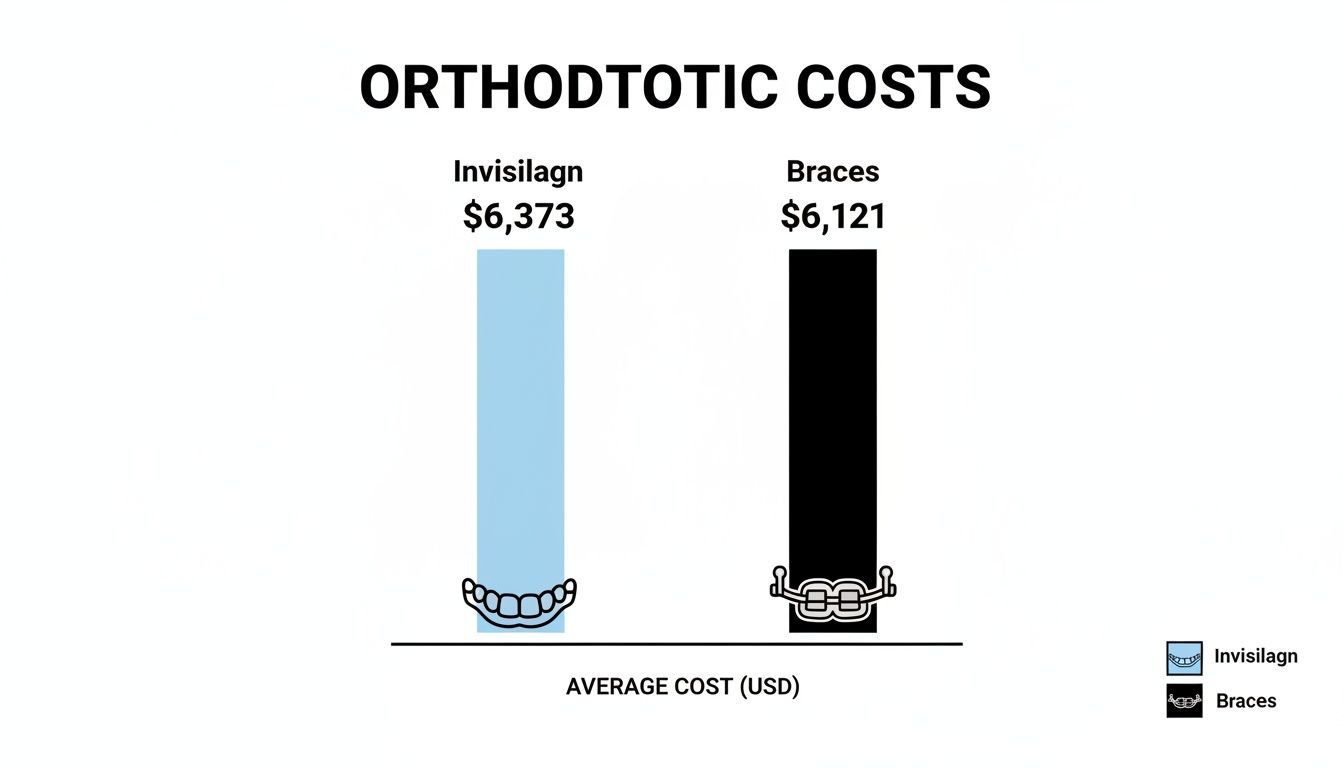
As you can see, the averages are nearly neck-and-neck. This proves that your final price tag is determined more by your individual treatment plan than by the type of appliance you choose.
At-a-Glance Invisalign vs Braces Financial Comparison
Use this table as a starting point to compare the key financial and treatment factors for both options.
Your best financial choice isn't about the lowest upfront price. Real value comes from selecting the treatment that aligns with your life, clinical needs, and long-term smile goals. This strategic approach helps you avoid unexpected costs from non-compliance or complications.
Feature | Traditional Braces | Invisalign |
|---|---|---|
Average National Cost | $3,000 - $7,000 | $3,500 - $8,000 |
Best For | Complex bite/alignment issues; patients who prefer a "set it and forget it" appliance | Mild to moderate cases; adults and teens who want a discreet, removable option |
Average Treatment Time | 18 - 36 months | 12 - 18 months |
Office Visits | More frequent (every 4-8 weeks for adjustments) | Less frequent (every 6-12 weeks for check-ups) |
This table offers a solid overview. Now, let's break down the specific factors that will influence your personalized quote.
Decoding the Factors That Shape Your Final Price
National averages provide a baseline, but they don’t tell your story. The critical question isn't just "how much does treatment cost," but "how much will my treatment cost?" Several key variables unique to your smile will determine the final number.
Understanding these factors empowers you to walk into a consultation prepared, turning potential sticker shock into an informed financial discussion.
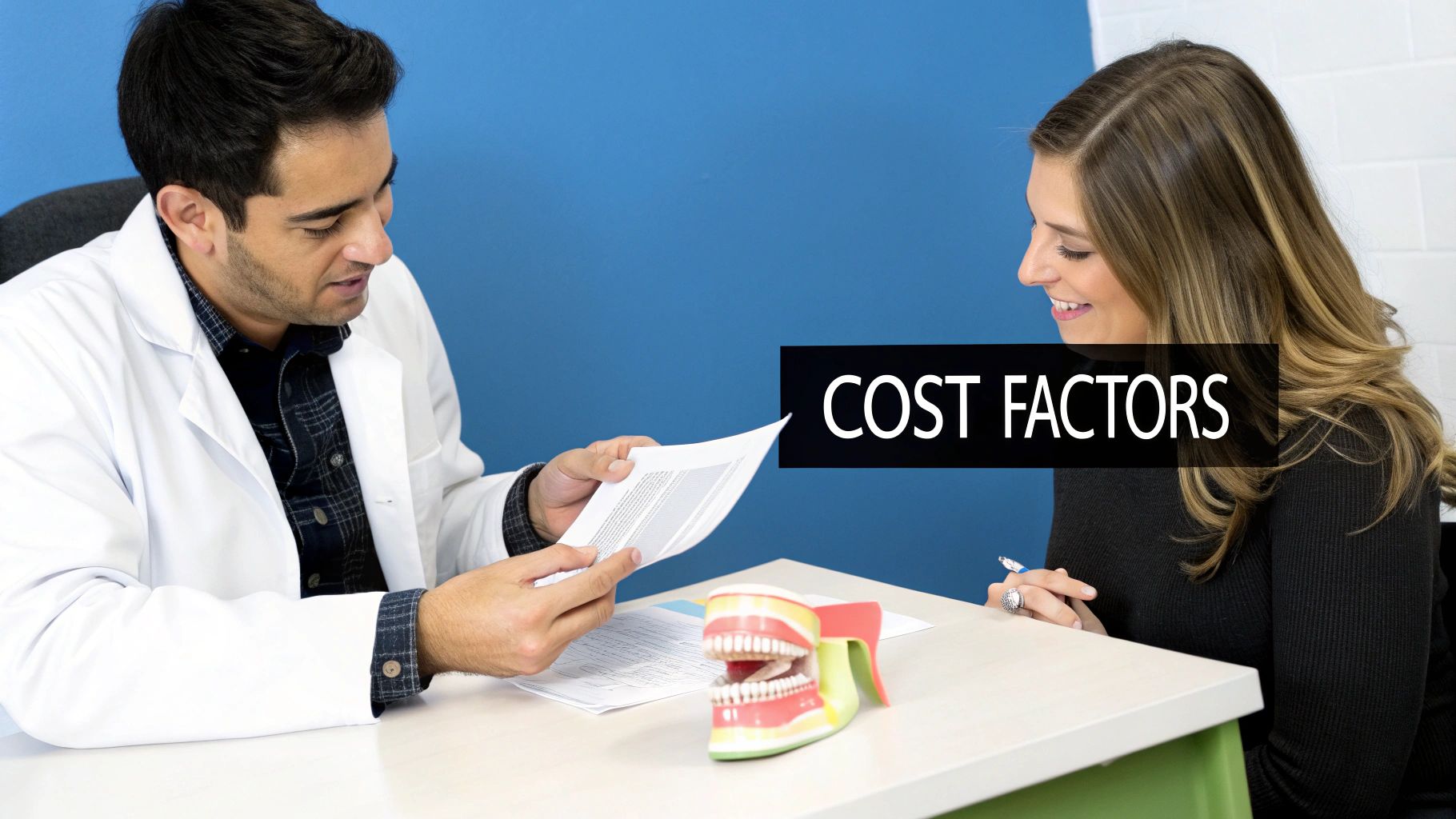
Case Complexity: The Biggest Cost Driver
The single biggest factor dictating your total cost is the complexity of your orthodontic needs. A simple case of minor crowding will always be less expensive than a complex one involving severe bite correction, major tooth rotation, or jaw alignment issues.
For example, a teen needing to close a small gap will land at the lower end of the price range for either braces or Invisalign. In contrast, an adult with a deep overbite and significant crowding will require a more intensive plan, more materials, and more of the dentist's time, pushing the price higher.
Actionable Tip: During your consultation, ask your dentist to classify your case as simple, moderate, or complex. This will give you a clear understanding of why your quote is what it is and help you compare it to the national averages.
The more complex your case, the more resources are needed. For Invisalign, this means more custom aligner trays. For braces, it means more frequent and intensive adjustments. Both scenarios directly increase the final price.
Treatment Duration: How Time Affects the Price Tag
Treatment length is directly tied to complexity. A longer timeline means more appointments, more materials (whether aligner trays or archwires), and more clinical monitoring from your dental team.
Traditional braces often take 18 to 36 months, while Invisalign typically ranges from 12 to 18 months. However, these are just averages. A simple braces case could be much shorter than a complex Invisalign case, proving that your individual needs are what truly dictate the final plan. For a broader perspective on how different methods compare, a complete guide to teeth straightening UK prices can offer valuable insights.
Provider Expertise and Geographic Location
Where you live and the provider you choose also play a role. The cost of running a dental practice varies significantly by location. In competitive markets like Tempe and South Phoenix, pricing can often be more favorable for patients than in higher-cost metropolitan areas.
Experience also matters. An orthodontist specializing in complex cases or a top-tier Invisalign provider may have higher fees reflecting their advanced training. Actionable Tip: When choosing a provider, balance cost with expertise. Investing in an experienced dentist is crucial for achieving your desired results and is a key part of the treatment's overall value. To understand how expertise impacts the process, see our guide on how Invisalign works for a deeper dive into the process.
Your final quote will be a precise calculation based on a combination of all these factors.
Navigating Hidden Fees and Ongoing Expenses
Your initial treatment quote is just the starting point. To accurately budget, you must account for the expenses that arise both during and after your teeth are straightened. Many people are surprised to learn that the investment continues after braces are removed or the last Invisalign tray is used. The maintenance phase is what protects your new smile.
The Mandatory Cost of Retainers
Once your teeth are aligned, they will naturally try to shift back. A retainer is the only way to prevent this, making it a non-negotiable part of your treatment. This cost is almost always separate from the main fee.
Actionable Tip: Ask your dentist to include the cost of your first set of retainers in your initial treatment plan so you can budget for it from day one.
Vivera Retainers: These clear retainers are durable and discreet. Expect to pay $400 to $1,200 for a set.
Hawley Retainers: The classic style with a plastic base and metal wire, they are durable and adjustable, usually costing $150 to $300 per arch.
Permanent Retainers: A thin wire is bonded to the back of your front teeth. It’s convenient but can make flossing difficult and may require future repairs.
Failing to budget for a retainer is a costly mistake that can undermine your entire investment.
Dealing With Unexpected Repairs and Replacements
Life happens. Brackets break, aligners get lost, and these accidents are where the costs for braces and Invisalign can diverge.
With braces, a broken bracket or poking wire often requires an emergency visit, which may come with a fee. These unscheduled appointments can add up.
For Invisalign, the primary risk is losing or damaging an aligner tray.
The lowest initial quote doesn't always lead to the most affordable treatment. When you factor in potential replacement fees, emergency visits, and the long-term cost of retainers, you get a much clearer picture of your total investment.
Replacing a single lost Invisalign aligner can cost $50 to $100 or more. While it seems small, a few instances can impact your budget. This is why discipline is crucial for keeping Invisalign affordable. Our guide on how much Invisalign costs provides an actionable breakdown of savings strategies offers more detail on these variables.
To budget effectively, anticipate these potential "what if" scenarios.
Potential Costs Beyond Your Initial Quote
Expense Type | Typical Cost Range | Applicability (Braces/Invisalign) |
|---|---|---|
Retainers (Post-Treatment) | $150 - $1,200 | Both |
Lost/Broken Aligner Tray | $50 - $100+ per tray | Invisalign Only |
Broken Bracket/Wire Repair | $25 - $75+ per incident | Braces Only |
Emergency Office Visit | Varies by clinic policy | Both (more common with braces) |
Retainer Replacements (over years) | $100 - $500+ per set | Both |
Actionable Tip: Before committing to treatment, ask your dental office for a clear list of their fees for replacements, repairs, and retainers.
Quantifying The 'Lifestyle Costs'
Finally, calculate the indirect costs of your time and travel. Traditional braces typically require adjustment appointments every 4-8 weeks. Each visit means time off work or school, plus travel costs. Over a long treatment, this can add hundreds of dollars to your true cost.
Invisalign usually requires fewer, shorter office visits—just a progress check every 6-12 weeks. For busy individuals and families, the reduced appointment frequency can translate into real savings and significant convenience.
Using Insurance and Savings to Lower Your Bill
The sticker price for orthodontic work is rarely what you'll pay out-of-pocket. By strategically using your dental insurance and any tax-advantaged savings accounts, you can significantly reduce the cost of Invisalign or braces. It's about knowing how to make the system work for you.
These financial tools are surprisingly straightforward and can save you hundreds, if not thousands, of dollars.
Demystifying Your Dental Insurance Benefits
If you have dental insurance, it likely includes some orthodontic coverage. A common myth is that insurance only covers braces, but most modern plans treat Invisalign and braces as equally valid treatments.
Typically, your insurance will pay a percentage of the total cost—often 50%—up to a lifetime maximum, usually between $1,500 and $3,000.
Lifetime Maximum: The total amount your plan will ever pay for orthodontics. It's a one-time benefit that doesn't reset annually.
Coverage Percentage: Your policy covers a portion of the bill (e.g., 50%) until the lifetime maximum is reached.
Equal Coverage: This benefit almost always applies to both clear aligners and metal braces, allowing you to choose based on preference, not financial penalty.
Actionable Step: Before your consultation, call your insurance provider and ask for the specifics of your orthodontic benefits, including the lifetime maximum and coverage percentage. This eliminates guesswork and lets you budget with real numbers. When weighing payment strategies, it's helpful to understand health insurance versus personal savings.
Leveraging Pre-Tax Dollars with FSA and HSA
After insurance, one of the smartest ways to cut costs is with a Flexible Spending Account (FSA) or a Health Savings Account (HSA). These accounts let you set aside money from your paycheck for medical expenses before taxes are taken out.
This means you’re paying for treatment with tax-free dollars. Depending on your tax bracket, this translates to an instant savings of 20% to 30% on every dollar you contribute. Both Invisalign and traditional braces are fully qualified expenses.
Using an FSA or HSA is like getting an automatic discount on your orthodontic treatment. Since you're using pre-tax money, your real cost is significantly lower than the sticker price, making it one of the smartest ways to pay for your smile.
An FSA is set up through your employer, and you must typically use the funds within the plan year. An HSA is for those with high-deductible health plans, and the funds roll over year after year.
Putting It All Together: A Real-World Savings Example
Here’s a practical breakdown of how to stack your savings on a $6,000 treatment:
Apply Insurance: Your dental plan covers 50% up to a $2,000 lifetime maximum. Insurance pays $2,000, bringing your balance to $4,000.
Use Your FSA/HSA: You use $4,000 from your FSA or HSA to pay the remainder.
Calculate Tax Savings: In a 25% tax bracket, using $4,000 of pre-tax money saves you $1,000 ($4,000 x 0.25) you would have otherwise paid in taxes.
In this scenario, your true out-of-pocket cost for a $6,000 treatment is only $3,000 after accounting for tax savings. This powerful combination of insurance and pre-tax accounts makes the invisalign vs traditional braces cost much more attainable.
Affordable Payment Plans and Financing Options
Even after applying insurance and savings, the final cost of orthodontic work can be daunting. But a large number shouldn't prevent you from getting a smile you love. The right payment plan can transform a major expense into a manageable monthly amount.
The goal is to help you start treatment without financial stress by finding a payment structure that fits your budget.
Breaking Down the Cost with In-House Plans
One of the most direct methods is an in-house payment plan. This is an agreement with our office where you make an initial down payment, and we divide the remaining balance into equal, interest-free monthly payments over the course of your treatment.
This option is clean and simple, with no third-party companies, credit checks, or complex applications, making it an accessible choice for most patients.
Exploring Third-Party Financing Like CareCredit
If you need to lower your monthly payments further, third-party financing is an excellent tool. We often work with companies like CareCredit, which functions like a healthcare credit card. They offer various payment plans, including popular 0% interest options if the balance is paid in full within a set period (e.g., 6, 12, or 24 months).
These plans allow you to start treatment immediately while spreading payments over a longer term, often well beyond your treatment completion date. This can make your monthly obligation much more comfortable.
The purpose of financing is to make your ideal treatment plan affordable. For instance, a $6,000 treatment can be broken down into payments as low as $150 per month, depending on the plan's length and terms. This converts a seemingly large one-time expense into a predictable monthly payment.
Making Your New Smile a Financial Reality
Actionable Tip: When evaluating financing, decide which is more important for your budget: the lowest possible monthly payment (which may include interest over a longer term) or paying zero interest (with a slightly higher monthly payment over a shorter term).
Here’s a quick breakdown of how a treatment cost could be structured:
In-House Plan: A $5,000 balance over a 20-month treatment is a simple $250 per month with no interest.
Third-Party Financing (0% APR): The same $5,000 on a 24-month, interest-free plan is about $208 per month.
Extended Third-Party Financing: To achieve the lowest monthly payment, a longer-term plan (e.g., 48 months) could drop the payment significantly, though this would include interest.
At Beautiful Dentistry, we believe financial discussions should be clear and stress-free. We are committed to working with you to find a solution. Explore our flexible payment options—they are all designed to help you achieve your dream smile.
Get Your Personalized Cost Estimate
While this guide provides a solid financial framework, national averages can only tell you so much. The only way to know your exact treatment cost—for Invisalign or traditional braces—is through a one-on-one consultation with a dentist.
An in-depth exam allows us to assess your unique smile, from bite alignment to the specific movements your teeth require. This is how we move from ballpark figures to a precise, personalized treatment plan.
Why a Professional Consultation is Non-Negotiable
A comprehensive exam is the blueprint for your future smile. It is our opportunity to evaluate your oral health, take detailed digital X-rays, and understand your goals.
This personalized approach ensures you understand every option, including the timeline, process, and exact costs involved, so there are no surprises.
Your smile is a unique investment. A personalized consultation is the only way to ensure you're not just choosing an affordable option, but the right option for achieving lasting, beautiful results.
Your First Step in Tempe
Ready to stop guessing and get definitive answers? We make it simple and affordable to get started at Beautiful Dentistry.
For our neighbors in Tempe and South Phoenix, we offer a $59 New Patient Exam, which includes a comprehensive evaluation and all necessary X-rays. It's a low-risk way to get professional advice and a clear financial roadmap from our team.
During your visit, we’ll provide a detailed cost breakdown for both Invisalign and traditional braces, verify your insurance benefits, and walk you through all applicable payment plans.
Don’t spend another day wondering. Take the first step toward a clear, actionable plan for your smile.
Call Us Directly: Schedule your appointment by calling (480) 831-1700.
Book Online: Visit our appointment page to find a time that works for you.
Reach out today to get your personalized estimate and start the journey to the confident smile you've always wanted.
Putting It All Together: Your Orthodontic Cost Questions Answered
Even with all the details, you might have a few remaining questions. Here are actionable answers to the most common inquiries we receive about the cost of Invisalign versus traditional braces.
So, Does Insurance Actually Cover Invisalign Like It Covers Braces?
Yes, in almost all cases. The idea that Invisalign isn't covered as well as braces is a common misconception. Most modern dental plans with orthodontic benefits treat them equally. Your coverage is tied to the need for treatment, not the specific appliance.
Typically, insurance pays a percentage (often 50%) of the total fee up to a lifetime maximum. This maximum is the same whether you choose clear aligners or metal braces. Actionable Step: Always call your insurance provider to confirm your exact orthodontic coverage details before your consultation.
Does My Age Change the Price Tag?
Not directly. The base price for braces or Invisalign doesn't change based on your age. However, adult orthodontic cases can sometimes be more complex due to factors like existing dental work (crowns, bridges) or changes in bone density.
This increased complexity might require a more intricate or longer treatment plan, which can affect the final cost. The price is ultimately driven by the work required, not by your age.
The cost of your orthodontic treatment is all about the complexity of the tooth movement required, not how old you are. While adult cases can bring unique challenges that shape the treatment plan, the fundamental pricing for both Invisalign and braces is based on the work needed to get you to your ideal smile.
What Happens (and What Does It Cost) If I Lose an Invisalign Aligner?
Losing an aligner is a common concern and a potential hidden cost unique to Invisalign. Actionable Step: If you lose a tray, call your dentist immediately for instructions. Don't wait for your next appointment.
Depending on your progress, your dentist might advise you to wear your previous set or move to the next set early. If a replacement must be ordered, there will likely be a fee, so it's wise to be mindful of this potential expense when budgeting for your total care.
Ready to get a clear, personalized answer to your cost questions? The team at Beautiful Dentistry is here to help you navigate your options and find the perfect fit for your smile and budget.Book your $59 new patient consultation today!


hitclub mình vừa vào thử cho biết vì thấy bạn bè nhắc hoài, chủ yếu xem trang họ làm ra sao chứ chưa có định làm gì nhiều. Lướt một vòng thấy họ để phần nhắc kiểm tra đúng link ngay khá nổi, kiểu mới vào đã thấy nên cũng đỡ lo bấm nhầm linh tinh. Mình thích cái cách họ trình bày mấy hướng dẫn cơ bản nhìn gọn, không bị rối mắt, đọc vài dòng là nắm được ý. Nút đăng ký đăng nhập đặt ngay chỗ dễ thấy nên khỏi phải mò menu. Với lại trên đầu trang có hiển thị thời điểm kiểm tra link, nhìn phát là biết họ vừa cập nhật hay chưa.
https://keonhacai.camp/ mình ghé thử lúc rảnh vì thấy bạn bè nhắc, kiểu vào xem cho biết thôi. Ấn tượng đầu là trang load khá nhẹ, nhìn phát là thấy ngay phần tỷ lệ kèo thể thao hôm nay nằm rõ ràng, không bị nhồi chữ hay màu mè quá. Mình hay xem trên điện thoại nên thích kiểu họ trình bày theo khối, kéo xuống là các bảng kèo hiện ra gọn gàng, đọc nhanh được biến động mà không phải zoom tới zoom lui. Mấy mục chính cũng để dễ thấy nên tìm trận đang diễn ra khá nhanh, không cần bấm vòng vòng. Nói chung cảm giác họ ưu tiên cho người xem kèo “nhìn một cái hiểu…