

How to Treat TMJ at Home for Jaw Pain Relief

When a TMJ flare-up hits, that sharp, radiating pain from your jaw is a signal to act fast. You don’t need a complicated plan; you need immediate, simple steps to calm things down. The goal is to soothe the irritated joint and release those tense, overworked muscles.
Thankfully, you can do a lot to manage this right at home. It’s all about giving your jaw a much-needed break.
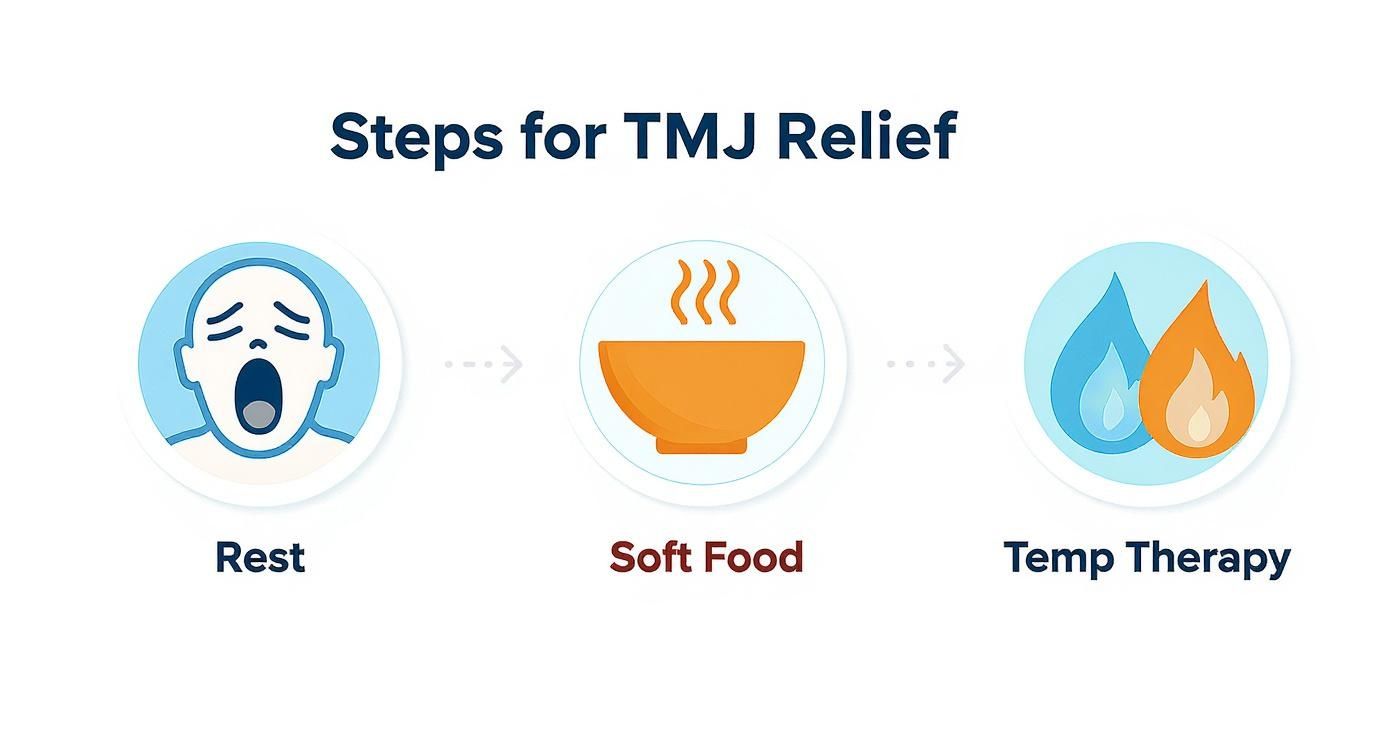
Think of it like any other joint injury. If you twisted your ankle, your first move would be to get off it, ice it, and avoid anything that causes more pain. Your jaw is no different. You can get a handle on the pain by resting the joint, switching up your diet, and using cold and heat therapy to your advantage.
Recent studies back this up. A 2023 meta-analysis confirmed that self-care—including lifestyle changes and simple exercises—can significantly cut down on pain and get your jaw moving comfortably again. So, let's get into what you can do the moment you feel that familiar ache.
I've put together a quick-reference table to help you get started.
Immediate TMJ Flare-Up Checklist
Use these first steps to manage pain and inflammation the moment you feel TMJ symptoms.
Action | How It Helps | Instructions |
|---|---|---|
Jaw Rest | Reduces strain on the joint and muscles, allowing inflammation to decrease. | Avoid chewing gum, biting nails, and hard/chewy foods. Be mindful of wide yawning or shouting. |
Cold Therapy | Narrows blood vessels to reduce swelling and numb sharp, acute pain. | Apply a cold pack wrapped in a thin towel to the area for 10-15 minutes. Best for the first 24-48 hours. |
Heat Therapy | Increases blood flow to relax tight muscles and ease dull, lingering aches. | Use a moist warm compress for 15-20 minutes at a time. Best used after the first 48 hours. |
Soft-Food Diet | Minimizes chewing effort, preventing further irritation to the jaw joint. | Stick to meals like smoothies, soups, scrambled eggs, mashed potatoes, and flaky fish. |
These initial actions are your first line of defense, creating the right environment for your jaw to start healing.
Give Your Jaw a Break
The most important action you can take right away is to lighten your jaw’s workload. This means making a conscious effort to stop doing things that put a strain on the joint and the muscles around it.
That means no more chewing gum, nail-biting, or clenching your teeth when you're focused on a task. Try to catch yourself before a wide yawn or a loud shout, as both can overextend the joint. This rest period is crucial—it gives the inflammation a chance to go down and lets those tired muscles recover.
Key Takeaway: The first rule of managing a flare-up is simple: if it hurts your jaw, don't do it. Your jaw needs a temporary vacation from stressful movements to begin the healing process.
Master Cold and Heat Therapy
Using temperature therapy is a classic for a reason—it works. But the trick is knowing when to use cold and when to use heat. They each play a different role in your recovery. Knowing how to deploy them correctly is key, and getting some practical tips on how to reduce inflammation in joints can make a real difference.
Here’s a clear action plan:
First 24-48 Hours? Go Cold. Grab a cold pack or some ice wrapped in a towel. Apply it to the sore spot for 10-15 minutes at a time. The cold constricts blood vessels, which is fantastic for reducing that initial swelling and numbing the sharp pain.
After 48 Hours? Bring the Heat. A moist, warm compress applied to the side of your face for 15-20 minutes will do wonders. Heat boosts blood flow, helping to relax tight, achy muscles and soothe that dull, persistent ache.
Just a quick safety note: never put ice or a heat pack directly on your skin. Always use a towel as a buffer to prevent any burns or irritation.
Switch to a Softer Diet
What you eat directly impacts your jaw pain. Crunchy, chewy, or tough foods make your jaw muscles work overtime, which is the last thing you want when your joint is already angry. For a little while, a soft-food diet isn't just a good idea—it's essential.
This doesn't have to be boring! You can get creative and still eat well without the painful chewing.
A Few Soft-Food Ideas:
Breakfast: Think smoothies, oatmeal, scrambled eggs, or yogurt.
Lunch: Creamy soups, mashed potatoes, well-cooked pasta, and flaky fish are all great options.
Dinner: Try slow-cooked meats that fall apart, like pulled chicken, or go for refried beans, soft-cooked veggies, or shepherd's pie.
For a few days, say goodbye to tough steaks, crusty bread, raw veggies like carrots, and sticky candies. Giving your jaw this break is one of the most effective things you can do.
Sometimes, the culprit is something we do without even realizing it—like grinding our teeth at night. If you suspect that might be contributing to your pain, you'll find helpful strategies in our guide on how to prevent teeth grinding at night.
Gentle Jaw Exercises for Lasting TMJ Relief
Once the initial flare-up has calmed down, you can introduce gentle, controlled movement. Think of this as physical therapy for your jaw—not a workout. The whole point is to release deep muscle tension, improve flexibility, and restore your natural range of motion without causing more pain.
The key here is to move slowly and pay close attention to what you’re feeling. You're aiming for a gentle stretch, not sharp pain. If you feel any real discomfort, that’s your body telling you to ease off or stop. This mindful approach helps retrain your jaw muscles to work properly and takes the strain off the joint itself.
It can be really helpful to get a baseline before you start. Knowing how to measure range of motion accurately lets you see the real progress you're making over time, which is great for staying motivated.
For best results, start these exercises after you’ve rested your jaw, switched to soft foods, and used heat therapy to relax the muscles. Calming the inflammation first makes these movements much safer and more effective.
Starting with Foundational Stretches
Let's begin with a couple of simple but surprisingly effective movements. The goal is consistency, not intensity. Doing these a few times throughout the day is far better than pushing too hard in one session.
A great one to start with is the tongue-up jaw stretch. Just press the tip of your tongue against the roof of your mouth, right behind your front teeth. Keeping it there, slowly open your mouth as wide as you can without pain. Hold for a moment, then slowly close. This simple move helps stabilize the joint and guide it into a better movement pattern.
Another go-to is resisted opening and closing.
To open: Place your thumb under your chin and provide gentle upward pressure. Now, slowly open your mouth against that light resistance. Hold for about 3-5 seconds, then relax.
To close: Put your thumb under your chin and your index finger on the little ridge between your lower lip and chin. Gently squeeze as you slowly close your mouth.
These resistance exercises aren't about building bulk; they’re about strengthening the small stabilizing muscles that support your jaw, giving you better control and stability.
Introducing the Rocabado 6x6 Exercises
If you feel ready for a more structured routine, the Rocabado 6x6 exercises are fantastic. They were developed by a physical therapist and are a gold standard in TMJ rehab. The concept is simple: six specific exercises, performed six times each, several times a day.
Here are a few of the core movements, explained for easy at-home practice:
Rest Position of the Tongue: This is all about finding your jaw's natural "home base." Touch the tip of your tongue to the roof of your mouth and just hold it there while you take six deep, relaxed belly breaths. This alone can help release a surprising amount of tension.
Controlled Opening: Keep your tongue on the roof of your mouth and slowly open and close your jaw six times. Don't go for your maximum opening—maybe just two-thirds of the way. The goal is a perfectly smooth, straight-down movement, with no clicking or veering off to one side.
Chin Tuck: Posture is a huge piece of the puzzle. Stand or sit up straight and gently pull your chin straight back, like you’re trying to make a double chin without looking down. Hold for a few seconds, relax, and repeat six times. This helps correct the "forward head" posture that puts so much strain on your neck and jaw.
Know the Difference: A good stretch feels like a gentle release of tension. Pain is a warning sign. If you feel any sharp, shooting, or increasing pain, you've gone too far. Always listen to your body.
Making Jaw Exercises a Habit
The easiest way to see real change is to sneak these exercises into your existing daily routine. Try a set when you get up from your desk, while you're waiting for the microwave, or during a commercial break.
Remember, this is a marathon, not a sprint. You are carefully working to restore function and break a cycle of chronic tension. Be patient with yourself. That consistent, gentle effort is what will get you a healthier, happier jaw in the long run.
How Stress and Sleep Wreak Havoc on Your Jaw
Ever notice your jaw hurts more after a really tough day at work or a night spent tossing and turning? That’s no coincidence. There's a powerful link between your mental state and your physical body, and for many of us, the jaw is ground zero for tension. Learning how to manage TMJ at home often means getting a handle on stress and sleep first.
When you're stressed, your body flips into "fight or flight" mode. This causes muscles all over—especially in your jaw, neck, and shoulders—to tighten up without you even thinking about it. This often leads to bruxism, the clinical term for clenching or grinding your teeth. A lot of people do this during the day while concentrating and then carry that habit right into their sleep.

All that constant pressure puts a massive strain on your temporomandibular joint, triggering inflammation, pain, and stiffness. Interrupting that cycle is absolutely crucial for finding lasting relief.
Simple Stress-Busting Techniques You Can Do Anywhere
You don’t need to book a week-long yoga retreat to start managing your stress. Small, consistent actions woven into your day can make a world of difference for your jaw tension. The idea is to stop the stress response before it settles into your muscles.
One of the simplest and most effective methods is diaphragmatic breathing, or "belly breathing."
Just place one hand on your chest and the other on your stomach.
Breathe in slowly through your nose for a count of four, feeling your stomach push out.
Hold it for a second, then exhale slowly through your mouth for a count of six.
Do this five times whenever you feel that tension creeping in.
Here’s another practical tip I give my patients: set a recurring alarm on your phone that just says, "Check your jaw." When it goes off, take a second to notice your jaw. Are your teeth clenched? Let your jaw go slack, creating a small space between your top and bottom teeth.
Expert Tip: A quick posture check can provide immediate relief. Gently pull your chin straight back, like you're trying to make a double chin. This little move helps align your head over your spine, instantly taking some of the load off your neck and jaw muscles.
Fine-Tuning Your Sleep for Jaw Recovery
A bad night's sleep does more than leave you groggy. It cheats your body out of vital recovery time and can make your TMJ symptoms significantly worse. Everything from your sleeping position to your pillow plays a role in whether you wake up feeling refreshed or in pain.
The way you sleep has a direct impact on jaw pressure.
Best: Sleeping on your back is the gold standard. It keeps your head, neck, and spine neutral, preventing any weird pressure on your jaw.
Worst: Stomach sleeping is a major no-go. It forces you to crank your head to one side for hours, which twists your neck and puts a ton of strain on your jaw joint. If you're a stomach sleeper, working to change this habit might be one of the most impactful things you do for your TMJ.
The right pillow is just as critical. You need something that supports the natural curve of your neck, not something that props your head up at a weird angle. A contoured memory foam or cervical pillow can be a great investment. Definitely avoid stacking two or three pillows!
Sometimes, poor sleep is a red flag for other issues. If you snore loudly and always wake up feeling unrefreshed, it’s worth looking into the connection. For more on this, check out our post offering an actionable guide to sleep apnea treatment options. Understanding how these conditions overlap can be a game-changer.
Finally, create a sleep environment that invites rest.
Keep your bedroom as dark, quiet, and cool as possible.
Power down all screens—phones, tablets, TVs—at least an hour before you plan to sleep. The blue light they emit messes with your body’s sleep signals.
Wind down with a calming routine, whether that's reading a book, taking a warm bath, or listening to some quiet music.
By actively managing your daily stress and prioritizing good sleep, you're directly addressing two of the biggest TMJ triggers. This builds a strong foundation for any other home treatments you try.
Smart Over-the-Counter Options for TMJ Pain
When a TMJ flare-up hits, your first thought is probably, "How do I make this stop?" While rest, gentle stretches, and other home care strategies are the foundation of recovery, sometimes you need a little extra help to get through the worst of the pain. That’s where a smart trip to the pharmacy aisle comes in.

It's crucial to view these products as short-term tools, not long-term cures. They're designed to break the pain cycle, giving your jaw a chance to rest and respond to the other healing strategies you're using. Think of them as a temporary bridge to get you out of that acute, throbbing pain.
Choosing the Right Anti-Inflammatory Medication
For most people, the go-to choice for TMJ pain is a nonsteroidal anti-inflammatory drug, or NSAID. You know these by their brand names: ibuprofen (Advil, Motrin) and naproxen (Aleve). They work by blocking the body's production of prostaglandins—the chemical culprits behind pain and inflammation.
Taking an NSAID can dial down the inflammation in your jaw joint and the surrounding muscles, providing real relief from that constant ache and tenderness. And this isn't just anecdotal. A 2023 systematic review confirmed that NSAIDs like naproxen offer substantial pain relief and improved jaw movement for TMD patients. The data was pretty compelling: for every 2.2 patients treated, one experienced at least a 50% drop in pain. You can read more about these TMD treatment findings for the full picture.
A Quick Word of Caution: These medications are for short-term relief only. Always stick to the dosage instructions on the label, and never take them for more than 10 days without talking to your doctor. The goal is to get you over the hump, not create a daily habit.
Exploring Topical Pain Relief Options
If you're hesitant to take oral medications or just want another layer of defense against the pain, topical analgesics are a fantastic option. These are the creams, gels, and patches you apply directly to the skin over your sore jaw muscles. They get the medicine right where it hurts.
You'll generally find two types on the shelf:
Counterirritants: These often contain ingredients like menthol or camphor. They create a cooling or warming sensation that essentially distracts your brain from the deeper muscle ache. It’s a simple but surprisingly effective trick.
Topical NSAIDs: Gels containing diclofenac, for instance, deliver anti-inflammatory medicine through the skin directly to the muscle and joint. This provides targeted relief with fewer of the systemic side effects that can come with pills.
A quick massage with a topical gel before bed can be a game-changer, helping to ease muscle tension that might otherwise lead to a rough night of clenching.
A Quick Look at Your Options
Here’s a simple breakdown of the most common at-home treatments to help you decide what might work best for you during a flare-up.
Comparing At-Home TMJ Treatment Options
Treatment Type | Primary Purpose | Key Consideration |
|---|---|---|
Hot/Cold Packs | Reducing inflammation (cold) and relaxing muscles (heat) | Use in 15-minute cycles; never apply directly to the skin. |
NSAIDs | Reducing pain and systemic inflammation | Meant for short-term use (10 days max); follow dosage. |
Topical Analgesics | Targeted, localized pain relief | Great for direct application with fewer systemic side effects. |
Jaw Exercises | Improving mobility and reducing stiffness | Must be gentle; stop immediately if pain increases. |
Soft Diet | Allowing the jaw joint and muscles to rest and recover | Avoid hard, chewy, or crunchy foods during a flare-up. |
Each of these tools has its place in managing TMJ discomfort. The key is to listen to your body and use them to support your jaw's natural healing process, not mask a bigger problem.
The Debate Over OTC Night Guards
Wander through any pharmacy, and you'll see them: "boil-and-bite" night guards promising relief from teeth grinding. The concept makes sense—put a barrier between your teeth. But for anyone with genuine TMJ issues, these one-size-fits-all solutions can do more harm than good.
The Potential Problems with OTC Guards:
A Terrible Fit: A bulky, poorly molded guard can actually push your jaw into an awkward, strained position, making your muscle pain and joint stress even worse.
Incomplete Protection: They might stop your teeth from wearing down, but they do absolutely nothing to address the root causes of TMJ disorders, like muscle hyperactivity or a misaligned joint.
Masking the Real Issue: Using an OTC guard can create a false sense of security. You might think you're solving the problem while the underlying condition gets worse, delaying the professional diagnosis and treatment you actually need.
While the low price tag is tempting, an OTC guard is almost never the right answer for TMJ pain. A custom-fitted oral appliance from a dentist is engineered not just to protect your teeth, but to guide your jaw into a comfortable, stable position. This allows the muscles to finally relax and the joint to decompress—addressing the cause, not just the symptom.
When It's Time to See a Professional About Your Jaw Pain
While the home treatments we’ve covered are fantastic for managing mild to moderate TMJ flare-ups, they aren't a cure-all. A crucial part of knowing how to handle TMJ at home is recognizing its limits. Your body has ways of telling you when it's time to stop the self-care routine and call in an expert.
Ignoring these signals can turn a manageable issue into a much more serious, chronic problem. This isn't meant to be alarming; it's about empowering you to make the smartest call for your long-term health. Think of home care as your first line of defense, with a dental professional as the essential backup you need when the situation gets more serious.
Red Flags That Mean You Need Professional Help
If you experience any of the following, it’s time to put down the warm compress and pick up the phone. These signs usually point to an underlying issue that home remedies just can't fix—things like a displaced disc in the joint, significant inflammation, or even structural problems.
Don't wait if you notice:
A Locked Jaw: This is a big one. It's when your jaw gets stuck open or closed. Whether it only lasts a moment or feels like an eternity, a locked jaw is a clear sign of a mechanical problem that needs an immediate professional assessment.
Severe, Unrelenting Pain: Pain that just won't quit after a week of diligent home care is a major red flag. If it's waking you up at night or making it difficult to eat or talk, professional help is necessary.
Painful Clicking and Popping: A quiet click here or there might not be a concern. But any popping, clicking, or grating sound that comes with pain is not normal. This often means the small cartilage disc inside your jaw joint is out of place.
Key Takeaway: Home care is meant to manage symptoms, not to diagnose the root cause. If your symptoms are severe, getting worse, or not responding to your efforts, it's time to stop self-treating.
What to Do When Home Treatment Isn't Working
Recognizing these red flags is the first step. Taking action is the next. Trying to push through severe pain or force a locked jaw to move will almost certainly make things worse. Your goal should be to get a clear diagnosis from a professional who truly understands the complex mechanics of the jaw.
This is where a dentist experienced in TMD comes into the picture. A thorough evaluation goes beyond just listening to your symptoms; it's about finding the why behind your pain. This usually involves a physical exam to check your jaw's range of motion, a bite analysis, and sometimes imaging like X-rays to get a detailed look at the joint itself.
For our patients in Tempe and South Phoenix, the team at Beautiful Dentistry offers specialized care and provides TMJ treatment for teeth grinding in Tempe. Scheduling an evaluation is the best way to get a precise diagnosis and a treatment plan built just for you, moving you past temporary relief and toward a real, lasting solution.
Other Symptoms to Watch For
Beyond the major red flags, a few other symptoms should prompt a call to our office. If your jaw pain is showing up with frequent headaches, earaches, dizziness, or a stuffy feeling in your ears, it’s a strong indicator that the TMJ disorder is affecting the surrounding areas. These aren't issues you should ignore or try to treat on your own indefinitely. A professional can help connect the dots and get to the real source of the problem.
Common Questions About At-Home TMJ Treatment
When you start any new self-care routine, questions are bound to pop up. Tackling TMJ pain at home is no different. Having good answers not only builds your confidence but makes sure you’re on the right path. Let's go through some of the most common questions we hear from our patients as they start managing their jaw pain.
Think of this as your go-to guide for those little "what if" or "how long" thoughts that can surface when you're trying to find relief.
How Long Until I Feel a Difference?
This is usually the first thing people ask, and for good reason. While you might get some immediate, temporary relief from something like a cold pack on a swollen jaw, real, lasting improvement from exercises and new habits takes time and consistency.
Generally, if you're diligent with your home care—we're talking gentle stretches, managing stress, and sticking to a soft diet—most people start to feel a meaningful drop in pain and stiffness within one to two weeks. The goal isn't some overnight miracle; it’s about slowly retraining your jaw muscles and giving that inflamed joint a chance to calm down.
Patience and Consistency Are Key: True relief comes from steady, daily effort. The small things you do every day really add up over time. Don't get discouraged by a minor setback—it happens. Just get back to your routine.
What you're really doing is creating healthier patterns for your jaw to follow, and that gradual progress is what leads to long-term comfort and stability.
Can My Chewing Habits Make TMJ Worse?
Oh, absolutely. It's surprising how big of a role your chewing habits play in your jaw health. Without even realizing it, many of us develop patterns that put a ton of uneven or excessive strain on our temporomandibular joints.
Here are a few common culprits that can really aggravate TMJ symptoms:
Chewing on One Side: If you always favor one side, you're forcing the muscles on that side to do all the work. This leads to fatigue and imbalance, which can pull the jaw joint out of its natural alignment.
Taking Huge Bites: Opening your mouth extra wide to cram in a big bite can overextend the jaw joint. This can easily strain the ligaments and irritate that sensitive disc inside the joint space.
Constant Gum Chewing: This is like sending your jaw muscles to the gym for an endless, repetitive workout with no breaks. That constant motion is a recipe for severe muscle fatigue and can trigger a nasty flare-up.
Making a conscious effort to take smaller bites, chew your food on both sides, and ditch the chewing gum can be game-changers. These small adjustments dramatically reduce the daily load you're putting on your jaw.
Will These Home Treatments Fix My TMJ Forever?
For many people, especially those whose TMJ is driven by muscle tension or minor inflammation, at-home treatments are incredibly effective. They can be enough to manage symptoms, keep flare-ups from happening, and let you live comfortably.
However, it's crucial to see TMJ for what it often is: a chronic condition. Home care is less of a one-and-done cure and more about long-term management. You can think of it like managing a sensitive knee—you learn what irritates it, you learn what soothes it, and you adjust your lifestyle to keep it happy.
If your TMJ stems from a bigger structural issue, like a displaced disc or arthritis in the joint, home care alone might not be enough to fix the root cause. In those situations, home treatments become an essential part of your support system, but they work best when paired with professional care. The ultimate goal is to build a personal toolkit that empowers you to control your symptoms for good.
If your jaw pain is sticking around despite your best efforts at home, or if you’re noticing any of the red flag symptoms we mentioned earlier, it’s time for a professional look. The dedicated team at Beautiful Dentistry is here to give you a precise diagnosis and map out a personalized treatment plan to bring you lasting relief. Don’t wait for the pain to take over—schedule your comprehensive TMJ evaluation in Tempe today.


Comments