

What Is a Dental Bridge? Your Guide to Restoring Your Smile

A dental bridge is a fixed, reliable solution for replacing one or more missing teeth. It’s designed to quite literally “bridge” the gap in your smile by using your healthy, neighboring teeth as anchors.
The bridge consists of a false tooth (called a pontic) fused between two crowns. These crowns are then permanently bonded to the teeth on either side of the gap, creating a solid, functional restoration. Think of it like a three-piece puzzle—two anchor crowns on your natural teeth with a prosthetic tooth seamlessly fitted in between.
Understanding Why a Dental Bridge Is Necessary
Losing a tooth is more than a cosmetic issue—it's a functional problem that can trigger a cascade of other dental issues if not addressed. Taking action with a solution like a dental bridge is a key step in protecting your long-term oral health.
Your teeth work together to maintain proper alignment and bite. When one is lost, the neighboring teeth may start to drift or tilt into the empty space. This domino effect can lead to a misaligned bite, difficulty chewing, and even strain on your jaw joint (TMJ).
Actionable Benefits of a Dental Bridge
A gap in your smile can quietly affect your daily life. A dental bridge is a practical solution designed to address these specific problems:
Restore Your Chewing Ability: A bridge lets you chew food properly again by distributing bite forces evenly. Your immediate action is to start eating a more varied, nutritious diet without discomfort.
Prevent Teeth from Shifting: By filling the space, a bridge acts as a placeholder, stopping adjacent teeth from migrating. This prevents more complex and costly alignment issues from developing later.
Maintain Your Facial Structure: Missing teeth can lead to jawbone deterioration over time, causing facial muscles to sag. A bridge provides support for your lips and cheeks, helping preserve your natural face shape.
Improve Speech Clarity: Your teeth play a crucial role in forming certain sounds. Replacing a missing tooth with a bridge can immediately help you speak more clearly and confidently.
The primary goal of a dental bridge is to re-establish the natural harmony and stability of your entire mouth. It restores both function and appearance, proactively protecting your smile for years to come.
Ultimately, addressing a missing tooth is a smart, preventative step. To understand the full scope, review our post on the importance of replacing missing teeth. A dental bridge is an effective, actionable solution to prevent these complications and help you maintain a complete, healthy smile.
Exploring the Different Types of Dental Bridges
When you're missing a tooth, several options can fill the gap, and dental bridges are among the most reliable. However, not all bridges are the same. Your dentist will recommend the specific type of bridge that best fits your unique dental situation, much like a builder choosing the right tool for a job.
The decision is about more than aesthetics. Leaving a gap can cause your other teeth to drift, leading to bite problems. A bridge is a functional fix that keeps your smile stable.
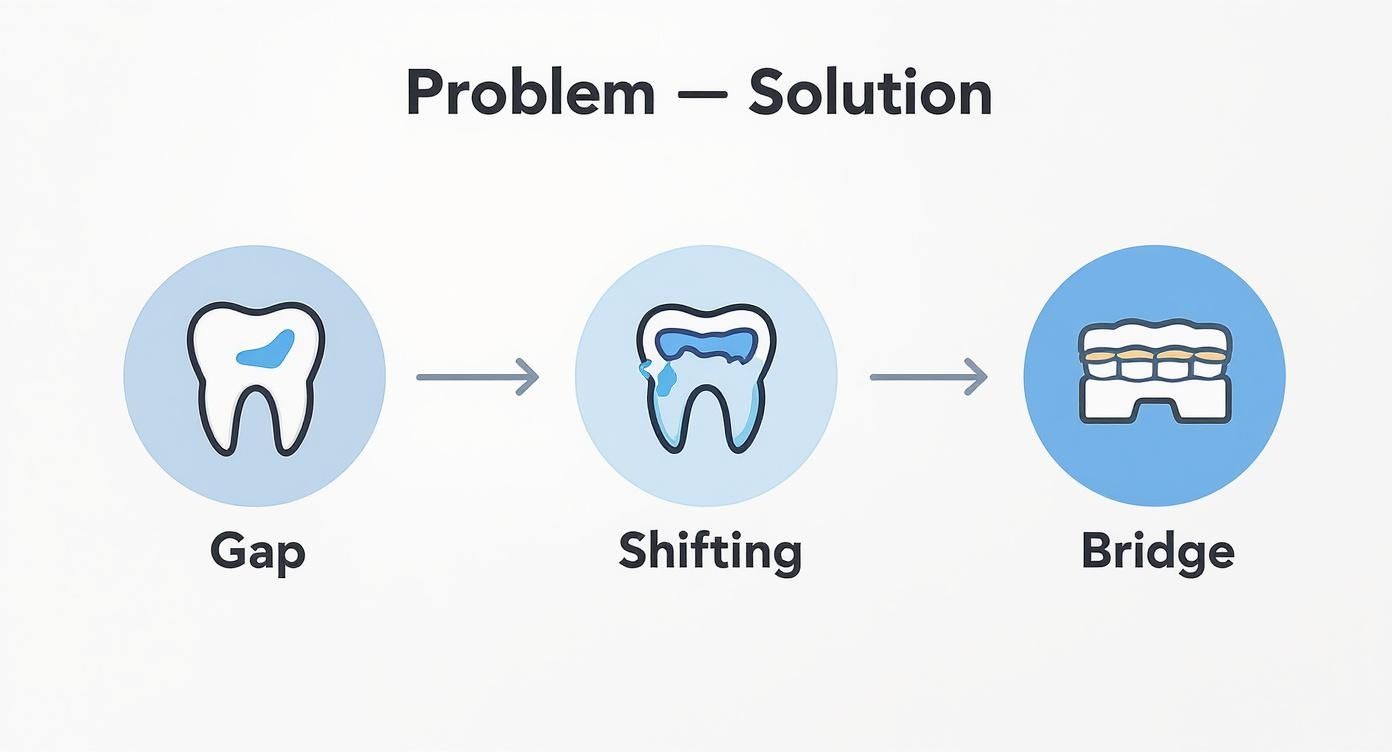
As you can see, a bridge protects the alignment and health of your entire smile. Here are the four main types to discuss with your dentist.
Traditional Dental Bridge
The traditional bridge is the most common and time-tested option. It consists of a false tooth (a pontic) anchored by dental crowns placed on the healthy teeth on either side of the gap. These supporting teeth are called abutments. This design is strong and durable, making it an excellent choice when you have solid, healthy teeth to serve as anchors. The main requirement is that these neighboring teeth are strong enough to support the new structure.
Cantilever Bridge
What if you only have a healthy tooth on one side of the gap? A cantilever bridge is the solution. Instead of being anchored on both sides, this bridge is supported by a crown on just one neighboring tooth. These are used less frequently because they place more stress on the single anchor tooth. Your dentist will only recommend this for areas with less biting force, like the front of your mouth, after confirming the supporting tooth is strong enough for the task.
Maryland Bridge
A Maryland bridge is a more conservative choice that avoids placing full crowns on neighboring teeth. Instead, a false tooth is supported by small metal or porcelain "wings" bonded to the back of the adjacent teeth, hidden from view. This approach is ideal for replacing missing front teeth as it preserves more of your natural tooth structure. However, the bond isn't as strong as a traditional bridge, so its use is more limited.
Implant-Supported Bridge
For maximum stability and longevity, the implant-supported bridge is the premium solution. It doesn't rely on natural teeth for support. Instead, it's anchored directly to dental implants—titanium posts surgically placed into your jawbone.
This is the preferred solution when you're missing several teeth in a row or if the nearby teeth aren't strong enough to act as anchors. Because implants fuse with your jawbone, they provide a rock-solid foundation and actively prevent bone loss.
To help you compare your options, here’s a quick breakdown you can use when discussing the best path forward with your dentist.
Comparing Dental Bridge Options at a Glance
Bridge Type | How It Works | Best For | Actionable Insight |
|---|---|---|---|
Traditional | A false tooth is held by crowns on teeth on both sides of the gap. | A single missing tooth with healthy neighbors on each side. | Most common and reliable for restoring chewing function anywhere. |
Cantilever | A false tooth is supported by a crown on only one neighboring tooth. | A missing tooth with only one adjacent tooth available for support. | A specific solution when a two-sided anchor isn't an option. |
Maryland | A false tooth has "wings" bonded to the back of neighboring teeth. | Replacing missing front teeth, especially in younger patients. | Preserves the most natural tooth structure; less invasive. |
Implant-Supported | The bridge is anchored to surgically placed dental implants, not natural teeth. | Multiple missing teeth in a row or when neighboring teeth are weak. | The best long-term investment for jawbone health and stability. |
Each option serves a specific purpose. Your best choice depends on your oral health, the location of the missing tooth, and your long-term smile goals.
To see how bridges compare to other treatments, explore our in-depth guide to the best options for missing teeth.
Your Dental Bridge Procedure from Start to Finish
Knowing what to expect makes any dental procedure feel more manageable. Getting a dental bridge is a straightforward process that typically requires just two visits. Here's a step-by-step guide so you know exactly what will happen from your first appointment to the moment you walk out with your restored smile.
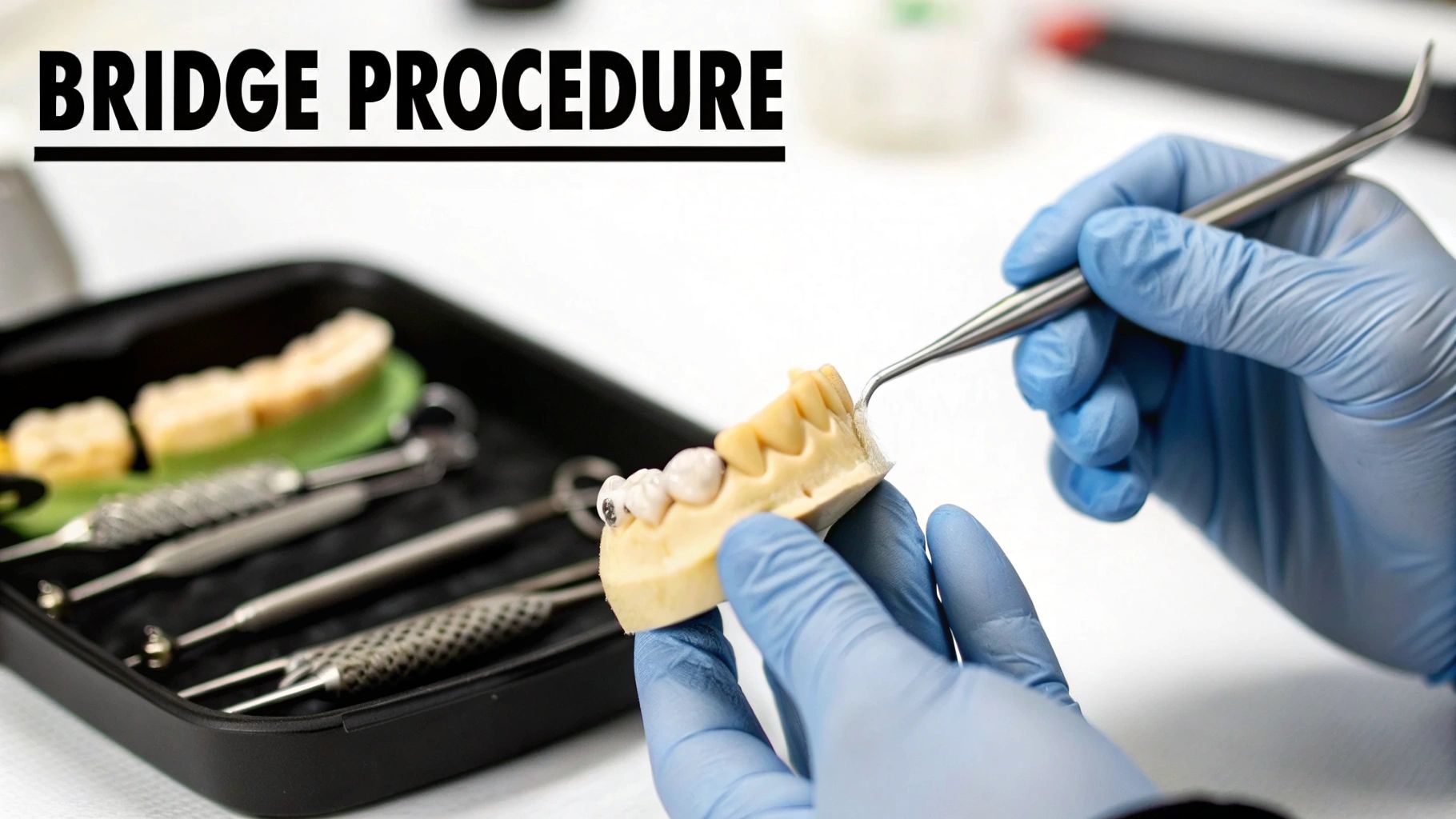
Our goal is to restore your smile’s function and appearance with minimal disruption to your daily life.
Your First Visit: The Preparation Stage
The first appointment is for creating the foundation for your new bridge. This visit typically lasts about 60 to 90 minutes.
First, we will numb the area to ensure you are completely comfortable. Then, we will carefully reshape the neighboring teeth that will serve as anchors—the abutment teeth. This step creates the ideal surface for the crowns that will hold your bridge securely.
Next, we take a precise digital scan of your mouth. This digital impression is sent to a dental lab where technicians will craft a custom bridge that perfectly matches your natural teeth. You won't leave with a gap; we will place a temporary bridge to protect the prepared teeth and maintain your smile's appearance.
Your Second Visit: The Final Placement
You will return for your second visit in about one to two weeks. This is when we permanently place the bridge custom-made for you.
We will start by removing the temporary bridge and cleaning the area. Then, we will carefully set your new bridge in place and perform several critical checks:
Check the Fit: We ensure it sits perfectly against your gums and adjacent teeth with no looseness.
Check the Bite: We confirm your upper and lower teeth meet correctly and feel natural when you bite down.
Check the Aesthetics: We verify that the color and shape blend seamlessly with your surrounding teeth.
Once you and your dentist are satisfied that everything is perfect, the bridge is bonded securely with strong dental cement. You can then leave with a complete, functional, and beautiful smile.
This two-visit process is a proven method in dentistry. It allows time for meticulous lab work, ensuring every detail from fit to shade is perfect for a restoration built to last.
The Beautiful Dentistry Advantage: CEREC Same-Day Technology
At Beautiful Dentistry, we value your time. That's why we use CEREC (Chairside Economical Restoration of Esthetic Ceramics) technology. This advanced system allows us to digitally design, mill, and place high-quality ceramic bridges in our office.
For many patients, this means the entire bridge procedure can be completed in a single appointment. No temporary bridge and no two-week wait. You can get back to your life with a permanent new smile faster than ever, without compromising on quality.
Choosing Your Tooth Replacement: Bridges vs. Implants
When replacing a missing tooth, your primary options are often a dental bridge or a dental implant. Both are excellent solutions, but they work differently. Understanding their key differences is the first step to making an informed decision that's right for you.
Think of it this way: a dental bridge spans a gap, supported by the teeth on either side. An implant, however, builds a new foundation directly into the jawbone where the tooth used to be. Both close the gap, but their underlying structure is fundamentally different.
Impact on Surrounding Teeth
The most significant difference lies in how each option affects neighboring teeth. This is a crucial factor to consider for your long-term oral health.
A traditional dental bridge requires reshaping the adjacent teeth (abutments) by filing them down to fit crowns over them. These crowns anchor the bridge. While effective, this process involves altering otherwise healthy tooth structure.
A dental implant, in contrast, is a self-supporting unit. A titanium post is placed into your jawbone, acting as a new tooth root. Because it stands on its own, it leaves your healthy adjacent teeth completely untouched and unaltered.
Durability and Long-Term Health
Both options are built to last, but their longevity depends on different factors.
Dental Bridges: With diligent home care and regular check-ups, a bridge can last 5 to 15 years. Its lifespan depends heavily on the health of the two anchor teeth. If one of those teeth develops a cavity or gum disease, the entire bridge may fail.
Dental Implants: Implants are considered a permanent solution and can last a lifetime. The implant fuses with the jawbone (a process called osseointegration), creating an incredibly strong and stable foundation. This fusion also stimulates the jawbone, preventing the bone loss that naturally occurs when a tooth is missing.
A dental implant is the only tooth replacement option that actively preserves and stimulates your natural jawbone, protecting your facial structure over the long term.
Maintenance and Daily Care
Here's what you need to do to maintain each option:
For an implant, your daily care is simple: brush and floss it just like a natural tooth.
For a dental bridge, you need to add a step to your routine. Use a floss threader or a water flosser to clean the space underneath the false tooth (the pontic). Keeping this area free of plaque is essential for preventing gum issues and decay on the supporting teeth.
When weighing your options, several factors come into play. Here’s a quick comparison to help you see the key differences at a glance.
Tooth Replacement Options Compared
Feature | Dental Bridge | Dental Implant | Partial Denture |
|---|---|---|---|
Durability | 5-15 years | Lifetime potential | 5-10 years |
Impact on Jawbone | No bone stimulation | Stimulates and preserves bone | No bone stimulation |
Impact on Other Teeth | Requires altering adjacent teeth | No impact on adjacent teeth | Can cause wear on adjacent teeth |
Daily Care | Requires special cleaning tools | Brush and floss normally | Must be removed for cleaning |
Surgery Required? | No | Yes | No |
Upfront Cost | Moderate | Higher | Lower |
Ultimately, both bridges and implants are excellent restorations. Many patients choose implants for their simplicity and long-term benefits. To learn more, get a complete overview by reading our guide on everything to know about dental implants.
The best choice depends on your specific oral health, budget, and long-term goals. We are here to provide all the details so you can make a decision you feel confident about.
How to Care for Your Dental Bridge to Make It Last
You've invested in your smile, and with the right care, your new dental bridge can last for years. The key is to think of it as a high-quality restoration that requires consistent attention. A well-maintained dental bridge can easily last from 5 to 15 years, and often longer.
The longevity of your bridge depends on the health of the supporting teeth. The biggest threat is decay or gum disease affecting these critical anchor teeth. If they become compromised, the entire bridge can fail. The actionable steps below will help you protect your investment.

Mastering Your Daily Cleaning Routine
Cleaning a bridge requires a more targeted approach than brushing natural teeth. Focus on the gap between the pontic (the artificial tooth) and your gums, as this area easily traps plaque and food.
To keep it clean, add these tools to your daily routine:
Floss Threaders: These flexible loops help you guide dental floss underneath your bridge to clean the otherwise unreachable space. Use them once daily.
Interproximal Brushes: Also known as proxy brushes, these tiny brushes are perfect for cleaning the sides of the abutment teeth and right under the pontic.
Water Flossers: An excellent tool for flushing out debris from hard-to-reach nooks and crannies. Use it to supplement, not replace, traditional flossing.
Your action plan: Brush twice a day with a fluoride toothpaste and, most importantly, clean under your bridge at least once a day using a floss threader or water flosser. This is non-negotiable for preventing plaque buildup that leads to cavities and gum inflammation around your anchor teeth.
The Role of Professional Dental Care
Your at-home diligence is crucial, but so are your regular professional check-ups. During these appointments, we perform a detailed inspection of your bridge. We check its integrity, look for signs of wear, and ensure the supporting teeth and gums are healthy. This allows us to spot and address potential issues early.
Dental restorations have come a long way. The earliest bridges date back to 700 BC, using animal or human teeth held by an ivory base. Thankfully, modern techniques provide restorations that are far more reliable and natural-looking. You can read more about the long history of dental bridges on thorncrestdental.com.
By combining a diligent at-home cleaning routine with consistent professional care, you can ensure your dental bridge has a long, healthy, and successful life.
Your Dental Bridge Questions, Answered
It’s normal to have questions as you consider a dental bridge. Getting clear, direct answers will help you feel confident in your decision to restore your smile. Here are the most common questions we hear from patients.
Does Getting a Dental Bridge Hurt?
No, the procedure itself is not painful. We use a local anesthetic to completely numb the area before we begin preparing the anchor teeth. You will not feel any pain during the appointment.
After the numbness wears off, you might experience some mild sensitivity or soreness for a few days. This is normal and can be easily managed with over-the-counter pain relievers like ibuprofen or acetaminophen.
What Is the Cost of a Dental Bridge?
The cost of a dental bridge varies based on several factors: the type of bridge you choose, the materials used (such as porcelain or zirconia), and the number of teeth being replaced.
Many dental insurance plans cover a portion of the cost. The most effective way to get an accurate price is to schedule a consultation. We can assess your specific needs and provide a personalized treatment plan with a clear cost breakdown.
Actionable Tip: Think of a dental bridge as a long-term investment in your ability to eat, speak, and smile with confidence. With proper care, it can last 5 to 15 years or more, making it a valuable health decision.
Can a Dental Bridge Be Fixed if It Breaks?
It depends on the type and extent of the damage. A small chip in the porcelain can often be repaired directly in the mouth. However, if the damage is more significant or if the supporting tooth structure is compromised, a full replacement is usually the best and safest course of action.
Your best strategy is prevention. Avoid chewing on hard items like ice, hard candy, or pen caps to protect your bridge from damage.
Getting clear answers quickly is essential. A responsive dental practice, often supported by systems like a reliable dental office answering service, ensures you can always get the information you need.
Your smile deserves personal attention from a team that combines advanced technology with a compassionate approach. At Beautiful Dentistry, we create restorations that are both beautiful and built to last.
Schedule your consultation today and let's create a clear action plan to restore your complete, healthy smile.


Comments