

Pros and Cons Dentures: A Clear Guide to Making Your Decision

Deciding to get dentures is a significant step toward restoring your smile, but it's crucial to weigh the pros and cons carefully. The primary pros of dentures are their affordability and the speed of the process. In contrast, the main cons often involve an adjustment period and potential issues with stability. Dentures are a proven way to regain your smile, but having actionable insights helps you make the best choice for your long-term health and lifestyle.
Your Quick Guide to Denture Pros and Cons

Choosing a tooth replacement solution is a major health decision. An actionable way to approach this is to compare dentures to other options, like cars. Dentures are the dependable, budget-friendly sedan—they get you where you need to go reliably. Alternatives like dental implants are the high-performance luxury car—they offer superior performance at a much higher price. Your goal is to select the option that best fits your immediate needs, daily life, and financial plan.
Dentures are an extremely common and effective solution worldwide. Their popularity is set to continue, with projections showing that around 42.46 million Americans will likely be using them by 2025. This is driven by their key advantages: they are significantly more affordable than implants, and the entire process is much faster. For a detailed breakdown of market trends, you can review the analysis on Mordor Intelligence.
At-a-Glance Denture Pros and Cons
To make an informed decision, you need to understand the key trade-offs. This summary table provides a clear, side-by-side view, giving you a balanced perspective on the advantages and disadvantages before we dive deeper.
Your Actionable Insight: Use this table to flag potential deal-breakers. If non-surgical treatment is your top priority, dentures are a strong contender. If you cannot tolerate the idea of potential slippage, it's a sign to explore implant-supported options more seriously.
Here's a straightforward comparison to help you weigh the benefits against the potential downsides.
Key Aspect | The Pros (Advantages) | The Cons (Disadvantages) |
|---|---|---|
Cost | Highly affordable; often covered by insurance | May require future costs for relining or replacement |
Timeline | Quick fabrication and fitting process | Requires an initial adjustment period for comfort |
Procedure | Non-invasive; no surgery required for traditional | Can slip or shift; may require adhesives for stability |
Maintenance | Easy to remove and clean daily | Can accelerate jawbone loss over time without stimulation |
Aesthetics | Restores a full, natural-looking smile | May feel bulky or less natural than implant alternatives |
This table serves as your starting point. The best choice for you depends on your specific dental health, and that's something we can assess and discuss during a personal consultation.
The Upside of Choosing Dentures

When weighing the pros and cons, the advantages of dentures provide immediate, practical solutions for missing teeth. These benefits extend beyond just aesthetics; they restore fundamental aspects of your quality of life.
The most significant draw is affordability. Dentures offer a cost-effective path to a complete smile, making them accessible to a wider range of people. This ensures that restoring your dental health doesn't have to be a financial luxury.
Furthermore, most dental insurance plans recognize dentures as a functional necessity, not merely cosmetic. This means your plan will likely provide coverage, reducing your out-of-pocket costs and making the financial decision more manageable.
A Faster Path to a Restored Smile
Another major advantage is the straightforward, non-invasive nature of the process. Getting dental implants, for example, requires surgery and a healing period that can last for months. Traditional dentures provide a much quicker turnaround.
The process typically involves a few appointments for impressions and fittings. The result is a new smile in a matter of weeks, not months. For anyone who wants to quickly regain their confidence and function, this is a compelling benefit.
Bringing Back Your Natural Look and Facial Structure
Dentures do more than replace teeth—they restore the natural contours of your face. Tooth loss leads to a lack of jawbone stimulation, which can cause cheeks and lips to sag, creating a sunken appearance that makes you look older.
By filling out your smile, dentures provide crucial support for your cheeks and lips, helping you maintain a fuller, more youthful facial profile. This visible improvement in appearance can significantly boost your confidence in social and professional settings.
Your Actionable Insight: This combination of aesthetic restoration and affordability is why dentures remain a trusted solution for nearly 90% of edentulous patients and why an estimated 42.46 million people in the US will be using them by 2025.
Modern denture technology allows for precise digital shade-matching, ensuring your new teeth look completely natural. This blend of accessibility and aesthetics is vital for the 19% of people in many countries who rely on dentures. You can find more details in the global dentures market report from Research and Markets.
Regaining Everyday Function and Confidence
Beyond aesthetics, dentures restore critical daily functions. You'll be able to chew a wider variety of foods and speak more clearly without feeling self-conscious. While there's an adjustment period, regaining these simple abilities is life-changing.
This functional improvement leads directly to better nutrition and makes social activities, like sharing a meal, more enjoyable. By addressing both the cosmetic and practical issues of tooth loss, dentures offer a holistic solution that helps you return to a full and active life.
The Reality Check: Understanding the Downsides of Dentures
While dentures are an excellent solution for many, it's crucial to be realistic about the challenges. Understanding the cons helps you set practical expectations and decide if this is the right path for you. Most issues fall into three categories: the initial adjustment period, long-term anatomical changes, and the required daily maintenance.
Getting new dentures is like breaking in a new pair of stiff leather shoes—they won't feel perfect immediately. The first few weeks are a learning curve. You can expect some soreness as your gums adapt, and talking and eating will likely feel awkward at first.
This is a normal part of the process. Your mouth needs to relearn basic functions. With patience and persistence, these actions will begin to feel much more natural.
The Daily Struggle with Fit and Stability
A common complaint about traditional dentures is their tendency to slip or feel loose, especially while eating or speaking. This occurs because they rely on suction to stay seated on your gums. For many wearers, this means using a dental adhesive daily to feel secure.
While adhesives work, applying a messy paste every morning can become a chore. This ongoing need for reinforcement is a significant lifestyle trade-off you must be prepared for.
Your Actionable Insight: Jawbone shrinkage is a real and significant factor. The jaw can shrink by 25-60% in the first year after tooth extraction. This directly alters the foundation your denture rests on, turning a once-snug fit into a loose one.
This bone loss is why studies show that 30-50% of patients require their dentures to be adjusted or refitted within the first year. You must be prepared for follow-up appointments and potential costs associated with maintaining a good fit. For more data on patient outcomes, the dentures market analysis by Fortune Business Insights provides revealing statistics.
The Biological Reality of Jawbone Loss
This leads to the most significant long-term drawback of dentures: jawbone deterioration. Natural tooth roots stimulate the jawbone during chewing, signaling the body to maintain its density. When teeth are removed, this stimulation stops.
Without this "workout," the jawbone begins to resorb, or shrink. Over the years, this process can significantly alter your jaw's shape, making a previously well-fitting denture feel wobbly. More importantly, this bone loss can lead to a sunken facial appearance, subtly changing your look over time.
The Commitment to Daily Care
Finally, dentures are not a "set it and forget it" solution. They require a strict daily cleaning regimen to maintain oral health and preserve the denture itself. This is more than a quick brush.
Your Daily Denture Care Checklist:
Remove and Rinse: After every meal, take out your dentures and rinse them thoroughly to remove food particles.
Brush Gently: Every day, clean your dentures using a soft-bristled brush and a non-abrasive denture cleaner. Do not use regular toothpaste, as it can create micro-scratches.
Clean Your Mouth: After removing your dentures, gently brush your gums, tongue, and palate with a soft brush or washcloth.
Soak Overnight: Most dentures must remain moist to retain their shape. Soaking them in a denture solution overnight is essential.
This daily routine is non-negotiable to prevent sores, bad breath, and infections. Additionally, regular dental visits are crucial for us to check the fit and monitor your oral health.
Navigating Your Denture Options
When you first explore dentures, the terminology can be confusing. Understanding the different types is the first practical step toward identifying your needs and having a productive conversation with your dentist.
Think of it this way: you wouldn't use a hammer for a job that needs a screwdriver. The right denture is designed for your specific situation, whether you're missing all your teeth or just a few. Let's walk through the primary options to clarify which might be right for you.
Complete Dentures: For Full Tooth Replacement
If you are missing all the teeth in your upper or lower jaw (or both), a complete denture is the indicated solution.
Conventional Complete Dentures: This is the standard approach. These are made after your gums have fully healed from any tooth extractions. The waiting period allows for a more precise and comfortable initial fit.
Immediate Dentures: For those who cannot go without teeth for weeks, immediate dentures are the solution. They are fabricated in advance and placed on the same day your teeth are removed. This allows you to leave with a full smile, but you must be prepared for more follow-up adjustments as your gums heal and shrink.
The flowchart below illustrates how common denture problems can guide you toward different solutions.
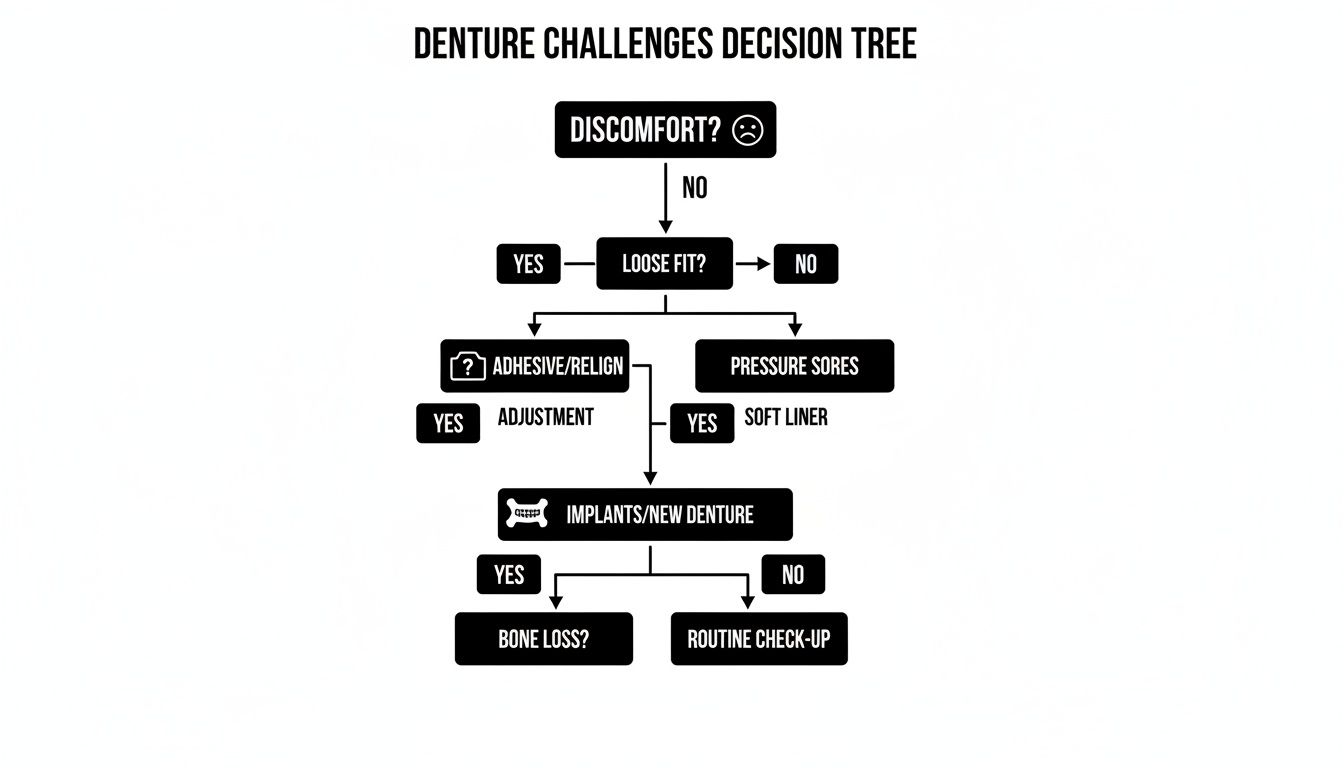
As you can see, persistent issues like a loose fit often lead to conversations about more stable, long-term solutions, such as those supported by implants.
Partial Dentures: For Filling in the Gaps
If you have several healthy, natural teeth remaining, a Partial Denture is often the ideal choice.
Think of it as a custom-designed puzzle piece that clips securely onto your existing teeth to fill the empty spaces. Most designs use a discreet metal framework hidden by a gum-colored plastic base that holds the replacement teeth. This not only restores your smile but also prevents your remaining teeth from shifting, which is crucial for maintaining a healthy bite.
Implant-Supported Dentures: The Best of Both Worlds
For those seeking maximum stability and function, Implant-Supported Dentures are a transformative option. Often called "snap-in" dentures, they attach securely to several dental implants anchored in your jawbone.
This direct connection provides incredible security, eliminating worries about slipping, clicking, or the need for messy adhesives.
Your Actionable Insight: By anchoring to the jaw, implant-supported dentures help preserve the underlying bone. This delivers a more natural and powerful chewing force, combining the full coverage of a denture with the solid foundation of implants.
This option requires a surgical procedure to place the implants and has a longer overall timeline. It's a greater initial investment, but the payoff in long-term comfort, function, and confidence is substantial. To fully grasp this, it's helpful to understand the entire process. Our guide explains everything to know about dental implants and how they can revolutionize your experience.
Comparing Denture Types
To help you quickly compare these options, this table breaks down their key differences.
Denture Type | Best For | Key Feature | Stability Level |
|---|---|---|---|
Complete Denture | People missing all teeth in an arch. | Rests on the gums, removable. | Low to Moderate |
Partial Denture | People with some healthy natural teeth remaining. | Clips onto existing teeth for support. | Moderate |
Implant-Supported | Those seeking maximum stability and function. | Snaps securely onto dental implants. | Very High |
Each option comes with its own set of considerations, from lifestyle and budget to long-term health goals. A detailed consultation with your dentist is the best way to weigh all the pros and cons dentures present and determine the optimal solution for your smile.
Comparing Modern Alternatives to Dentures
While dentures are a time-tested solution, it's smart to review all your options. Modern dentistry offers excellent alternatives that might better align with your health, lifestyle, and long-term goals.
Think of this as choosing a route to restore your smile. Each path has different costs, timelines, and daily realities. Understanding these distinctions is key to making a confident decision you'll be happy with for years.
Dental Bridges: The Fixed Solution
A dental bridge "bridges" the gap left by one or more missing teeth. It's a fixed restoration, meaning it is permanently cemented in place. It consists of artificial teeth (pontics) supported by crowns placed on the healthy teeth on either side of the gap.
What's great about bridges? Because they are cemented in, you don't have to worry about them slipping. They feel and function very much like natural teeth.
What's the downside? The major trade-off is that we must permanently alter the adjacent healthy teeth to place the supporting crowns. If those teeth are otherwise healthy, this can be a significant compromise.
Dental Implants: The Gold Standard
Most dentists agree that dental implants are the premier solution for tooth replacement. An implant is a small titanium post surgically placed into the jawbone to act as an artificial tooth root. Over several months, the bone fuses to the implant through a process called osseointegration, creating an exceptionally strong foundation for a crown.
This fusion is the key difference. By mimicking a natural root, the implant stimulates the jawbone and prevents the bone loss that occurs with dentures and bridges. This is vital for maintaining your facial structure as you age.
Your Actionable Insight: A dental implant is the only tooth replacement option that actively prevents jawbone deterioration. This unique benefit preserves your facial profile and provides a level of stability that other solutions simply cannot match.
This rock-solid stability allows you to eat anything you want, speak with clarity, and smile without hesitation. There are no adhesives, embarrassing slips, or dietary restrictions. While the upfront investment and timeline are greater, the long-term benefits for your health and confidence are unparalleled.
For a deeper dive into how these options stack up, take a look at our complete guide on the best options for missing teeth.
Your Next Steps at Beautiful Dentistry in Tempe
Reading about the pros and cons of dentures is an excellent start, but the most valuable step is getting personalized guidance. Your journey to a renewed smile in Tempe should start with a conversation, not a sales pitch. At Beautiful Dentistry, your initial consultation is a no-pressure opportunity to explore your options and find what works for you.
We will begin with a thorough examination and, more importantly, a discussion about your goals and concerns. This conversation is the foundation for creating a treatment plan that fits your specific needs, lifestyle, and budget. We are committed to transparency, ensuring you understand every option available.
We believe the best decisions are informed ones. Our commitment is to empower you with professional, honest advice so you can move forward with confidence and clarity.
For a local practice like Beautiful Dentistry, a strong and positive digital presence is key to connecting with patients; a practical guide to dentist reputation management offers valuable insights on this.
Ready to explore how we can help you smile again? You can find out more about your options for dentures in Tempe right here. When you're ready, schedule your consultation. We are here to help you navigate your choices and find the perfect path to a healthy, confident smile.
Got Questions About Dentures? We Have Answers.
It's one thing to read about dentures, but another to imagine what daily life with them is like. Here are answers to some of the most common and practical questions we hear from our patients in Tempe.
How Long Does It Really Take to Get Used to New Dentures?
The honest answer is: it’s a process. For most people, it takes a few weeks, up to a month, to feel truly comfortable.
Initially, expect minor soreness, increased saliva, and a feeling of fullness in your mouth. Speaking and chewing will feel awkward at first. This is all normal.
Here are a few tips to smooth out that break-in period:
Adapt Your Diet: Start with soft foods cut into small pieces. Chew slowly, using both sides of your mouth to keep the denture balanced.
Practice Speaking: Read a book out loud or talk more with family. This helps your tongue and cheeks adapt quickly to the new appliance.
Attend Your Follow-Ups: A minor adjustment from us can make a significant difference in comfort. We need to see you to make these crucial tweaks.
Will I Still Be Able to Taste My Food?
This is a common concern, especially for those getting a full upper denture that covers the palate. While you may notice a slight reduction in taste initially, it's usually temporary.
Most of your taste buds are on your tongue, not your palate. Your brain is also excellent at adapting. The majority of patients report that their sense of taste returns to normal after a short adjustment period. Furthermore, partial and implant-supported dentures cover much less of your mouth and have minimal, if any, impact on taste.
How Often Will I Need to Replace My Dentures?
With proper care, a quality set of dentures should last between five to 10 years. It's typically not the denture that wears out—it's your mouth that changes.
Your Actionable Insight: Your jawbone and gums will change shape over time, causing a once-snug denture to loosen. This is a normal process. Plan for regular check-ups to manage it effectively.
During your visits, we can often "reline" your existing denture to improve its fit. However, eventually, your mouth will change enough that a new denture is necessary to ensure proper facial support, a correct bite, and optimal oral health.
Thinking through your options is the first step toward getting your confident smile back. The team at Beautiful Dentistry is here to give you personalized advice based on your specific situation. Schedule your consultation with us in Tempe today!


Clear guide on dentures—knowing pros and cons is so helpful! For those seeking a permanent, strong alternative, dental implants tempe az offer durability, function, and a natural-looking smile: https://tempefamilydentistry.com/services/dental-implants/