

Can Cavities Go Away? Expert Tips on Reversing Tooth Decay

The short answer? Yes, but only if you act fast. A cavity can be reversed, but there’s a critical catch: it must be in its absolute earliest stage, before a physical hole breaks through your tooth's enamel.
Think of it like a small, damp spot on a wall. If you catch it early, you can dry it out, add a stain blocker, and repaint, making it strong again. But once that moisture causes the plaster to crumble and a hole forms, you can’t just wish it away—you have to patch and fill it. It’s the same with your teeth.
The Critical Window for Reversing Tooth Decay
Most of us picture a cavity as a dark spot or a hole, but that's the end of the story, not the beginning. The process starts silently with the weakening of your tooth's hard outer shell, the enamel.
This initial stage is called demineralization. It’s a science-y term for a simple process: acids, produced by bacteria feeding on sugars in your mouth, start leaching vital minerals like calcium and phosphate from your enamel. This mineral loss creates a weak, porous area that often looks like a chalky white spot. Consider this your tooth’s warning light.
This is your moment to take action.
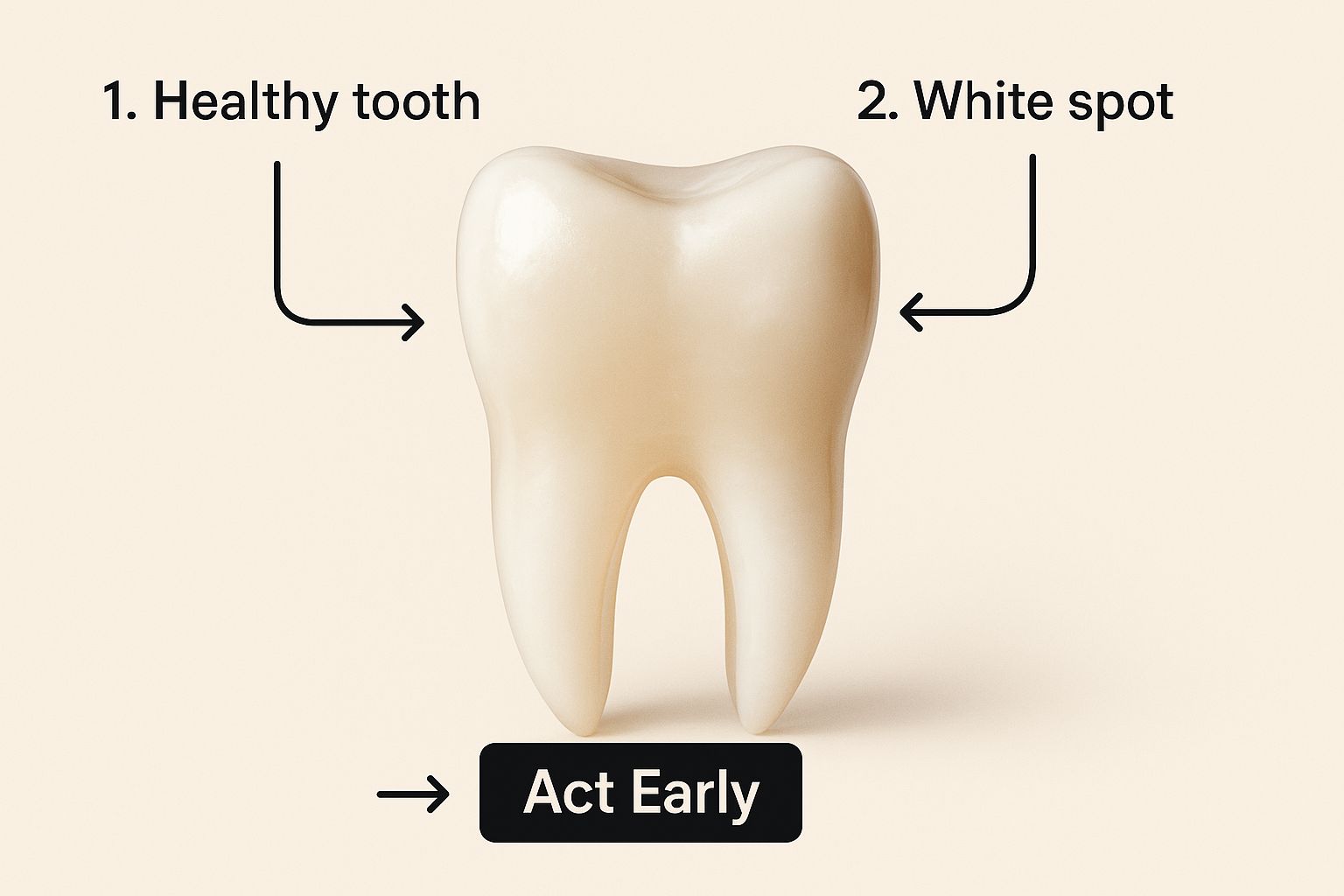
This early "white spot" stage is where you have the power to step in and stop decay, right before it breaches the enamel and causes permanent damage.
Demineralization vs. Cavitation
Understanding these two terms is key to knowing what you can fix at home versus what needs a dentist.
Demineralization: This is the reversible phase. The structure of your tooth is still intact; it’s just become soft and weak. Your action plan: You can help your body redeposit minerals back into the tooth and repair the damage through a process called remineralization.
Cavitation: This is the point of no return. The acid has eaten away at the enamel until a physical hole—the cavity—is formed. Once that structure is gone, it's gone for good. Your action plan: Schedule a dental appointment, as your body cannot regrow tooth enamel on its own.
Your most important takeaway: You have the power to intervene, but only before the enamel surface is broken. At this early stage, improving your oral hygiene and diet can effectively "heal" the weakened spot. This is the only time a cavity can truly go away without professional dental work.
To make it even clearer, let's break down the different stages of tooth decay and what you can do at each step.
Tooth Decay Stages: When Can a Cavity Go Away?
This table walks you through what happens as decay progresses and when you can still turn things around.
Stage of Decay | What It Looks Like | Can It Go Away? | Your Action Plan |
|---|---|---|---|
Stage 1: Demineralization | A chalky, white spot on the tooth. No pain or sensitivity yet. | Yes, this is reversible! | Double down on oral hygiene, use fluoride toothpaste, cut back on sugar, and talk to your dentist for personalized advice. |
Stage 2: Enamel Decay | The white spot may turn light brown. Still usually painless. | No. Once the enamel surface is broken, it needs professional repair. | A small filling is typically needed. Call your dentist to get it fixed before it worsens. |
Stage 3: Dentin Decay | The decay has reached the softer layer beneath the enamel. A visible hole appears. | Definitely not. | A larger filling is required. You may start feeling sensitivity. Don't wait for the pain to increase. |
Stage 4: Pulp Involvement | The decay reaches the tooth's inner nerve (pulp). Often causes a toothache. | No. The damage is severe and the tooth is at risk. | Root canal therapy is usually necessary to save the tooth. This is now an urgent dental issue. |
Stage 5: Abscess | Infection spreads to the root tip and surrounding bone, causing severe pain and swelling. | No. This is a serious dental emergency. | Seek immediate dental care. Treatment may involve a root canal or, if the tooth cannot be saved, an extraction. |
As you can see, time is of the essence. Acting early is the only way to avoid the dentist's drill and allow your body to naturally reverse the damage.
Understanding How a Cavity Develops Step by Step
To get a handle on whether cavities can truly go away on their own, we first need to look at how they form in the first place. Imagine your tooth's enamel is like a brand-new, perfectly paved road—it's strong, smooth, and built to last. But just like any road, it's constantly dealing with "traffic" from the foods and drinks you consume every day.
The whole journey from a healthy tooth to a full-blown cavity starts with a silent attack. When you eat sugars and starches, certain bacteria in your mouth see it as an all-you-can-eat buffet. As they metabolize these food particles, they create a nasty byproduct: acid. This acid is what starts the whole destructive process.
The First Stage: Demineralization
This ongoing acid bath begins to pull crucial minerals, like calcium and phosphate, right out of your tooth’s surface. This process is called demineralization. Think of it like constant rain and chemical spills starting to wear down that new road, creating tiny, invisible weak spots.
At this early stage, the damage is microscopic. You won't feel a thing, and you won't see a dark spot. The only clue might be a faint, chalky "white spot" on the tooth, which is honestly tough to spot without a dentist's trained eye. This is the make-or-break moment where the damage can still be reversed.
This initial demineralization is your body’s alarm bell. The enamel’s structure is compromised, but the surface hasn’t caved in yet. This is the only point where a cavity can truly "go away" as your body works to repair itself.
If you step up your oral hygiene and give your teeth the minerals they need, your body can actually fight back and rebuild this weakened area. But if the acid attacks just keep coming, the decay moves on to a much more serious phase.
Breaching the Enamel and Reaching the Dentin
As more and more minerals are lost, the weakened enamel structure finally gives way and collapses, creating a physical hole. This is the moment demineralization becomes cavitation—and it's the point of no return. Those tiny cracks in our road analogy have now turned into a genuine pothole.
Once the enamel is breached, the decay has a direct, unguarded path to the softer layer underneath called the dentin.
Dentin is nowhere near as tough as enamel. It's porous and contains tiny, hollow tubes that lead straight to the tooth's nerve. This is exactly why you might start feeling that jolt of sensitivity to hot, cold, or sweet things once a cavity gets this deep. The decay process speeds up dramatically once it hits this softer tissue.
Enamel Decay: The first hole breaks through the protective outer shell. At this point, a filling is almost always necessary.
Dentin Decay: The cavity sinks deeper, spreading much faster through the softer material. The tooth is now structurally compromised.
Pulp Involvement: If you ignore it, the decay will eventually reach the pulp—the living nerve center of the tooth—leading to a painful infection.
Catching decay before it tunnels into the dentin is the key to avoiding more complicated and expensive treatments. This is where modern diagnostic tools are invaluable. You can learn more about how dentists use a [dental X-ray in Tempe](https://www.zdentist.com/dental-x-ray-in-tempe) to spot these problems early on. Without that kind of technology, these sneaky cavities often go completely unnoticed until they've caused some serious damage.
How to Power Up Your Body's Natural Repair Process

While you can't make a physical hole in your tooth just vanish, you can supercharge your body's built-in system to fight back against the very first stage of a cavity. This natural defense is called remineralization, and it's your best strategy for stopping decay before it ever really starts.
Think of it as putting your tooth’s personal repair crew on overdrive. Here’s your actionable game plan:
1. Fuel Your Teeth From the Inside Out
Just like your bones, your teeth need the right nutrients to stay strong. What you eat directly impacts your saliva's ability to remineralize your enamel. To kick this process into high gear, pack your diet with these mineral-rich foods:
Calcium-Rich Foods: Make dairy (milk, cheese, yogurt) a staple. For non-dairy options, leafy greens like spinach and kale are fantastic sources.
Phosphorus-Rich Foods: Your body needs phosphorus to use calcium effectively. Find it in protein-packed foods like fish, lean meats, eggs, and nuts.
Vitamin D: This vitamin acts as the gatekeeper, allowing your body to absorb calcium. Get it from sunlight, fatty fish like salmon, or fortified foods.
For a deeper dive into how minerals support dental health, this guide on Calcium Magnesium tablets offers some great insights.
2. Master Your Oral pH Balance
The environment inside your mouth determines whether you're building up or breaking down your teeth. Bad bacteria thrive in an acidic environment, which is what strips minerals from your enamel. A more alkaline (or neutral) pH creates the perfect conditions for repair.
An acidic mouth is a playground for decay. A neutral or alkaline mouth is a workshop for remineralization. Your goal is to tip the scales in favor of repair.
Here are two easy ways to do it:
Cut back on frequent snacking: Constant exposure to sugary and acidic foods (soda, candy, citrus) keeps your mouth in an acid-attack mode.
Rinse with water: After a meal or an acidic drink, swish with plain water to quickly neutralize acids and wash away debris.
3. Harness the Power of Fluoride
When it comes to remineralization, fluoride is the undisputed MVP. It helps your enamel rebuild with a new, super-powered surface mineral called fluorapatite. This new crystal structure is far more resistant to future acid attacks than your natural enamel.
The most effective way to get this benefit is to use a fluoride toothpaste twice daily. When you brush, you’re not just cleaning away plaque—you’re applying a topical treatment that fortifies your teeth. For those more prone to cavities, a professional [fluoride treatment in Tempe](https://www.zdentist.com/fluoride-treatment-in-tempe) can provide an even stronger protective shield.
The science backs this up. One study tracking early weak spots on children's teeth found that an impressive 60.8% of them actually regressed and became healthy enamel again over four years. It’s a powerful testament to how effective your body’s repair process can be when you give it the right support.
When You Absolutely Need to See a Dentist
While you have a remarkable ability to reverse the earliest whispers of tooth decay, there's a definite point of no return. Once that demineralization turns into an actual, physical hole—what dentists call cavitation—the game changes. Your toothbrush and diet can't fix it.
Think of it like this: you can water a wilting plant and bring it back to life, but you can't regrow a branch that has snapped clean off. Once your tooth’s structure is physically gone, your body has no way to rebuild it. This is when a trip to the dentist becomes non-negotiable, not just to fix the immediate problem but to stop it from spiraling into something much worse.
Ignoring a cavity is like ignoring a small leak in your roof. It might seem minor at first, but left untreated, it guarantees more extensive damage, pain, and a much bigger repair bill down the line.
Your Dentist is Your Partner, Not a Critic
Many people feel anxious about dental work, but modern dentistry is focused on preserving your natural teeth comfortably. Treating a cavity isn't a punishment; it's a collaborative effort to get you out of pain, clear out the infection, and save your tooth. We're on your team, working to restore your tooth's function and protect your overall health.
Here are the most common ways we can partner with you to fix a cavity:
Dental Fillings: Our first line of defense. We gently clear out the decayed part and fill the space with a strong, durable material, restoring the tooth's shape and stopping the decay.
Crowns: If a cavity is too large for a filling, a dental crown (or cap) acts like a helmet, fitting over the entire tooth to give it the strength it needs for daily use.
Root Canals: This procedure is a tooth-saving miracle. When decay reaches the tooth's nerve, a root canal removes the infected tissue, cleans the inside of the tooth, and seals it up, saving a tooth that would otherwise need to be extracted.
A dental visit for a cavity isn't about what you did wrong; it's about taking a positive step to protect your health. Putting it off only gives the decay more time to advance, potentially leading to a dental abscess—a serious infection that can spread to other parts of your body.
So, when we come back to the question, "can cavities go away?" the answer becomes a firm "no" once a real hole has formed. Getting timely professional care is the only path forward. If you think you have a cavity, learning about restorative options like [dental fillings in Tempe](https://www.zdentist.com/dental-fillings-in-tempe) can take the fear out of the process and empower you to make the best decision for your health.
Exploring Modern No-Drill Dental Treatments
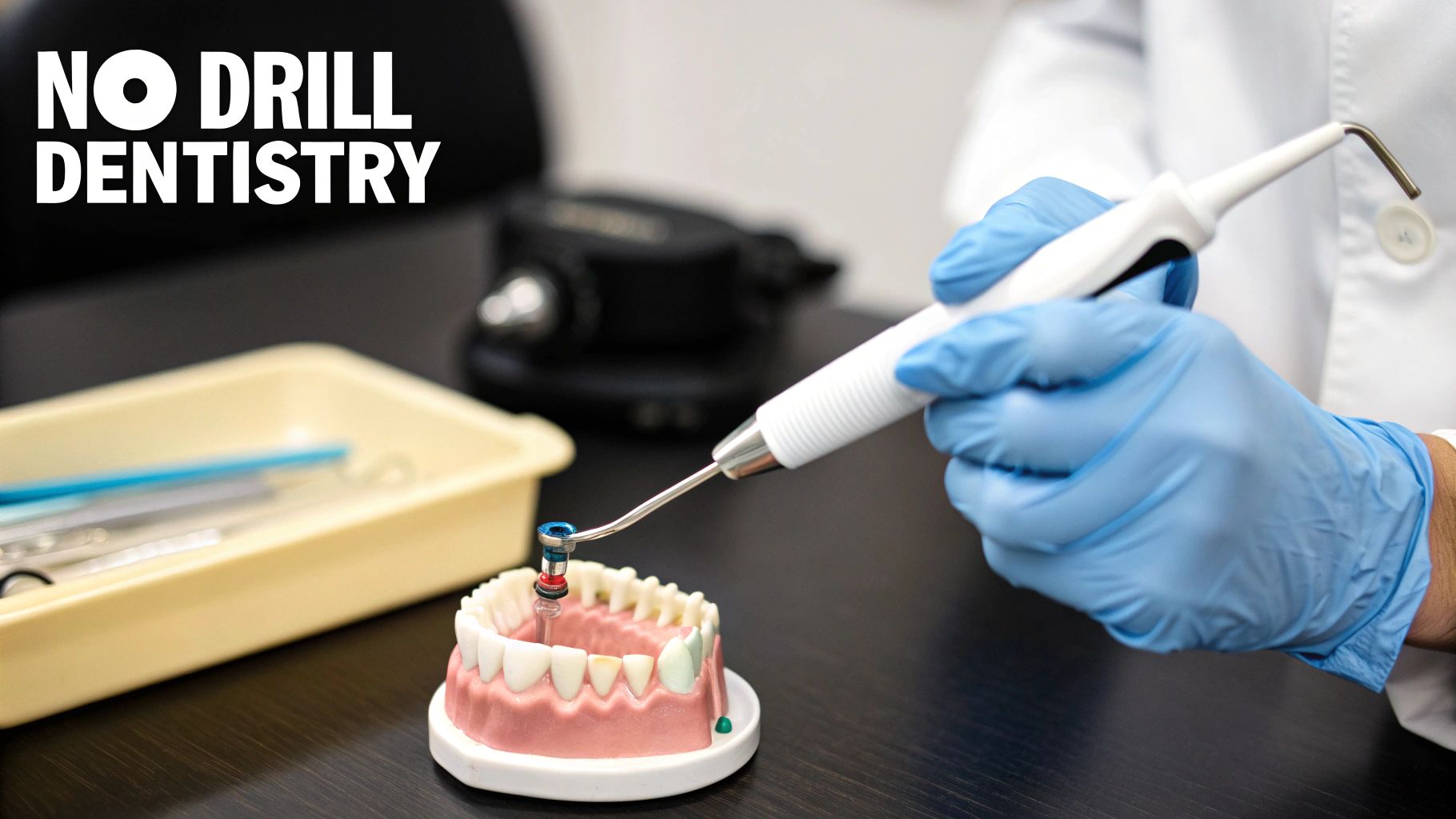
For many, the high-pitched whine of a dental drill is a major source of anxiety. But what if you could stop a cavity without it? Modern dentistry now offers incredible no-drill treatments that focus on catching tooth decay in its earliest stages, providing a less invasive and more comfortable path to a healthy smile.
This approach means we can do more than just "watch and wait" for a weak spot to become a cavity. We can actively intervene early and stop decay before it ever requires a filling.
Silver Diamine Fluoride (SDF)
One of the most effective no-drill options is Silver Diamine Fluoride (SDF). It’s a liquid that a dentist simply paints onto an early-stage cavity—no numbing or drilling required.
SDF works with a powerful one-two punch: silver kills the bacteria causing the decay, and fluoride helps remineralize and harden the tooth enamel. Together, they stop the decay process cold. This treatment is a game-changer, especially for young children, older adults, or anyone who finds traditional dental work challenging.
The magic of SDF is its ability to *arrest* a cavity—it literally stops the decay from getting worse. The main trade-off is that it stains the decayed area black, but for many, it's a small price to pay for a quick, painless, and effective way to manage decay.
This powerful liquid gives us a way to control cavities, buying valuable time and preventing a tiny problem from escalating into a much bigger one.
Dental Sealants: A Protective Shield
Another fantastic no-drill strategy is the dental sealant. Think of it as a protective raincoat for your teeth. Sealants are thin, plastic coatings painted onto the chewing surfaces of back teeth (molars and premolars). These teeth have natural grooves and pits that are difficult to clean, making them a perfect hiding spot for bacteria.
A sealant flows into those nooks and crannies and hardens, creating a smooth shield over the enamel. This barrier seals out food and bacteria, stopping decay before it can start. They are a cornerstone of preventive care for both kids and adults.
Personalized Caries Management Systems
Modern dentistry is shifting away from the old "drill and fill" model toward a proactive and personalized approach called a Caries Management System (CMS). Instead of just reacting to cavities, your dentist first assesses your personal risk for decay and then creates a tailored plan to keep your teeth healthy.
This concept, pioneered by researchers like Professor Wendell Evans, has shown amazing success in reducing the need for fillings. By focusing on managing decay at its earliest stages, a CMS helps you maintain a healthy mouth with far less invasive work. You can read more about how this approach stops tooth decay on this page from the University of Sydney. A typical plan might involve:
Risk Assessment: Analyzing your diet, hygiene habits, and saliva flow.
Specialized Products: Recommending high-fluoride toothpastes or prescription mouth rinses.
Dietary Counseling: Providing practical advice to reduce sugar and acid intake.
Targeted Treatments: Using options like SDF or sealants precisely where they're needed.
Ask your dentist about these no-drill options to take control of your oral health and actively prevent the need for more extensive treatments down the road.
Common Questions About Reversing Cavities
When you're dealing with tooth decay, a lot of questions can pop up. Let's tackle some of the most common concerns and myths about reversing cavities so you can feel more confident about your dental health.
Can Diet Alone Heal a Cavity?
A healthy diet is a cornerstone of defense against tooth decay. By cutting back on sugar and focusing on mineral-rich foods, you give your teeth the raw materials they need to repair themselves. This approach is highly effective at reversing the very first stage of decay, demineralization.
However, once the enamel is broken and a physical hole has formed, diet alone cannot fill it. At that point, a good diet supports your overall oral health and prevents new cavities, but you need professional dental treatment to restore the damaged tooth.
How Long Does It Take for a Cavity to Form?
There's no single timeline; it can range from a few months to several years. The speed of decay depends on your personal risk factors: your diet, oral hygiene habits, saliva quality, and fluoride exposure.
For someone with a high-sugar diet and poor brushing habits, a cavity can develop quickly. For most people, however, it’s a slow process. This is good news! It means there’s often a long window where you and your dentist can catch and reverse the damage while it’s still just a weak spot on your enamel.
The slow progression of most cavities is an opportunity. It emphasizes the importance of regular dental check-ups, which can spot these weak spots long before they become a serious problem requiring a filling.
Is Silver Diamine Fluoride a Safe Option for Adults?
Yes, absolutely. Silver Diamine Fluoride (SDF) is a safe and effective treatment to stop cavities for adults, not just children. It's an especially valuable option for older adults or anyone who might have difficulty with traditional dental procedures due to health or mobility issues.
The research is clear. Studies show this simple, non-invasive treatment can prevent more than 80% of cavities and halt the progression of about half of existing ones. You can learn more about these impactful findings on SDF treatment and see how it's changing modern dentistry.
The main consideration is cosmetic: SDF permanently stains the decayed part of the tooth black. Your dentist can discuss the pros and cons to help you decide if it’s the right choice for your situation.
At Beautiful Dentistry, our goal is to empower you with clear information and personalized care. If you're wondering about a potential cavity or want to explore modern treatment options, our team is here to guide you. Schedule your comprehensive exam today and take the first step toward a healthier, more confident smile. Book your appointment now at zdentist.com.
Article created using [Outrank](https://outrank.so)


Comments